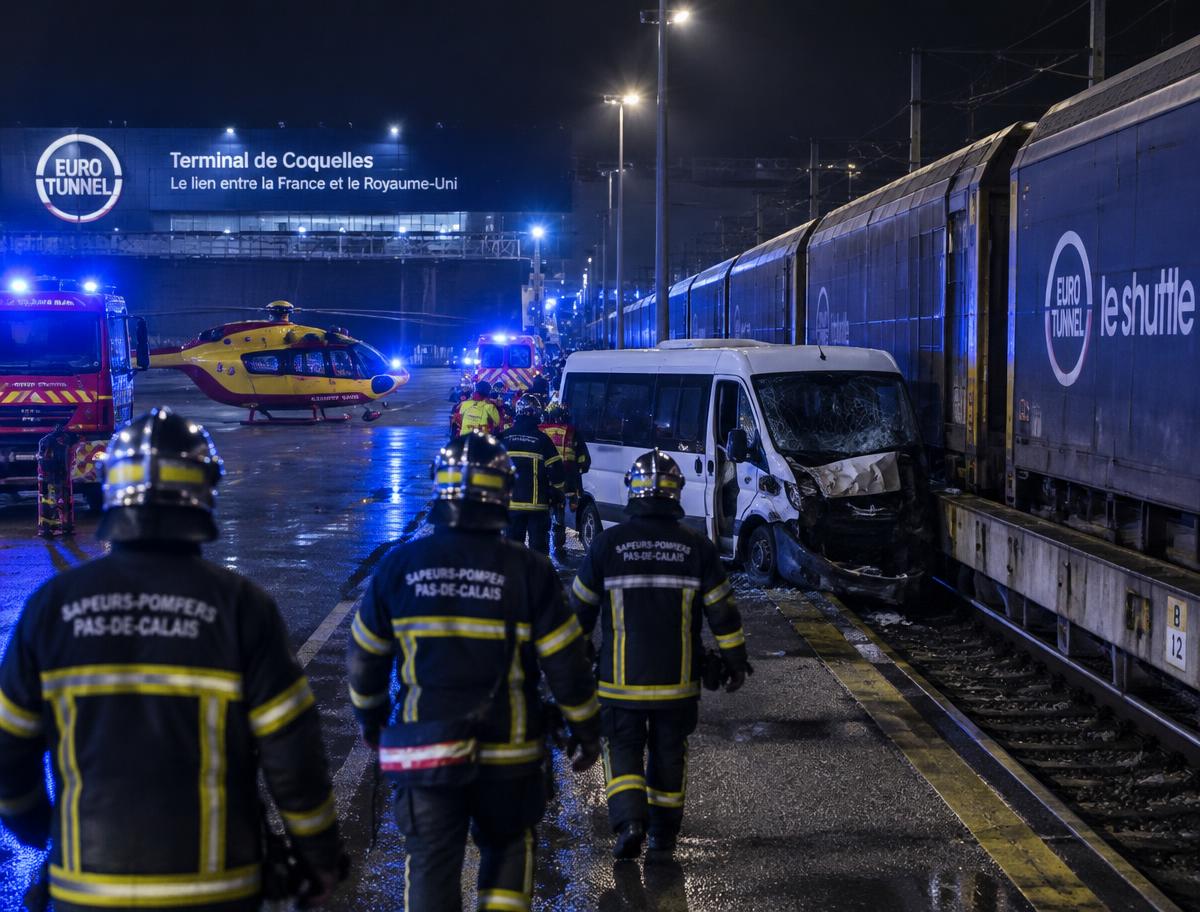
A minibus has crashed into a train at the French entrance to the Channel Tunnel, injuring the driver and 18 passengers, French authorities have said.
The bus, which was carrying lorry drivers due to take the Le Shuttle rail service, struck the train at a loading platform at the Eurotunnel terminal in Coquelles, near Calais, at 19:27 local time (18:27 BST) on Thursday.
The driver and one passenger were severely injured and evacuated by helicopter. A local official said none of the injuries was life-threatening.
‘For a reason that remains unknown’
Agathe Cury, the local sub-prefect, said two trains were standing on either side of the platform at the time. “One was being loaded by heavy goods vehicles ahead of a cross-Channel journey, and another train that had previously been loaded was departing,” she said.
“For a reason that currently remains unknown, the minibus collided with the departing train. The bus did not overturn, it is still upright — but the shock and the collision caused injuries to the people involved.”
Those on board were workers about to board Le Shuttle. All were men of different nationalities, Ms Cury said. It is not yet clear whether any British nationals were among the injured. An investigation has begun.
Ms Cury described it as “the first time an incident of this type has occurred” on a Eurotunnel loading platform.
Traffic keeps moving
Freight and Eurostar passenger services were briefly halted while the injured were evacuated, but traffic through the tunnel was not otherwise disrupted, French officials said.
Photographs published by the regional newspaper La Voix du Nord showed a small bus with heavy damage to its front and side standing alongside the train, surrounded by emergency workers.
The BBC presenter Evan Davis, who was travelling to Calais through the tunnel when the crash happened, described blue-light vehicles “concentrated on one of the platforms” as he arrived in France. Cars were still queueing and passing through check-in, he said.
Eurostar said the incident had happened several kilometres from the tunnel itself and did not involve or affect its trains between London and the continent. All services ran as expected.
How the terminal works
The Channel Tunnel runs beneath the sea from Folkestone in Kent to Coquelles. Three types of rail service use it: Eurostar passenger trains from London; freight trains carrying goods; and Le Shuttle, which carries cars, coaches and lorries between the two terminals.
On the freight shuttle, lorry drivers typically leave their vehicles on the train and travel separately in a passenger carriage. Minibuses ferry drivers around the vast terminal sites, crossing areas where loaded shuttles arrive and depart. The French investigation is expected to examine how a vehicle came to strike a departing train in what should be a tightly controlled environment.
Safety questions
The Channel Tunnel has a strong safety record for an infrastructure link of its scale, but serious incidents have prompted major reviews in the past, including fires aboard freight shuttles in 1996 and 2008. Thursday’s crash is of a different kind, involving road vehicles in the terminal rather than trains inside the tunnel.
For the tens of thousands of hauliers who rely on the route each week — many of them carrying goods to and from the UK — the speed with which services resumed will come as some relief. But questions over how terminal traffic is separated from moving trains are likely to feature prominently as investigators piece together what went wrong on the loading platform.
Eurotunnel’s operator, Getlink, has not yet set out what changes, if any, it plans to make while the investigation continues. Prosecutors in the region are expected to decide whether any criminal inquiry is warranted once the initial findings are known.