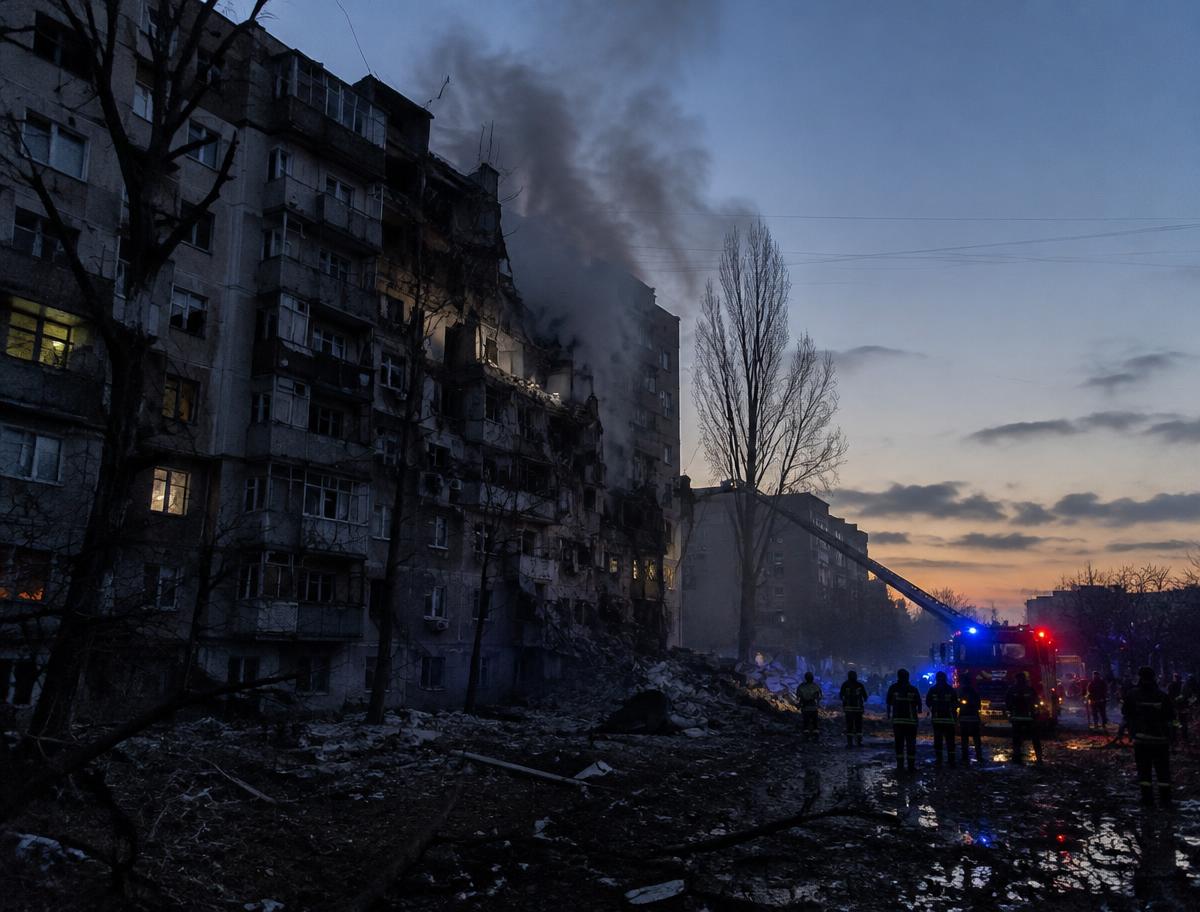
At least 15 people, including three children, have been killed after Russia struck the Ukrainian city of Zaporizhzhia with five glide bombs, President Volodymyr Zelensky said, in an attack that landed hours after Donald Trump announced a deal to resume importing Russian diesel.
The bombs hit residential buildings in the south-eastern city in the early hours of Saturday morning. Emergency services said at least 16 other people were injured, with more still unaccounted for and feared to be trapped under rubble.
Zelensky said 13 other regions of Ukraine had also come under attack overnight, warning that "our responses to these Russian strikes will come."
Scenes at the apartment block
Photographs and video from the scene showed a five-storey apartment block largely reduced to rubble, its upper floors collapsed onto the ground. Acting Zaporizhzhia mayor Regina Kharchenko, speaking from the site, said the ground floor had taken the direct hit and the floors above had simply come down on top of it.
She said more than 80 rescue workers were involved in search and rescue operations expected to continue through the day, periodically pausing their machinery to listen for any sound of survivors beneath the debris.
Mykhailo Semikin, acting head of the Zaporizhzhia regional military administration, said the strike had damaged 26 residential buildings across two city districts, marking the second consecutive day that the regional capital had been hit by glide bombs. Four of the injured were hospitalised, with two in critical condition, according to officials.
Kharchenko said Russia had struck at "our very heart" by killing young children, adding that their deaths were "awful grief for their families. For the city."
Russia's 'thanks' for a diesel waiver
Zelensky drew a direct line between the bombing and Washington's abrupt change of course on Russian energy exports a day earlier. "Today, Russia expressed its thanks for the lifting of sanctions on diesel exports by dropping five glide bombs on residential buildings in Zaporizhzhia," he wrote on Facebook.
On Friday, Trump announced on social media that he had struck a deal with President Vladimir Putin during a phone call in which Russia would immediately supply more than 300,000 tonnes of diesel to the United States, followed by a further 500,000 tonnes in November and a million tonnes thereafter. The move marked a striking reversal after years of US pressure on Moscow over the war, and comes as the Trump administration looks to bring down fuel prices ahead of the American midterm elections.
Zelensky had already criticised the arrangement before the strikes, calling it a gift to Putin that amounted to "an investment in a war that must be ended, not prolonged."
A war of attrition in the skies
The attack came as Russia and Ukraine remain locked in a long-range aerial campaign even as their ground forces stay largely deadlocked along the front line, more than four and a half years after Moscow's full-scale invasion began. Ukrainian officials say escalating Russian bombardments have killed more than 60 people across the country in the past four days alone.
Zaporizhzhia, a regional capital that sits close to the front line, has been repeatedly targeted by Russian glide bombs throughout the war. The weapons, cheap gravity bombs fitted with simple guidance kits to extend their range, allow Russian aircraft to strike from well inside their own territory while remaining largely out of reach of Ukrainian air defences, but their relative inaccuracy makes them especially dangerous to civilians when dropped near populated areas.
Diplomacy stalls as the fighting goes on
The strikes also landed just as separate diplomatic efforts to end the war appeared to stall. In a call with Trump on Friday, Putin said an immediate resumption of three-way peace talks between Russia, Ukraine and the United States was unlikely, citing Ukrainian drone attacks on Moscow and other cities during last month's Russian parliamentary elections.
Kremlin foreign policy aide Yuri Ushakov said Moscow viewed the drone strikes, which also targeted people involved in organising the elections, as having "interrupted the possibility of an immediate resumption of the negotiation process." He added that Russia would now assess when talks might resume.
US Secretary of State Marco Rubio said this week that the war had reached a dangerous stalemate and that Washington would keep working towards a deal to end it. Ukrainian officials say they remain ready to take part in trilateral talks whenever Moscow agrees to return to the table.
Rescue effort continues
As night fell on Zaporizhzhia, rescue teams were still working through the wreckage of the apartment block, with the final death toll expected to rise as search operations continue. Local officials appealed to residents to avoid the affected districts to allow emergency vehicles clear access to the site.
For a city that has endured repeated bombardment throughout the war, the attack was a grim reminder that even as diplomats discuss the shape of a possible future peace, the human cost of the conflict continues to mount in its present.