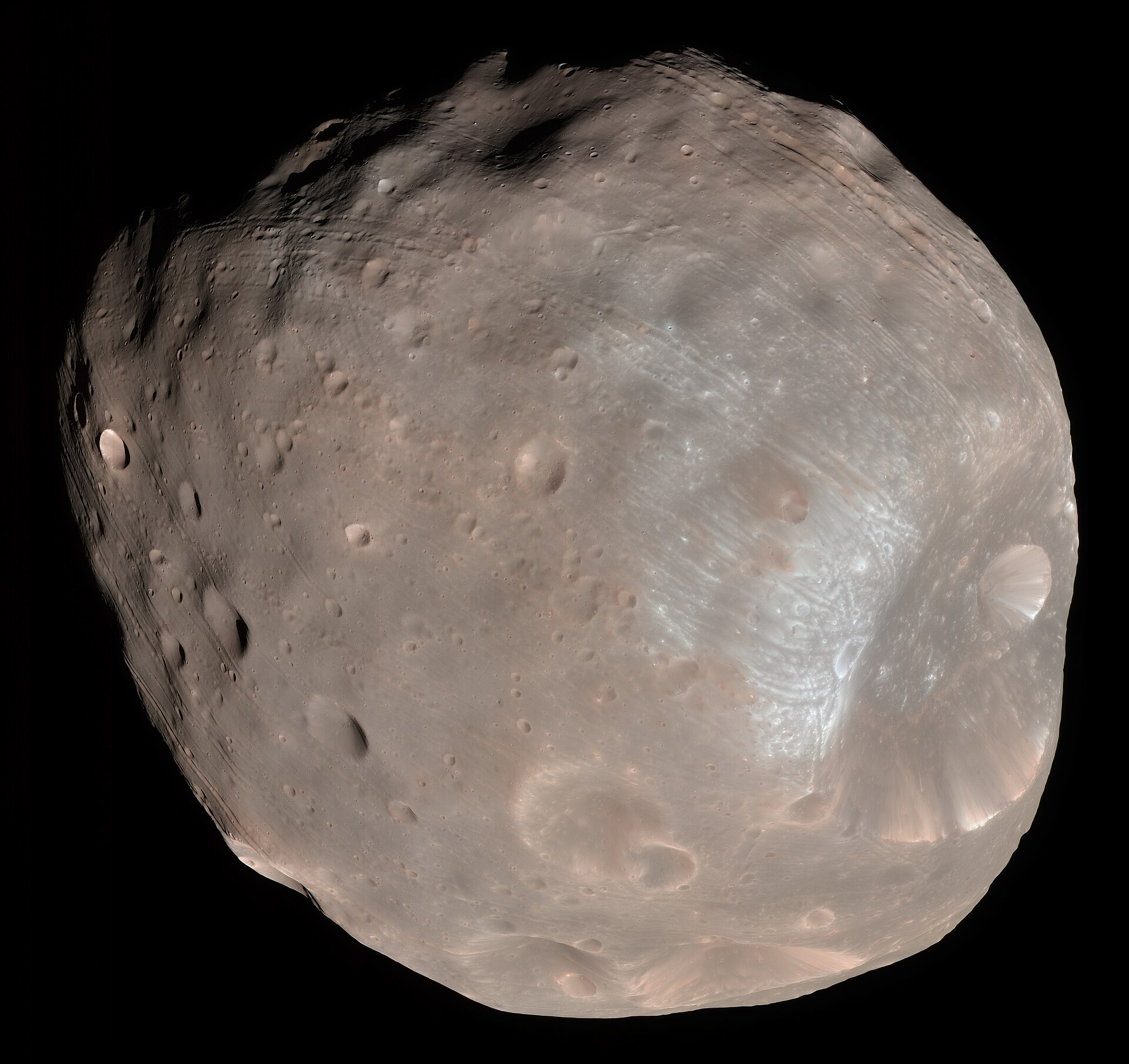
A Japanese spacecraft has blasted off on a mission to Mars’s largest moon, Phobos, where it will attempt to collect a sample of dust and bring it back to Earth for the first time.
If it succeeds, the Mars Moons Exploration (MMX) mission, led by the Japan Aerospace Exploration Agency (JAXA), will be the first to return material from Mars or either of its moons to laboratories on Earth. The spacecraft is scheduled to arrive at Phobos in August 2027.
Prof Sara Russell of the Natural History Museum in London, the mission’s deputy for sample analysis, said: “There hasn’t yet been a successful mission to go to Phobos and bring a bit back to Earth. I think this is an incredibly ambitious and fun mission.”
Two ‘space potatoes’
There are only three moons in the inner Solar System: our own Moon and the two that orbit Mars, Phobos and Deimos. Both are tiny and irregularly shaped. Phobos is about 20km (12 miles) across and Deimos about 10km (six miles). Phobos orbits only about 6,000km above the Martian surface, closer to its planet than any other known moon, and is slowly spiralling inwards.
MMX will study Deimos as it arrives in the neighbourhood of Mars before turning its attention to Phobos. It will first set down a small rover, built by the French and German space agencies, to explore the terrain and scout out a safe landing site for the main spacecraft.
That will be no easy task. “The moon itself doesn’t have very much of its own gravity,” Prof Russell said. “But it’s next to an enormous planet that’s got a much higher gravity, and that makes it much harder to get a rover onto the surface.” No one has ever landed a rover on such a small moon.
Ten grams of dust
Once on the surface, the spacecraft will deploy a robotic arm and two samplers to collect moon dust. The material will be sealed in a small capsule that will return to Earth in 2031, landing in the Woomera desert in South Australia, the same area where Japan’s Hayabusa2 capsule landed in 2020 carrying samples from the asteroid Ryugu.
The amount coming back will be tiny, about 10g. “It’s a very small amount actually,” said Dr Chrysa Avdellidou of the University of Leicester, who is working on the mission. “However we can do several studies even on individual grains. You don’t need to have kilos back from a surface in order to do science. So it’s worth every gram.”
A 4.5-billion-year-old mystery
Mars acquired its moons about 4.5 billion years ago, but scientists do not know how. There are two competing ideas. One is that a large space rock smashed into Mars early in its history and that Phobos and Deimos formed from the debris thrown into orbit. The other is that they are asteroids from the outer Solar System that strayed too close and were captured by the planet’s gravity.
“When we get the sample back, we’ll be able to look in detail at its chemistry and its mineral composition, and the two hypotheses will produce very distinct results,” Prof Russell said. “It should be pretty much immediately obvious whether it’s the product of this dramatic impact or whether it’s a captured asteroid.”
A bonus from Mars itself
Scientists are also hoping for an extra prize. Because Phobos is so close to Mars, debris blasted off the planet by meteorite impacts over billions of years is thought to have landed on the moon’s surface.
“That means that the sample we get back may actually contain grains of Mars as well,” Prof Russell said. “So it can give us really direct information about the composition and history of Mars.” That could give researchers their first laboratory look at Martian material collected directly from space, rather than from meteorites that have fallen to Earth.
Japan’s sample-return record
Japan has built a strong reputation for bringing material back from space. Its Hayabusa mission returned grains from the asteroid Itokawa in 2010, despite serious technical problems, and Hayabusa2 brought back more than 5g from Ryugu a decade later.
Phobos has proved a difficult target. Two Soviet probes sent to the moon in 1988 failed, and Russia’s Phobos-Grunt sample-return mission became stranded in Earth orbit after its launch in 2011 and fell back into the atmosphere.
MMX is an international effort, with contributions from Nasa, the European Space Agency, the French space agency CNES and the German Aerospace Center, DLR, as well as UK scientists who will help to analyse the samples. Its success would give Japan another first and could help shape plans by the US, Europe and China for future missions to bring back samples from Mars itself.