
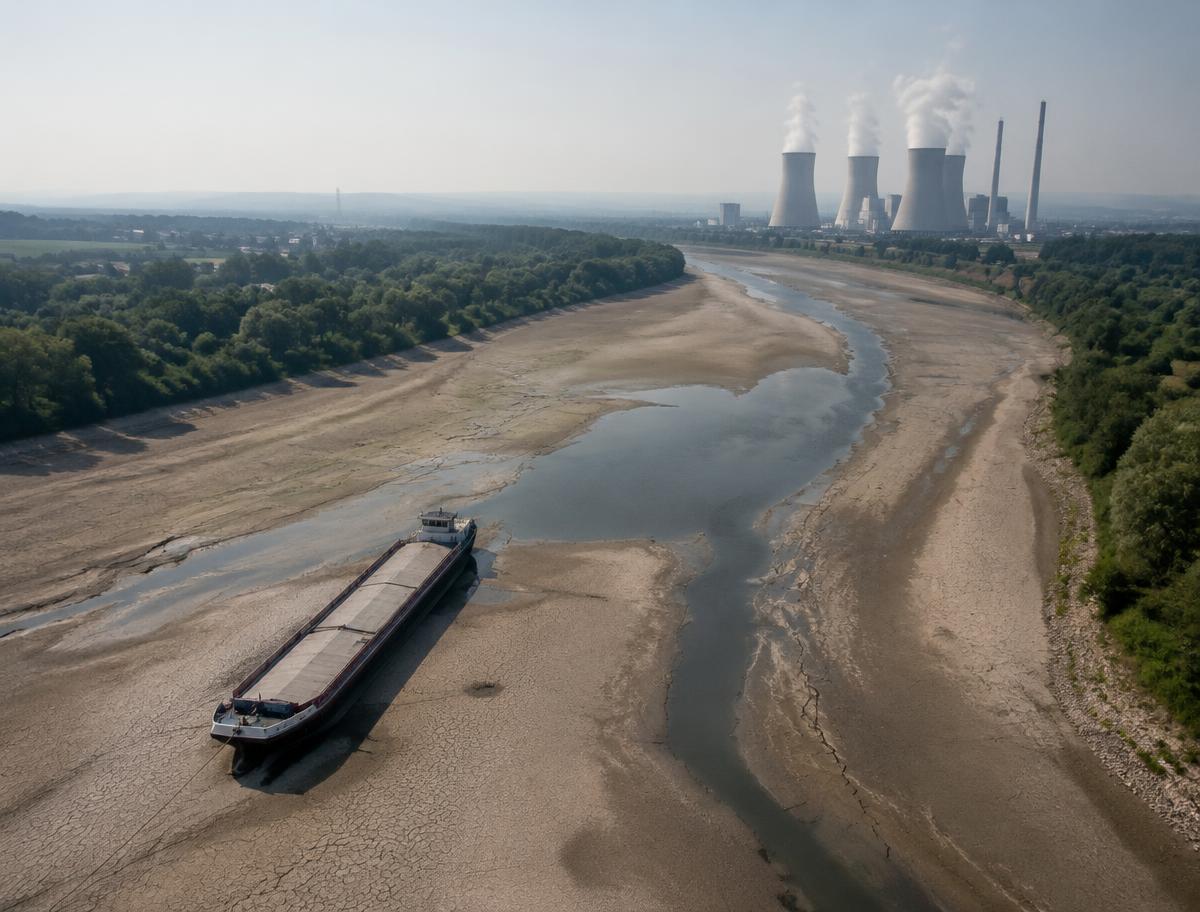
Europe's major rivers recorded their lowest summer flows in more than three decades this year, according to new data from the EU's Copernicus Climate Change Service, with knock-on effects that have disrupted electricity generation, industrial production and freight transport across the continent.
Copernicus said prolonged and severe drought conditions across Europe had set the stage for the lowest continental river flow recorded since the European Flood Awareness System began keeping records in 1992. Twelve of the continent's largest rivers, including the Rhine and the Danube, were affected.
The findings formed part of the agency's seasonal climate assessment, published this week, which described the summer as one marked by particularly intense and unusually early heatwaves, the first of which struck in May. Across the continent as a whole it was the third-warmest summer on record; in western Europe specifically, it was the worst on record, surpassing even the deadly summer of 2003.
Power plants and production halted
The consequences have rippled well beyond the rivers themselves. Hungary and Romania were both forced, for the first time, to halt nuclear reactors because there was not enough water in the Danube to cool them. Romania declared a state of emergency and resorted to detonating explosives along the riverbed in an attempt to divert more water towards its nuclear plant.
Hungary's Paks nuclear plant, which normally supplies around half the country's electricity, was left operating at below 50% of its capacity for extended periods during the summer. Car manufacturers Dacia and Ford both suspended production in Romania as a result of the disruption.
In Germany, the Rhine recorded historic lows along several stretches, forcing cargo vessels to sail with sharply reduced loads to avoid running aground and creating bottlenecks for industries including chemicals and steel that depend on the river for transporting raw materials and finished goods.
Tourism and trade also hit
The impact extended to tourism as well. At least 120 Spanish tourists who had booked a Danube river cruise had to complete much of their journey by bus after low water levels made parts of the route impassable for their ship.
European Commission President Ursula von der Leyen described the season as Europe's "summer of truth" in her State of the Union address last month, pointing to the mounting toll of a warming climate that has struck the continent with renewed force this year.
Economists have estimated that the broader drought which gripped Europe over the summer, affecting agriculture, water supplies and industry well beyond the rivers themselves, could cost the continent's economy at least €50bn in the short term. Wheat production across the EU and the UK is expected to fall by around a quarter this year, costing producers roughly €2bn, as drought conditions withered crops across the continent's breadbasket regions.
A pattern repeating each year
This is not the first summer in recent years in which Europe's rivers have run critically low, but Copernicus's data suggests the pattern is intensifying rather than easing. Scientists have repeatedly linked the increasing frequency and severity of these droughts to human-caused climate change, noting that rising average temperatures accelerate evaporation from soil and waterways while also altering the rainfall patterns that would normally replenish them.
River transport has historically offered a low-carbon alternative to road and rail freight across much of Europe, particularly for bulk goods such as coal, grain and chemicals. But as low water levels become a more frequent feature of European summers, logistics firms and heavy industry are increasingly having to build contingency plans around the prospect of rivers simply becoming unusable for weeks at a time.
Looking ahead
Climate researchers have urged governments to treat this summer's figures as a warning rather than an anomaly, calling for greater investment in water storage infrastructure, more resilient energy systems less dependent on river cooling, and diversified transport routes that do not rely solely on waterways vulnerable to drought.
For now, river levels across much of central Europe remain well below their historical averages heading into autumn, and officials in several countries have said it remains too early to say whether normal conditions will return before the usual winter rains and snowmelt begin to replenish the continent's waterways.