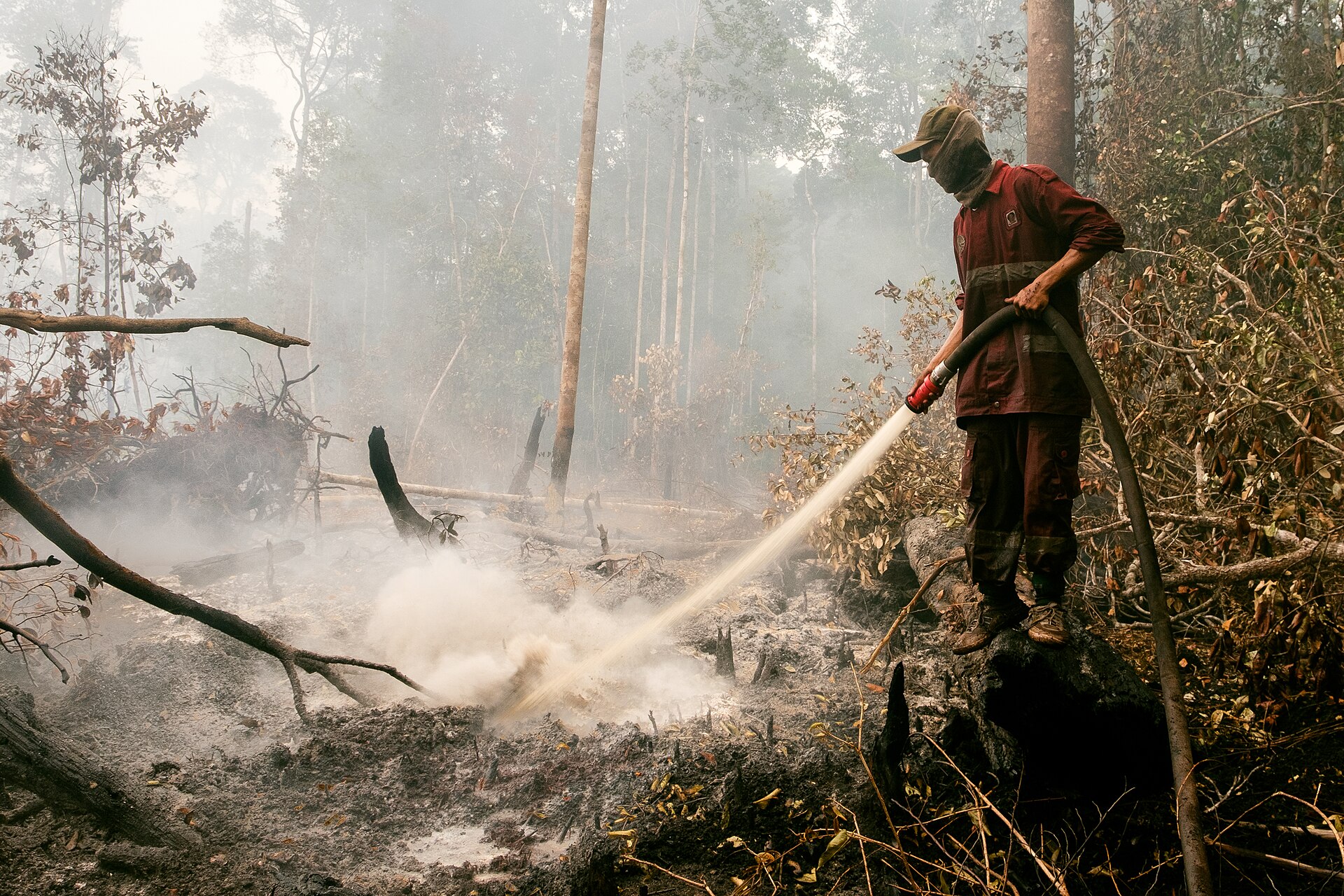
Wildfires have burned about 1.9 million hectares of Indonesia since the start of the year, blanketing large parts of South East Asia in a toxic haze and making hundreds of thousands of people ill.
The figure, from the open-access satellite monitoring platform Nusantara Atlas, covers an area roughly the size of the US state of New Jersey, or of the entire nation of Fiji. About one million hectares are thought to have burned in September alone.
Smouldering forest, swamp and peatland has filled the air with microparticles and carbon monoxide, creating a noxious cloud that has drifted from Indonesia as far as Singapore, Malaysia and the Philippines.
A health emergency
By mid-October Indonesia’s Health Ministry had recorded more than 277,000 cases of chronic cough and acute respiratory infection. More than 62,000 of them were children under five.
In Palangkaraya, the capital of Central Kalimantan in Indonesian Borneo, the smog turns the light the colour of rust. Dianyra Eka Nastiti, a mother of three, told the BBC that her baby daughter had been treated in hospital for bronchopneumonia at six weeks old. “Sometimes at night my baby’s chest makes a rattling sound,” she said. “Every single night I worry: will my child cough tomorrow?”
Smoke from peat fires contains a complex mix of pollutants. The finest particles can penetrate deep into the lungs and in some cases enter the bloodstream, causing inflammation and chronic lung disease and raising the risk of premature death. Children, older people and pregnant women are especially vulnerable, particularly when exposure lasts for weeks.
Riduan, head of the Palangkaraya Health Office, said: “The sky has turned yellow and hazy. So what are the residents actually breathing in? It’s not fresh oxygen; it’s carbon dioxide and pollutants.”
‘Where else can we go?’
Official advice is to stay indoors, but many residents say that is impossible. “I still need to buy vegetables, stock up on food, purchase school supplies,” Nastiti said. In the village of Ramang, 50km north of the city, Lola Macitri said her children had been taking school classes online while adults struggled to manage half a day’s work in the poisonous air.
Farmers, day labourers and small traders have been forced either to give up their income or to risk going outside. “If you ask whether we are afraid of the health risks, of course we are. But where else can we go?” Macitri said.
Fires that burn underground
Seasonal fires are not new in Indonesia, where land is often cleared by burning and drained peatlands dry out each year. This year a so-called Super El Niño has intensified the drought and delayed the rains that are vital to putting out peat fires.
Peat fires can smoulder beneath the surface for months, even when the flames above appear to be out. Fauzi Rahman, a firefighter in Palangkaraya, said: “On regular land we can clear 20 hectares in a single day, especially with a large team. On peatland, it can take months. We really have to inject water deep down, all the way to the bottom, which requires a huge amount of water. And right now, water is hard to find.”
Another firefighter, Juni, has been tackling blazes for more than 100 days and now suffers from breathlessness, a persistent cough and pain in his eyes. Asked what he needed, he replied: “Air.”
Dr Nisa Novita, a forestry expert and peatland researcher at the Indonesian conservation group Yayasan Konservasi Alam Nusantara, said her team had found fires spreading into areas with no previous history of burning. “It’s a bit like trying to save a sinking ship,” she said. “We need to act urgently, use whatever tools can help, and prevent further damage while we still can.”
Pressure on the government
The authorities face mounting public criticism over what many regard as an inadequate response. Officials say they have used aerial water-bombing and experimental weather modification, and last week the government said it had deployed more than 60,000 personnel in a land operation, claiming an 80% success rate in extinguishing new fires.
Peatlands store vast quantities of carbon, so fires on this scale also release large amounts of greenhouse gases, adding to the climate pressures that make droughts more severe. Indonesia’s 2015 fire season, which caused one of the worst regional haze crises on record, prompted promises of reform that this year’s blazes are now testing.
For people in Palangkaraya, the hope is simpler. “The fires are still burning,” Riduan said. “Our greatest hope is that Almighty God will bring us rain soon.”