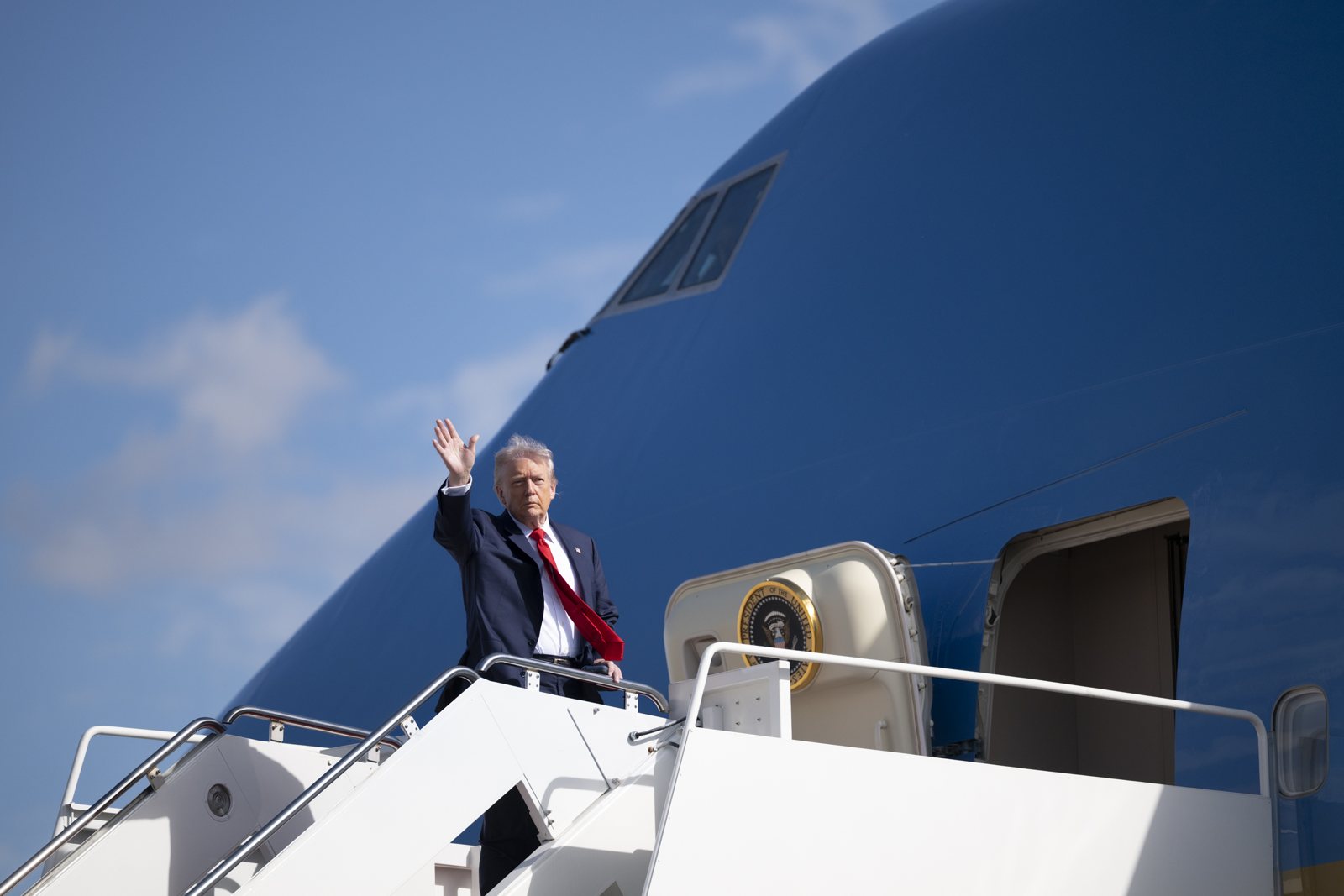
Donald Trump has been ordered by a US judge to sit for a deposition in his $10bn lawsuit against the BBC by 11 December, and to hand over relevant documents, or face sanctions that could include the case being thrown out.
Federal magistrate judge Enjoliqué Lett gave the ruling during a lengthy hearing in Miami on Thursday, telling the president’s legal team that it had not done enough to comply with the pre-trial process known as discovery.
She also rejected a request from Mr Trump’s lawyers to stop the seven-hour deposition from being videotaped, although the recording will be available only to lawyers involved in the case.
The Panorama edit
The lawsuit stems from a BBC Panorama documentary that spliced together two parts of a speech Mr Trump gave at a rally in Washington on 6 January 2021, shortly before the riot at the US Capitol. The two remarks were made almost an hour apart.
The BBC has acknowledged that the edit was misleading. Mr Trump has since claimed, without evidence, that the corporation used artificial intelligence to insert words into his speech, a claim the BBC has not accepted.
Although the programme was not readily available to watch in Florida, Mr Trump’s lawyers argue that he was personally harmed by it under the state’s Unfair and Deceptive Trade Practices Act.
‘Absolutely nothing of any substance’
Judge Lett agreed with the BBC’s lawyers that Mr Trump’s team had failed to hand over internal documents relevant to the case ahead of an 18 December deadline for discovery.
“We still have a completely lopsided situation here on discovery. They have produced absolutely nothing of any substance,” Charles Tobin, representing the BBC, told the court. The documents supplied so far, the court heard, had mostly been taken from the internet or provided by the BBC itself.
“It strains credulity that a thorough search has been done in order to determine that all of these requests have been responded to,” the judge told Alejandro Brito, Mr Trump’s Florida-based lawyer. “The court is not satisfied that anyone is doing a thorough job.”
She gave Mr Trump’s side 30 days to produce the documents. While acknowledging that discovery can be “burdensome” for both parties, she warned that “failure to do so could result in sanctions, including possible dismissal of the suit for failure to prosecute the case and engage in meaningful discovery process”.
“This is the last opportunity to do so,” she said.
Cancelled date
The BBC had asked the court to compel Mr Trump to agree a deposition date after an earlier one, set for 16 October, was cancelled. His lawyers said at the time that he was dealing with “other matters of national importance”.
The BBC’s lawyers told the court that Mr Trump had in fact been campaigning in Georgia that day, prompting Mr Tobin to accuse the president’s team of transmitting “fake news”. Mr Brito replied that the president was “involved in a host of things” every day that the BBC’s legal team “has no idea” about.
In a filing on Wednesday, Mr Trump’s team said he would be willing to give evidence during the second or third week of January. Judge Lett said she was bound by the existing timetable, though it could be extended by the district judge overseeing the case, Jeffrey T Kuntz. Mr Tobin said the BBC would accept a later deposition if the wider discovery schedule were adjusted.
“The lesson for the day is that no plaintiff is above the law, and no plaintiff is above the orders of the court,” Mr Tobin said.
Mar-a-Lago subpoena allowed
The judge also allowed the BBC’s subpoena to Mar-a-Lago, Mr Trump’s private club in Palm Beach, to go ahead, despite objections from his lawyer that the business is separate from the president.
“The president’s occupation is the president of the United States,” Mr Brito said. “It has nothing to do with Mar-a-Lago as far as his occupation.”
Mr Tobin disagreed, arguing that Mr Trump uses the club to host world leaders, including Ukraine’s President Volodymyr Zelensky, and to project his personal power. “His business successes are a measure of his reputation,” he said.
Judge Lett agreed that the club “falls within the scope of discoverability”. “I think it is intertwined with his profession and therefore any harm that may be alleged under his professional trade and occupation would be reflected with how he conducts business with Mar-a-Lago, at least for discovery purposes,” she said.
What happens next
The case is one of the most serious legal challenges the BBC has faced from a foreign head of state. The controversy over the Panorama edit led to the resignations of the corporation’s director general and head of news last year, and prompted a wider debate in Britain about editorial standards and the licence fee.
The BBC has said it will fight the lawsuit, arguing that it has no case to answer in a US court. If Mr Trump does not comply with the judge’s orders, the corporation is expected to press for sanctions, including dismissal. If he does, a deposition under oath would give BBC lawyers the chance to question the president directly about the harm he says the programme caused.