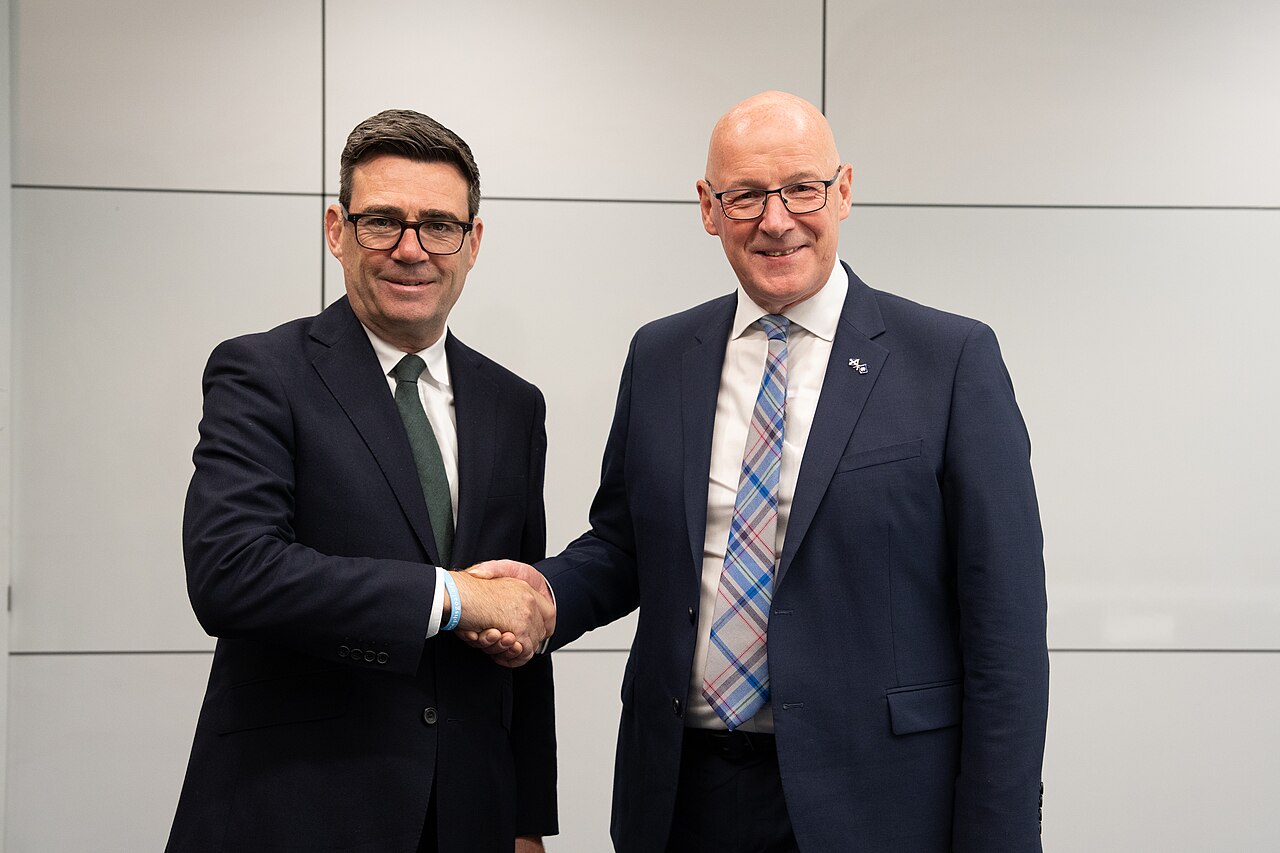
Prime Minister Andy Burnham and First Minister John Swinney have promised to work together on handing more power to Scotland, after talks in Glasgow that both sides described as positive. But Downing Street made clear that the one thing the SNP wants most, a second independence referendum, is not part of the deal.
The two leaders met on Friday after the first meeting of the National Economic Council to be held outside London with the leaders of the devolved nations. Welsh First Minister Rhun ap Iorwerth also attended, while Northern Ireland was represented only by officials.
In a statement after the meeting, Downing Street said the Prime Minister and First Minister agreed the council had been "extremely positive" and "a valuable exercise" in exploring how each government could help with regional empowerment, reindustrialisation and "good growth in every postcode".
A 'policy sprint' on new powers
The two governments agreed to start what No 10 called a "policy sprint", led by its new No10 North unit and involving officials from both administrations, to turn the talks into concrete proposals.
The ideas on the table include giving Scotland and Wales more control over employment support, particularly for young people, and devolving innovation funding to help rebuild industry. Mr Burnham, Mr Swinney and Mr ap Iorwerth agreed that too many young people in all three nations are out of work.
The Prime Minister also suggested that Glasgow could be given more control over its own finances, along the lines of the fiscal powers for English city regions announced in this week's Budget. "We're looking at fiscal devolution to city regions and I don't want to see Scotland left out in that," he told reporters during an unplanned walkabout in the city.
"This is an incredible place. I love coming here to the great city of Glasgow," he said. "I want it to be set up in the same way to forge its own path, be proud of its amazing culture and identity and do what it wants to do."
'Problem solving rather than point scoring'
Opening the council, Mr Burnham said he wanted to "draw a bit of a line" under years of tension between London and the devolved governments. "I've talked about problem solving rather than point scoring," he said. "I hope you've seen enough so far to know that is how I work."
The former mayor of Greater Manchester, who entered Downing Street in the summer, has made devolution the centrepiece of his premiership, promising to "rewire the state". He revived the National Economic Council, first created by Gordon Brown during the 2008 financial crisis, and brought six Cabinet ministers and two other ministers to Glasgow.
He pointed to the decline of Ravenscraig steelworks in Lanarkshire as an example of communities left behind during past industrial change. He also mentioned the Scottish steel industry, oil and gas, and last week's decision on the Jackdaw gas field as live issues for Scotland.
"It's really important we all move at the same pace together, and I won't allow anything to delay that," Mr Burnham said. "Growth can't wait. People need to see improvements in employment and in living standards in all parts of the UK."
Swinney: 'a welcome start'
Mr Swinney said there had been "a series of constructive discussions" and described the meeting as "a welcome start" on further devolution, while stressing that he and the Prime Minister still disagree on independence.
He said he welcomed recognition that "Westminster is not working for Scotland" and pledged to work "constructively and collaboratively" with Mr Burnham to bring more powers to Holyrood, as long as they deliver "higher wages, better jobs, more opportunities for business to start and expand, and support with the cost of living".
A separate meeting brought together Mr Swinney, his deputy Jenny Gilruth, Mr Burnham and Hamish Falconer, the minister for intergovernmental relations. Mr Burnham said he had first met Mr Swinney about 20 years ago, when he was chief secretary to the Treasury, and that their talks then had sometimes been "robust". "I think we can find a way of working together for Scotland's benefit," he said.
Independence ruled out again
Outside the policy sprint, Downing Street said the UK government would review and respond to a range of other issues raised by the First Minister. That review, it said, "would not include a second independence referendum in Scotland", which the Prime Minister has repeatedly said is off the table.
That leaves the central fault line in Scottish politics untouched. Both Mr Swinney and Mr ap Iorwerth have called for a wider conversation about independence, but Mr Burnham has ruled out referendums in both nations.
For Wales, Mr ap Iorwerth said the meeting was "positive". He welcomed what he called a "step forward" on the Welsh government's tax and borrowing powers, but insisted that any further devolution within Wales was "a matter for the Senedd and only the Senedd".
Northern Ireland absent
Northern Ireland's first minister did not attend. The political fallout from the Drumcree parade dispute meant the DUP blocked Sinn Féin's First Minister from going, so the province was represented by officials. Mr Burnham said it was "a shame" that Northern Ireland's leaders were not there, but added that the UK government was working with them on the same agenda.
What happens next
The meeting comes as Finance Secretary Jenny Gilruth prepares to deliver the Scottish Budget next month, after Wednesday's UK Budget set out a £100 winter energy payment for homes in council tax bands A to D in England and equivalent funding for Scotland. Scottish ministers have said they will work with councils on how that money reaches about 1.9 million Scottish households.
The policy sprint is expected to report back on the detail of new powers over employment support and innovation funding. Whether it produces real change for workers and young people in Scotland, or simply a warmer tone between two governments that still disagree on the biggest question of all, will become clear in the months ahead.