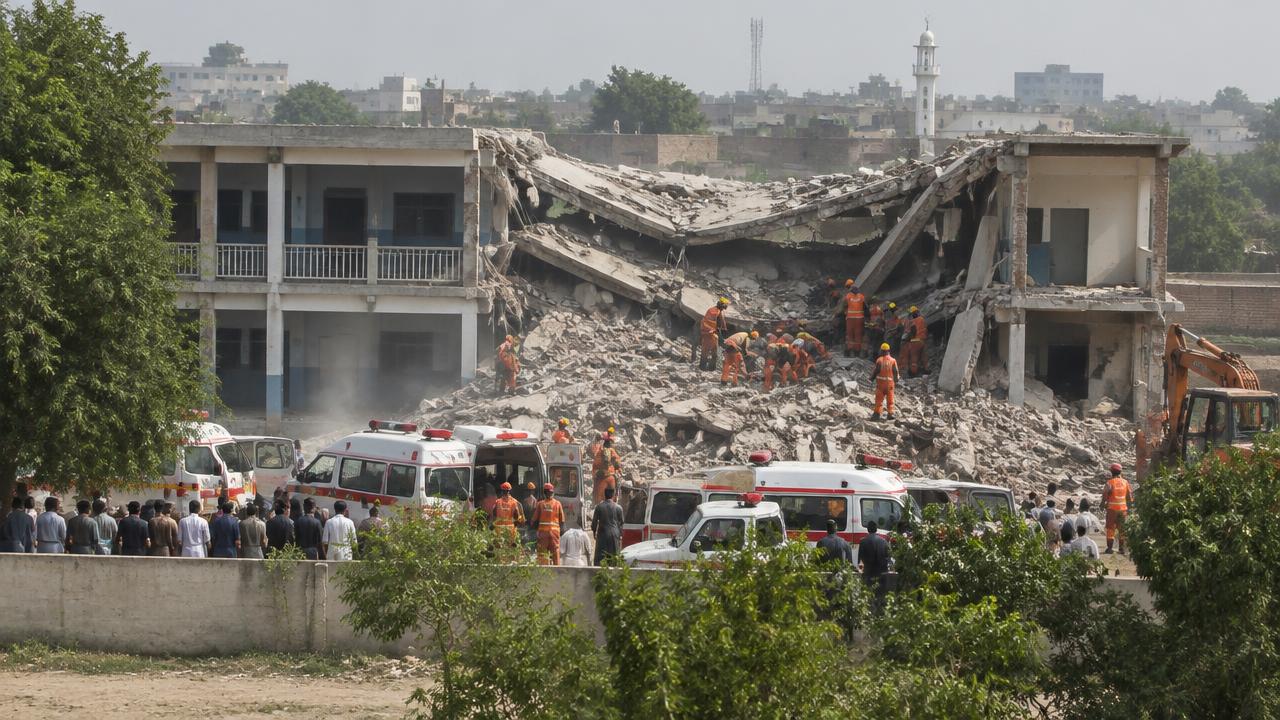
At least 27 students, most of them younger than 13, have been killed after a school roof collapsed on classrooms during lessons in Peshawar, in north-west Pakistan.
A teacher also died, local authorities said, warning that the death toll was likely to rise as rescuers searched for dozens of pupils still unaccounted for.
The collapse happened at the privately run al-Khair Education Center. Television pictures showed ambulances racing to the scene as rescue workers pulled injured children from the rubble.
Floors crushed together
A rescue official said the ceiling came down on the students after the roof of a higher floor gave way, crumpling two storeys of the building.
Peshawar's police chief, Mian Saeed, said 110 students had been in the three affected classrooms when the structure failed. Only 47 had been rescued so far.
"It was a weak building structure," he said. "Its roof was overweight with construction on a weak structure that caused the collapse."
District emergency officer Iftikhar Khan said rescuers had brought out at least 45 children, adding that more were reported to be buried under the debris.
Government official Bilal Faizi said teams were working both to recover bodies and to get the injured to hospital. Twenty of the injured were taken to the city's Lady Reading Hospital, according to its spokesperson, Mohammad Asim.
Authorities have ordered an investigation to establish the cause.
The building housed classes for young pupils, which is why so many of the victims were small children. Officials did not immediately say how long the school had operated from the site, whether it was registered with provincial regulators, or when any upper-floor work had been carried out. Those questions are expected to sit at the centre of the inquiry.
Desperate scenes
As news spread, parents rushed to the school, searching for their children among the injured and waiting outside hospitals for news. Rescue crews worked with heavy machinery and their bare hands to lift slabs of concrete, conscious that survivors might still be trapped beneath.
In a disaster of this kind the first hours are critical. Children caught in pockets beneath collapsed floors can survive, but crushing injuries, dust and lack of air make every minute count.
Questions over building safety
The police chief's comments point to a problem long raised by engineers and campaigners in Pakistan: the addition of extra floors or heavy construction to buildings that were never designed to bear the weight.
Peshawar, the capital of Khyber Pakhtunkhwa province, is a fast-growing city of several million people. Like many cities in the region, it has a large number of private schools, many operating from converted or extended buildings.
Building rules exist, but critics have long argued that enforcement is weak and that inspections are patchy, particularly for smaller private institutions. Low-cost private schools play a big role in educating Pakistani children, filling gaps left by an overstretched state system.
The investigation is expected to examine who approved any additional construction, whether the building had been inspected, and whether warning signs such as cracks had been reported before the collapse.
Region with a history of loss
Khyber Pakhtunkhwa has endured more than its share of tragedy involving schoolchildren. Peshawar is still haunted by the 2014 attack on the Army Public School, in which militants killed about 150 people, most of them pupils.
Thursday's disaster appears to have a very different cause – structural failure rather than violence – but it will reopen painful memories for families in the city.
What happens next
Provincial officials are expected to come under pressure to publish the findings of the investigation quickly and to check the safety of other school buildings, especially those that have been extended upwards.
For now, rescuers are still working through the rubble. With more than half of the children who were in the classrooms not yet accounted for at the latest count, officials have warned that the number of dead may climb substantially.