Barack Obama has told a packed arena in Glasgow that the world's drift towards political extremism is "not inevitable", while warning that artificial intelligence is about to make it even harder to tell what is true.
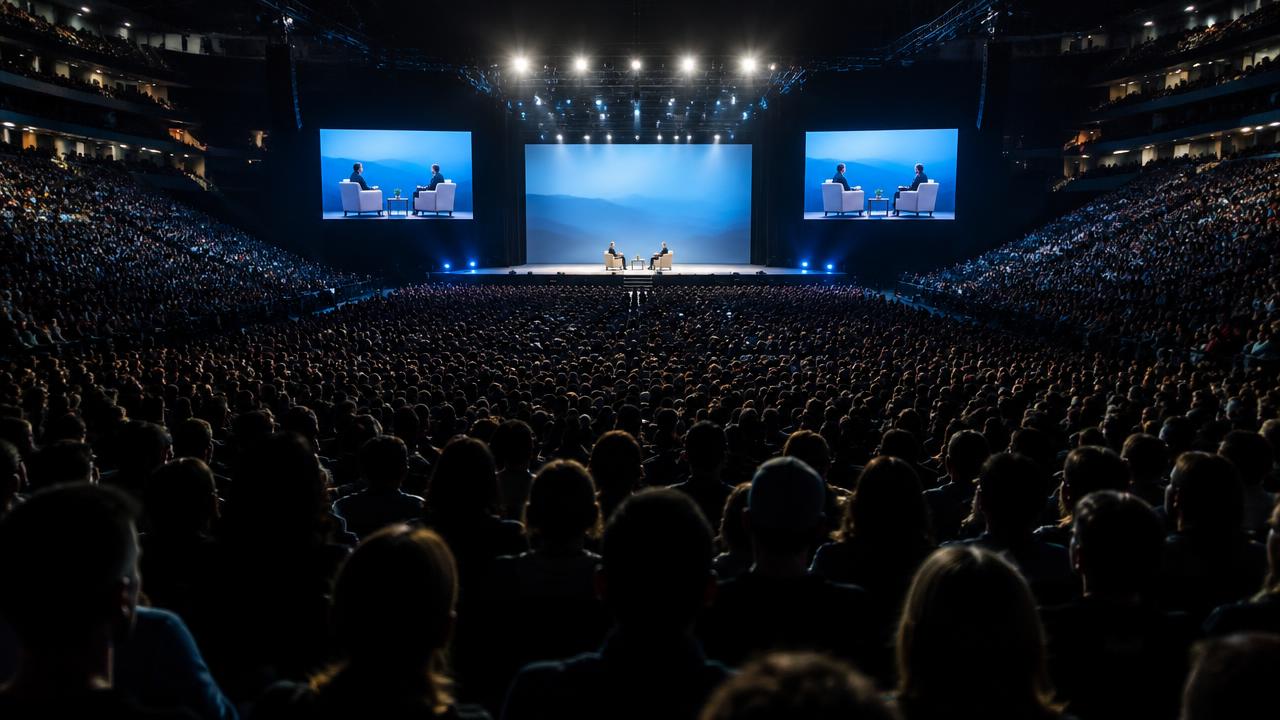
The former US president spoke to about 12,150 people at the OVO Hydro on Wednesday evening, in conversation with the British journalist and author Sathnam Sanghera. The event was part of a three-night UK tour that began in Belfast on Tuesday and moves to Manchester on Thursday.
Over the course of the evening, the 65-year-old reflected on his years in the White House and on the political and social forces reshaping the United States and the wider world.
From beacon of hope to 'blame pie'
Mr Obama recalled how, during his 2008 campaign, the still-young internet and social media had looked like a force for good, helping to mobilise ordinary people.
But the same tools, he said, had proved just as useful to hate groups. "It connected people for good, but also for ill," he told the audience.
He argued that online platforms had changed in recent years. "It turns out that the reptilian side of our brain really gets attracted to anger, fear, resentment and the sense that someone is out to get you," he said. "So a lot of social media and a lot of our information is informed around that."
Asked why politics had become so divided, he said: "If I had a blame pie for why politics is so polarised and why we're seeing a rise of populism in many places, it's because of that information that is going into our brains every day."
AI and the battle over facts
Mr Obama said the problem was set to deepen. "It's not a healthy diet that our brains are on at the moment, and it's about to get even more troubling with AI, where it's going to get even more difficult for us to distinguish between what is true and what is not," he said.
"It's hard for democracy to function if we can't at least agree on the facts."
He pointed to the period after the Second World War, when governments in the US and Europe introduced rules on broadcasting and information after seeing "what propaganda can do in the hands of somebody like Hitler".
There was a "critical balance" to be struck between free speech and regulation, he said. Leaders would need to build new mechanisms and institutions that allowed vigorous debate and disagreement while helping people establish basic facts.
His comments come as governments on both sides of the Atlantic argue over how far to regulate online platforms and AI systems – a debate in which critics of tighter rules warn of threats to free expression, and supporters argue that unchecked algorithms are damaging public life.
Warning on hateful language
Mr Obama said humanity appeared to move in cycles, forgetting hard-won lessons and taking freedoms for granted.
"We start thinking 'maybe using language in public from our politicians that fosters hatred and scapegoats certain people – immigrants, Jews, or blacks or gays – that's just talk, it's humour'," he said.
"We forget what that leads to when it becomes a common habit and we normalise it, and we start thinking 'democracy is not that important', and we forget what authoritarianism leads to."
He did not name any current politicians in the remarks reported from the event.
Hope as a choice
Asked whether he still believed Martin Luther King Jr's line that the arc of the moral universe is long but bends towards justice, Mr Obama said he did.
He described hope as an active, "almost theological" decision. "It is a decision about how do we face and embrace this finite amount of time we have on the planet," he said.
"I think when we act on that basis, it doesn't always work out, but over time things do get better."
He told the crowd the world would face "big challenges" but insisted: "We can be better."
"When we choose, when we make that decision, I do believe – and there is evidence for this – that the world gets incrementally better, and that is a worthy goal and it's worth fighting for."
A big night for Glasgow
The appearance was one of the largest speaking events the Hydro has staged, filling a venue more used to major music tours. Tickets for the UK dates sold quickly when they were released.
For an audience that had come largely to hear a message of optimism, Mr Obama offered one – but it came with a clear warning that the information people consume every day, and the technology now shaping it, will decide how much of that optimism survives.