A physicist who realised that a cubic kilometre of Antarctic ice could be used to catch some of the most elusive particles in the universe has won the 2026 Nobel Prize in Physics.
The Royal Swedish Academy of Sciences awarded the prize to Francis Halzen, of the University of Wisconsin–Madison in the United States, "for decisive contributions to the IceCube Neutrino Observatory and the discovery of high-energy neutrinos of astrophysical origin".
He receives the full prize, worth 11 million Swedish kronor.
Ghost particles
Neutrinos are among the most common particles in the universe, but they almost never make themselves known. Trillions pass through the Earth — and through every human body — each second without leaving a trace.
Very rarely, a single neutrino collides with an atomic nucleus. With the right equipment, that collision can be detected.
Scientists have long known that the cosmos contains natural particle accelerators that fire out particles with energies up to a million times greater than anything achieved in laboratories on Earth. Much about these sources remains a mystery: what they are, where they are and what happens inside them.
Neutrinos are produced in the same violent environments. But unlike other particles, they travel across the universe without changing direction or losing energy. That makes them unique messengers, carrying information that cannot be obtained in any other way.
A vision from 1988
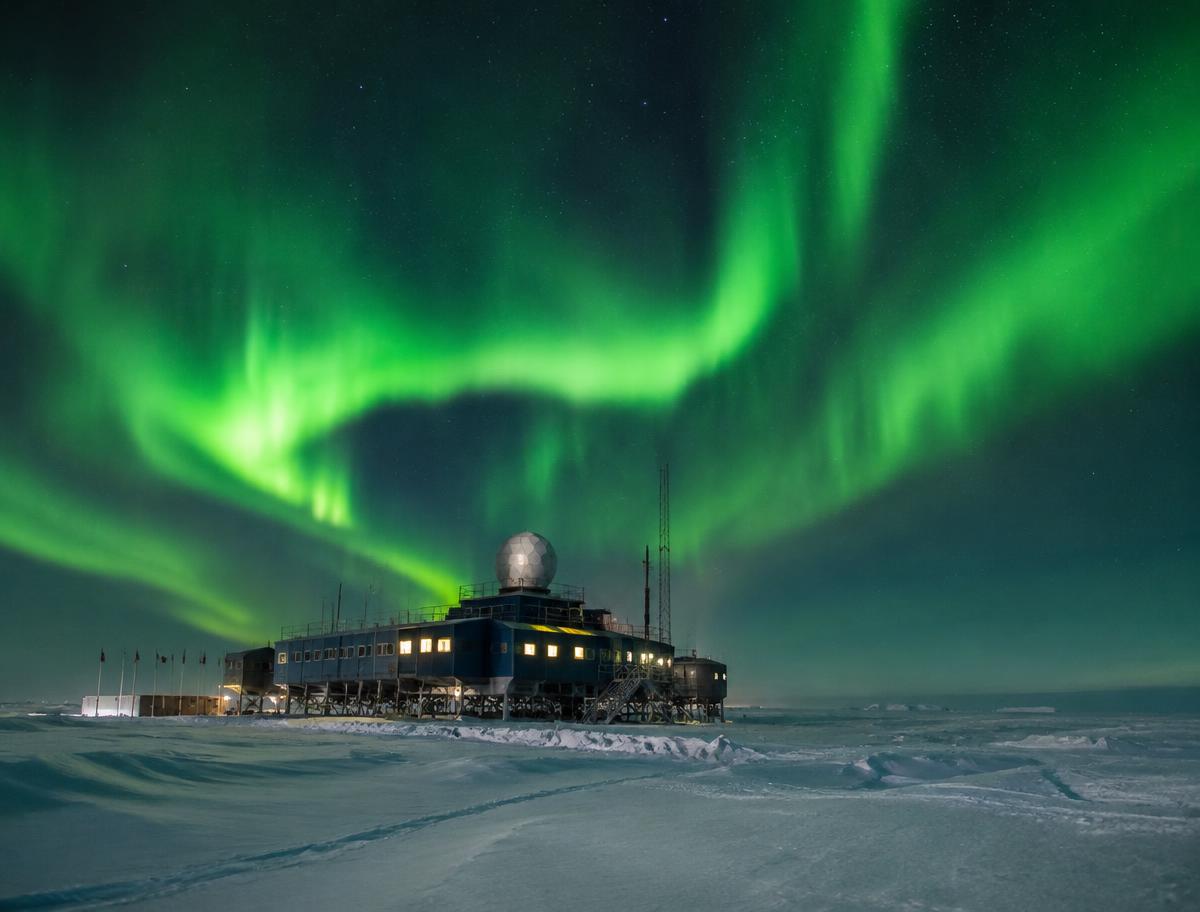
Professor Halzen first set out his idea of capturing neutrinos at the South Pole in 1988. When a neutrino strikes an atomic nucleus, it produces a faint flash of light. In the exceptionally clear glacial ice of Antarctica, that light can be tracked by sensitive detectors.
The South Pole offered other advantages. Its ice is free from many forms of interference, and the area is geologically stable, with no earthquakes.
His proposal soon gained the support of other researchers, and within a few years preliminary tests of sensors in the ice were under way.
A cubic kilometre of ice
Because high-energy cosmic neutrinos are extremely rare, an enormous volume of ice is needed to record enough collisions. IceCube, completed in 2011, covers an entire cubic kilometre, with thousands of light sensors lowered deep into holes melted into the ice.
Researchers soon detected the first high-energy neutrinos. A few years later they published evidence of neutrinos that must have originated far outside our solar system — opening a new window on the universe.
The search for the sources of those cosmic neutrinos could then begin in earnest. IceCube has since helped researchers link high-energy neutrinos to specific objects in the distant cosmos.
A new kind of astronomy
For centuries astronomy depended on light. In recent decades scientists have added gravitational waves and cosmic rays to their tools. Neutrino astronomy, which IceCube helped make a reality, adds another sense with which to study the universe.
Because neutrinos pass through dust, gas and even whole planets, they can reveal processes hidden from conventional telescopes, including events at the hearts of galaxies.
The Academy described Professor Halzen's vision and scientific leadership as fundamental to IceCube's success. The observatory is run by a large international collaboration of scientists, but the prize recognises the man who first imagined it.
The detector also studies neutrinos produced closer to home, when cosmic rays strike the Earth's atmosphere, helping physicists refine their understanding of the particles' strange properties.
Why it matters
Prizes in physics often reward discoveries made decades earlier. This one honours a project that began as an unlikely idea, took more than two decades to build in one of the harshest environments on Earth, and is still producing results.
It is also a reminder of how fundamental science can depend on patience and ambition: burying instruments under the South Pole to catch particles that almost never interact with anything.
The award will be presented in Stockholm on 10 December.