
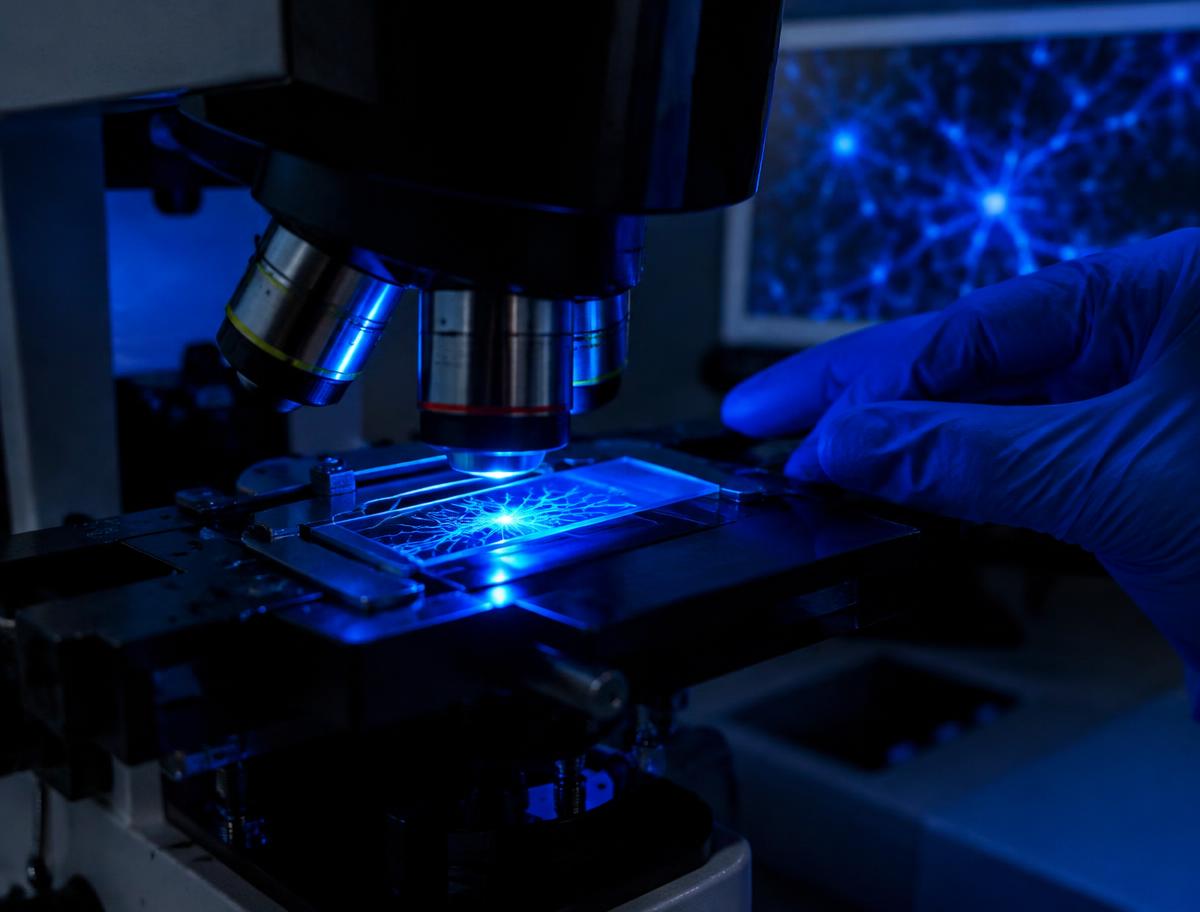
Three scientists who discovered how to control brain cells with flashes of light — starting with a tiny single-celled alga — have won the 2026 Nobel Prize in Physiology or Medicine.
The Nobel Assembly at Karolinska Institutet in Stockholm awarded the prize jointly to Karl Deisseroth, of the Howard Hughes Medical Institute and Stanford University in the United States, Peter Hegemann, of Humboldt University of Berlin, and Georg Nagel, of the University of Würzburg in Germany.
They were honoured "for their discoveries concerning light-gated ion channels and optogenetics", a technique the Assembly said makes it possible to show how nerve cells shape memories, feelings and behaviours in the living brain.
A mystery of the brain
How the brain governs our emotions, actions and bodily functions has long been one of the greatest puzzles in science.
In the 20th century researchers began working out which areas of the brain affect which functions. But the methods available could not prove cause and effect. The Assembly compared the resulting picture of the brain to "a sketch map, full of question marks and unknowns".
"Optogenetics provides opportunities for mapping the brain in a way that we could once only dream of," said Per Svenningsson, chair of the Nobel Committee for Physiology or Medicine.
It began with an alga
The discovery started with curiosity. Professor Hegemann wanted to understand how Chlamydomonas, a single-celled green alga, is able to swim towards light.
In the early 2000s he and Professor Nagel discovered channelrhodopsin, a protein on the surface of the alga with remarkable properties. When it is lit by blue light, a channel opens through the protein. Charged particles flow into the cell, creating an electrical impulse.
Crucially, they found that whichever cell they placed the protein in, that cell became sensitive to light.
A light switch for nerve cells
Professor Deisseroth took the next step. He introduced the gene for channelrhodopsin into nerve cells from rats. By shining blue light on the cells, he was able to trigger them to fire on command.
That turned an obscure algal protein into a precise switch for nerve cells. Researchers could now activate specific groups of neurons, in living animals, with millisecond timing — and watch what happened to behaviour.
The technique, known as optogenetics, has since been taken up by laboratories across the world. It has allowed scientists to test directly which brain circuits are involved in processes such as memory, fear, reward, sleep, appetite and movement.
A new era in neuroscience
The Assembly said the three laureates had "laid the foundation of a new era in neuroscience". Instead of only observing which parts of the brain are active, researchers can now switch circuits on and off to establish what they actually do.
That has transformed the study of conditions linked to brain circuits, including depression, anxiety, addiction and Parkinson's disease, by helping scientists understand the biology behind them.
Optogenetics is primarily a research tool, and most of its use so far has been in laboratory animals. But it has also inspired work on possible future treatments, including efforts to restore some light sensitivity in people who have lost their sight through certain eye diseases.
Other light-sensitive proteins have since been added to the toolkit, including ones that silence nerve cells rather than activating them. Together they allow researchers to turn specific circuits both on and off, giving a far more complete picture of how the brain works.
The method is often combined with other technologies, such as thin optical fibres that carry light deep into the brain and imaging techniques that record the activity of thousands of neurons at once.
Curiosity rewarded
The prize is a striking example of how basic research can lead to unexpected breakthroughs. A question about how pond algae find sunlight ended up giving neuroscientists one of the most powerful tools they have ever had.
The three laureates will share the prize money of 11 million Swedish kronor. The award will be presented in Stockholm on 10 December, the anniversary of Alfred Nobel's death.