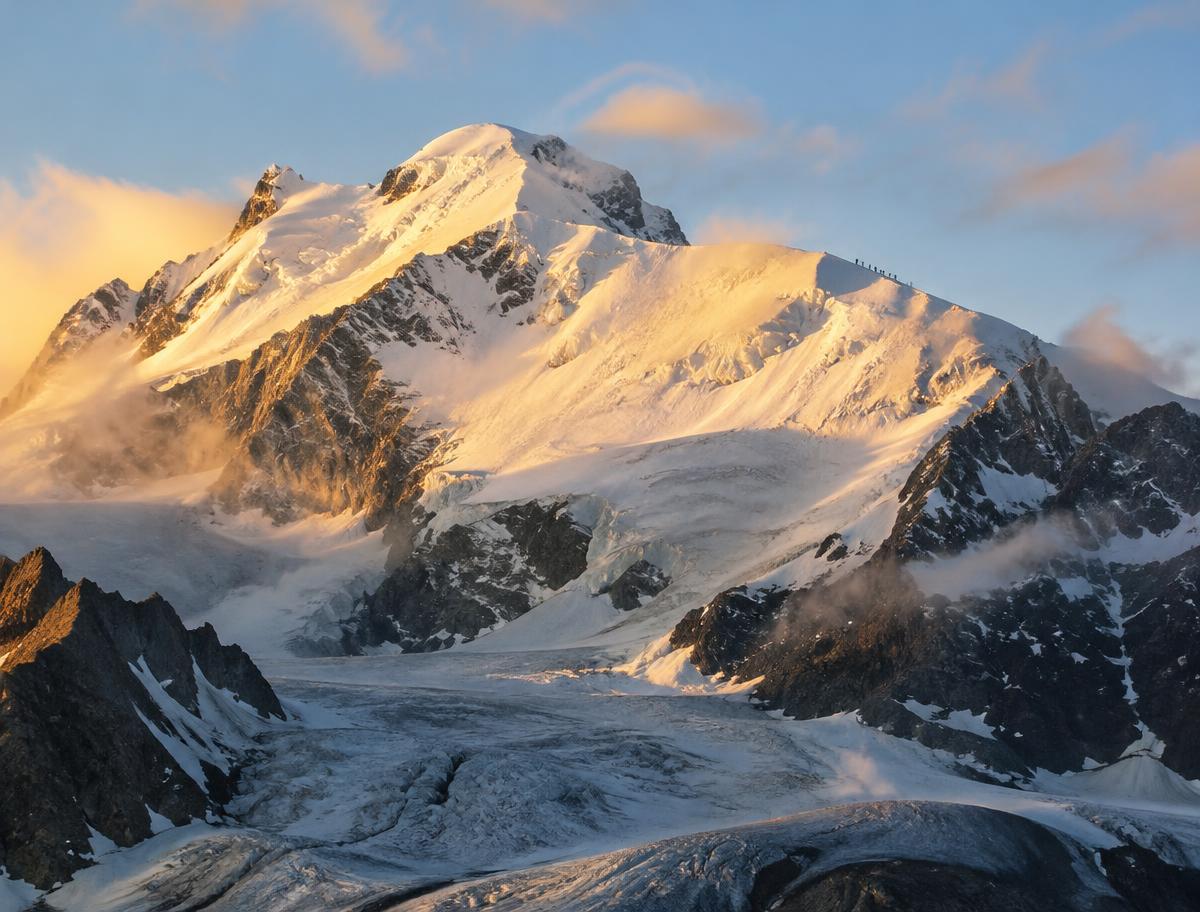
Western Europe's highest mountain has shrunk by more than a metre in a year.
The summit of Mont Blanc in France now stands 4,807.47 metres above sea level, surveyors announced on Wednesday – 1.29 metres lower than in 2025.
The figure was recorded during an expedition last month by chartered surveyors from the Union Nationale des Géomètres-Experts (UNGE) and the Ordre des Géomètres-Experts, who have regularly monitored the peak since 2001.
A summit made of snow
Mont Blanc's rock summit lies beneath a thick cap of snow and ice. The height that climbers stand on changes constantly as heat, wind and precipitation add or strip away that cap.
To measure it, the surveyors used precise satellite positioning and drones that build a detailed model of the summit's snow and ice.
The latest reading is 1.88 metres higher than in 2023, when the mountain fell to its lowest level in recent memory. But it is 3.43 metres below the high of 4,810.90 metres recorded in 2007.
Caution over climate
The experts warned against reading too much into a single year's change. "Regarding ice mass, it is essential to distinguish between changes in surface altitude and changes in the total volume or mass of ice," a UNGE spokesperson said.
"An increase in summit altitude does not necessarily mean that the mountain has gained ice mass, nor does it contradict the documented retreat of Alpine glaciers."
In other words, a higher summit one year can simply reflect heavy snowfall, while a lower one may reflect wind or a dry spell – the long-term story is told by the ice lower down.
'Melted before our very eyes'
That story is stark. Jean des Garets, president of the Haute-Savoie chamber of surveyors and leader of the expedition, said warming could be seen with the naked eye across the rest of the massif, even if "for the moment, climate change doesn't seem to have the same impact above 4,000 metres".
Describing the climb, he told the French broadcaster TF1: "When we climb, we pass by the Brigade Blanche hut before the Tête-Rousse glacier. We've seen that the glacier has moved up. It has literally melted before our very eyes and now in some places we're crossing a stream instead of a glacier."
A brutal summer for the Alps
Western Europe this year endured its hottest summer on record, a heatwave in which scientists say climate breakdown played a part. Alpine regions were scarred, and ice melted at a dizzying pace.
Earlier this month, Swiss glaciologists warned of an "explosion of melt rates" after confirming that one-fifth of Switzerland's ice had been lost in the past five years, with 5.5% of the remaining volume disappearing between 2025 and 2026 alone.
Melting glaciers raise the risk of rockfalls, landslides and floods in mountain valleys, threaten water supplies that depend on summer meltwater, and are reshaping classic climbing routes – including the paths to Mont Blanc itself.
Researchers also point out that the mountain is a magnet for climbers, with thousands attempting the ascent each summer. Authorities in the Chamonix valley have in recent years issued warnings and even temporarily restricted access to some routes during heatwaves because of the danger of falling rocks loosened by melting ice.
Why it matters in Scotland
Scotland has no glaciers, but the same warming is felt in its mountains: Ben Nevis's famous long-lasting snow patches have disappeared completely in several recent years, and ski centres are wrestling with shorter, less reliable seasons.
Mont Blanc's annual measurement has become a symbolic check-up on the health of the Alps. This year's result is a reminder that the roof of Europe is not fixed – and that the ice holding it up is under pressure.