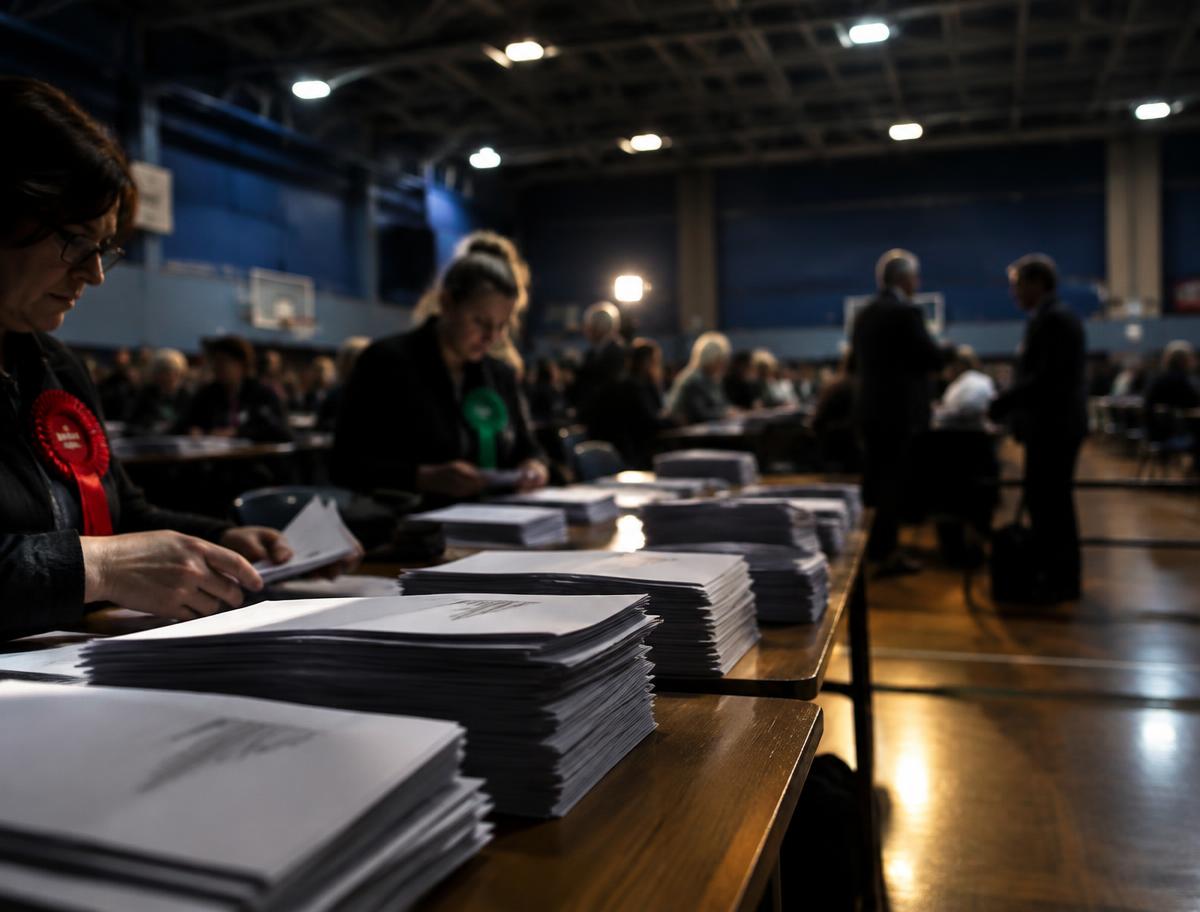
Labour has seen off a high-profile challenge from the Green Party leader, Zack Polanski, to win the Holborn and St Pancras byelection, the seat vacated by former prime minister Sir Keir Starmer.
Labour's Sagal Abdi-Wali took 12,292 votes, 45% of the total, against 8,928 votes, or 33%, for Mr Polanski. The contest had been seen as a two-horse race between the two parties for one of the most symbolic seats on the left of British politics.
Turnout was just 38.7%, the lowest at any byelection in England during this parliament and 15.4 points down on the 2024 general election.
'Who gets to belong'
Ms Abdi-Wali, who came to the UK from Somalia as a child refugee in the 1990s, used an emotional victory speech to hit out at "those who seek to divide us".
Her remarks appeared to answer Reform UK's Zia Yusuf, who suggested shortly after the byelection was called that she was not British.
"I hope this moment says something about who gets to belong," she said. "For people who look like me. I hope they see themselves reflected in this place and know that their path too belongs here. This is Camden and this is Britain."
A first test for Burnham
The result is the first big electoral test for Andy Burnham since he succeeded Sir Keir in Downing Street, and it will reassure his allies.
It supports polling suggesting the new prime minister has recovered some of the public support Labour lost under his predecessor.
Labour chair Bridget Phillipson told Times Radio the win showed that "Labour's message of hope is really cutting through", and that voters wanted progressive change "delivered in action".
But the very low turnout points to a harder truth. Labour is still struggling to enthuse voters in big cities, and particularly in London, where the Greens took control of three councils in May's local elections.
A bruising week for the Greens
For Mr Polanski, the defeat caps the most difficult week of his leadership. On Sunday, Green members at the party conference voted for a motion declaring Zionism a form of racism and calling for Israel to be replaced by a single Palestinian state.
The motion passed despite opposition from four of the party's five MPs. Mr Polanski abstained, missing the debate and vote to campaign in north London — a decision that drew sharp criticism inside and outside his party.
Former Green leader Caroline Lucas refused to say whether he should stand down, telling BBC Newsnight she wanted him to "show the leadership that was frankly missing on Sunday".
Mr Polanski told Sky News he would have backed the motion only if the call for a single state had been removed. "I would have supported the motion as amended. It wasn't amended, so no," he said.
Polanski: 'Of course I can carry on'
Speaking after the count, the Green leader insisted he would stay in post. "Of course I can carry on as leader of the Green party," he said. "We're a party of 220,000 members. I've taken a loss tonight but our movement is so much bigger than one election or one motion."
He argued the result was the party's second-best byelection performance and claimed the Greens would be "more of an electoral threat to Labour than we ever have in our history".
The numbers offer a more mixed picture. In 2024 the Greens and the independent pro-Gaza candidate Andrew Feinstein together won nearly 11,350 votes in the seat. Mr Polanski's tally suggests the party has not significantly widened its base, despite sending thousands of activists to knock on doors.
The Greens' poll ratings, and Mr Polanski's personal approval, have slipped since their peak last summer, when the party won a seismic victory in the Gorton and Denton byelection in February.
What the new MP says
Ms Abdi-Wali told the Guardian that parents at the school gates had found the Green conference motion "divisive", and said she did not want to engage in that kind of politics.
She credited the Foreign Secretary, Ed Miliband, for work on Gaza, Israel and Palestine that she said had "resonated really well with local people".
The result settles the immediate contest in Camden. The larger battle for the progressive vote — between a Labour government trying to rebuild trust and a Green Party that believes it can overtake it in the cities — is only beginning.