Ethiopia has taken delivery of 12 Su-35 fighter jets from Russia, as fighting intensifies in the northern region of Tigray, which borders Eritrea.
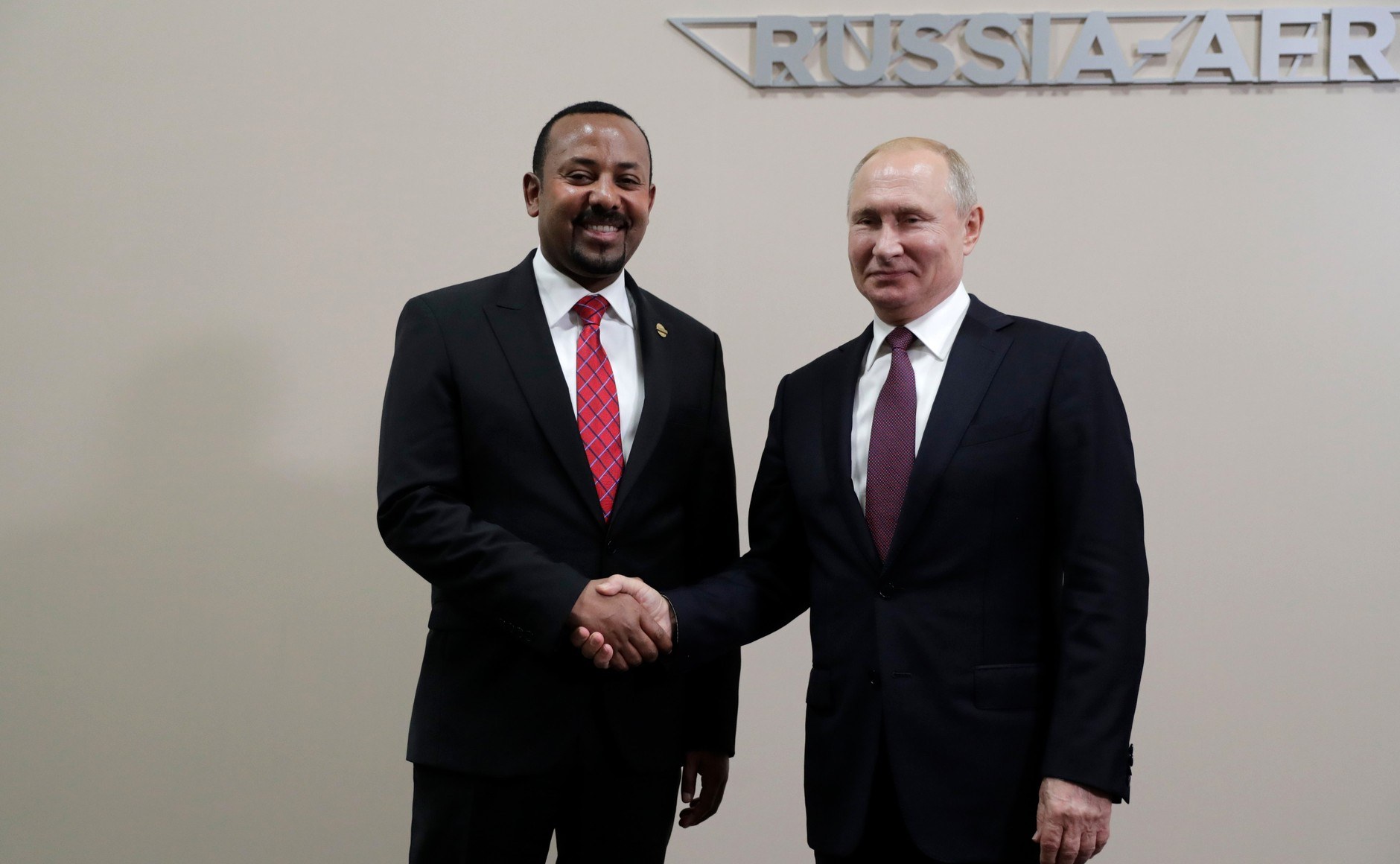
Prime Minister Abiy Ahmed, who is attending the Russia-Africa summit in Moscow, described the acquisition as a “milestone” that would strengthen Ethiopia's defences. He said the deal had been agreed with Russia several years ago, that the aircraft had arrived ahead of schedule, and that Ethiopia also planned to acquire four S-400 air defence systems from Moscow.
Abiy said the military hardware was essential to protect the country from external threats. “If we fail to build this capability, surviving as a country in our region will become difficult,” he said. “Countries with sufficient preparation are not easily defied.”
‘A close friend of Ethiopia’
The Ethiopian leader described Russian President Vladimir Putin as “a close friend of Ethiopia” and said his country had become the first in sub-Saharan Africa to own this kind of “advanced combat technology”.
Russia and Ethiopia have signed several military agreements in recent years, including a 2021 deal on training and improving military technology. Abiy said the decision to buy Su-35 jets and S-400 systems had been driven by global air force trends and the security threats facing Ethiopia.
The Su-35 is a twin-engine Russian combat aircraft designed for both air-to-air and air-to-ground missions. Abiy said it could detect and neutralise incoming cruise missiles at distances of up to 200km.
Ethiopia has relied heavily on military drones, including models sourced from Turkey and China, in recent conflicts. “We need to build capacity not only with drones, but also with the fourth generation capabilities of the Su-30 and Su-35,” Abiy said.
‘Preparing for possible wars with other countries’
Military intelligence analyst Qalaab Segatu told BBC Amharic that the purchase was a key sign that Ethiopia “was preparing for possible wars with other countries, not just internal conflicts”.
He said the jets were highly manoeuvrable, could cover large areas and carried radars capable of long-range scanning. Combined with the S-400 systems, he said, they would “create a significant capability to protect and defend major cities and critical infrastructure such as the Renaissance Dam, providing key strategic air superiority”.
The Grand Ethiopian Renaissance Dam on the Blue Nile, Africa's largest hydroelectric project, has been a source of long-running tension with Egypt and Sudan downstream, which fear for their water supplies.
Fighting returns to Tigray
The arrival of the aircraft comes after a new conflict broke out last month in northern Tigray between the federal government and the Tigray People's Liberation Front (TPLF), the party that controls the region.
The two sides fought a devastating civil war from 2020 until a peace deal signed in Pretoria in November 2022. Each now accuses the other of violating that agreement.
Ethiopia accuses neighbouring Eritrea of backing the TPLF, which Eritrea denies. Ethiopia has also warned that it will defend itself after reports of Eritrean troops crossing the border.
The question of the sea
Relations between the two countries have been further strained by Abiy's description of Ethiopia's lack of direct access to the sea as an “existential question”. Eritrea, which gained independence in 1993 after a decades-long war that left Ethiopia landlocked, views such statements as a direct threat to its sovereignty.
Diplomats and analysts have warned that a renewed war in Tigray could draw in Eritrea and destabilise the wider Horn of Africa, a region that sits beside some of the world's busiest shipping lanes in the Red Sea.
Wider implications
Ethiopia's purchase also has implications beyond the region. Under a 2017 US law known as CAATSA, countries that make significant purchases of Russian weapons risk American sanctions; Washington used the law against Turkey in 2020 over its own purchase of the S-400. There has been no indication so far of how the US or European governments will respond to Ethiopia's deal.
For Moscow, the deliveries showcase its growing security partnerships in Africa, which have been a central theme of the Russia-Africa summit. For Addis Ababa, they mark a shift from a drone-led air war to a conventional air force able to contest the skies — at a moment when the risk of a wider conflict is rising.