
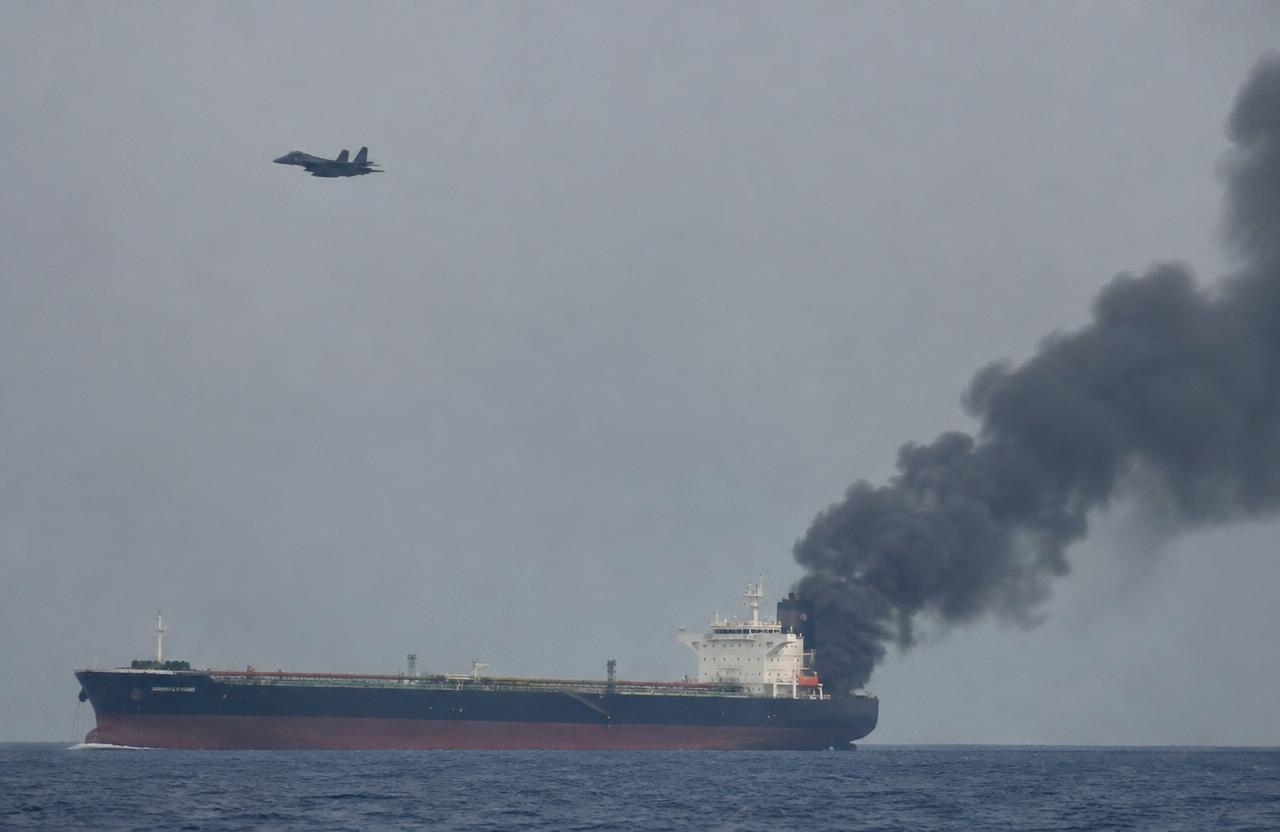
A US fighter jet has struck a commercial cargo ship attempting to break Washington's naval blockade of Iran, as fires broke out on tankers in the Strait of Hormuz in one of the most dangerous nights for shipping in the region for months.
US Central Command (Centcom) said the jet hit the stern of the Panama-flagged Ocean Molika, also known as the Arika Sun, with a precision munition on Saturday, "fully disabling the ship's propulsion without harming the crew".
The vessel had departed an Iranian port and was attempting to transit regional waters after its crew "ignored repeated warnings", Centcom said in a statement on Sunday.
Blockade enforced with live fire
Video footage released by Centcom showed an explosion erupting from the rear of the ship, sending a plume of smoke into the air that briefly obscured the vessel.
The strike marks the latest escalation of a campaign that began with ships being turned away and is now being enforced with live fire. Since the blockade resumed on 14 July, US forces say they have disabled four commercial vessels and turned around 135 more. The restrictions apply to ships entering or leaving Iranian ports.
Washington says the blockade is intended to cut off revenue and supplies to Tehran. Iran has condemned it as piracy and a violation of international law, and has warned that it will defend its shipping.
Tanker set ablaze
Separately, the UK Maritime Trade Operations (UKMTO) centre reported that an outbound tanker was struck by an unknown projectile in the Strait of Hormuz at 11.20pm UAE time on Saturday, causing a fire on board. All crew members were reported safe.
UKMTO also reported an incident involving a tanker and military forces in the Gulf of Oman on Sunday, but gave no further details. It said authorities were aware and that investigations were continuing.
Iran's Islamic Revolutionary Guard Corps Navy offered its own account, claiming that a supertanker carrying crude oil caught fire after striking a naval mine while trying to leave the strait. In a statement carried by Iran's Fars news agency, it said the vessel had entered a designated high-risk area before a powerful explosion. That account could not be independently verified.
The cause of several recent incidents remains unconfirmed, but together they underline how hazardous the waterway has become.
A vital artery under strain
Roughly a fifth of the world's oil normally passes through the Strait of Hormuz, the narrow channel between Iran and Oman. Any disruption ripples quickly through energy markets, shipping insurance and fuel prices far beyond the Gulf.
Shipping companies have been rerouting or delaying voyages, while war-risk insurance premiums for vessels entering the region have climbed sharply. Some operators have suspended Gulf services altogether.
Oil prices have remained firm in recent sessions, with traders citing the risk of further attacks and uncertainty over whether the conflict will widen.
Wider regional tensions
The incidents come as tension rises elsewhere in the region. In Saudi Arabia, the civil aviation authority said 12 people were killed and more than 300 injured in a Houthi attack on Riyadh's King Khalid International Airport. The Saudi-led coalition has vowed to respond.
President Donald Trump said he would "take a look" at joining Saudi Arabia in striking the Houthis and planned to speak to Crown Prince Mohammed bin Salman. Debate in Washington has also turned to whether to resume strikes on Iran itself.
Tehran has not commented directly on the disabling of the Ocean Molika. Iranian officials have previously said that ships trading with Iran are exercising their legal right to free navigation.
Rising risk for crews
Seafarers' unions have warned that crews are being placed in harm's way by a confrontation they have no part in. While Centcom stressed that no one was hurt aboard the cargo ship, the combination of air strikes, projectiles and alleged mines in a busy waterway has raised fears of a mass-casualty incident.
With both Washington and Tehran showing no sign of retreat, the strait looks set to remain the front line of a confrontation that is increasingly being fought at sea.


