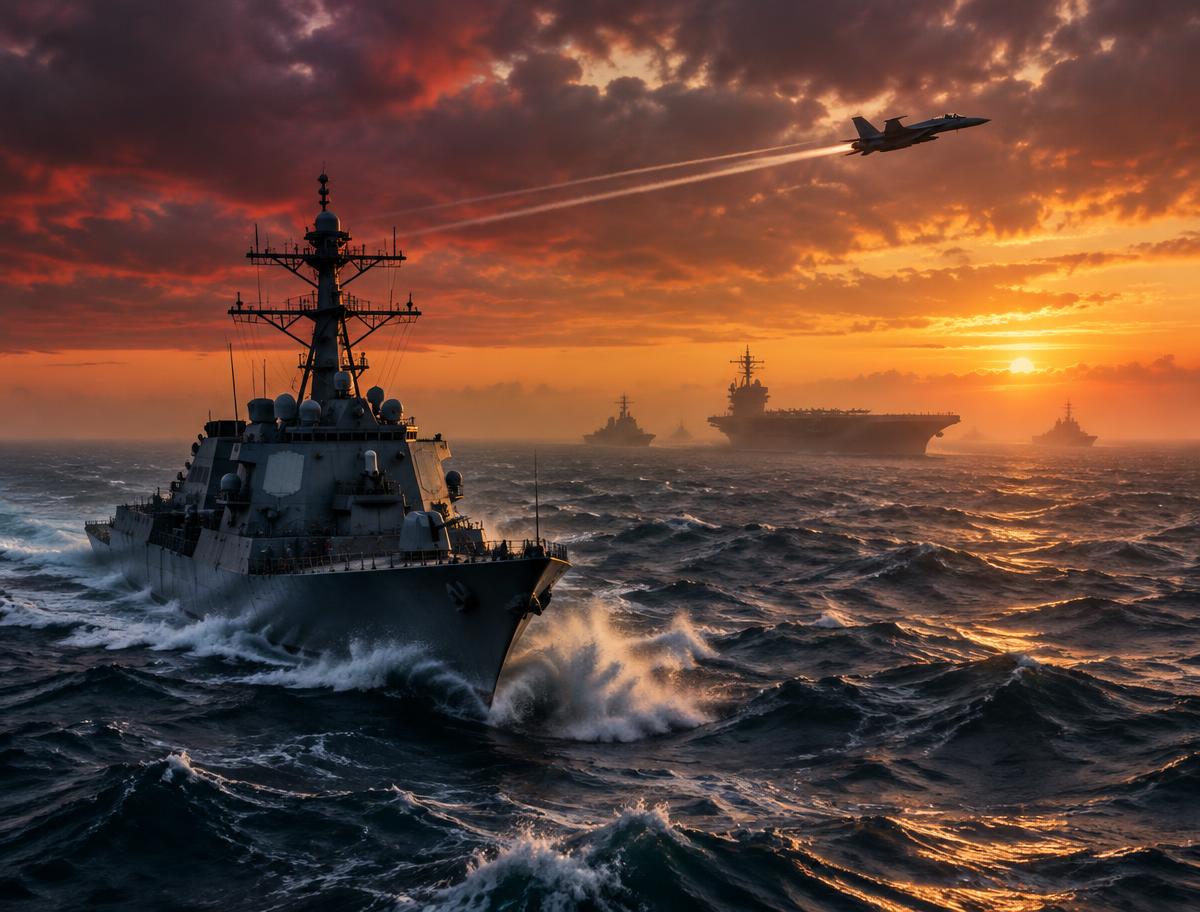
The United States is sending a third aircraft carrier strike group and thousands of additional troops to the Middle East, as President Donald Trump signalled that American military action against Iran could resume after the November midterm elections, with the eight-month conflict remaining in a tense stalemate.
A US official told reporters the USS Theodore Roosevelt carrier group and the Makin Island Amphibious Ready Group, carrying the 13th Marine Expeditionary Unit, had departed from San Diego. The Wall Street Journal reported that the build-up, which US officials said would include between 9,000 and 10,000 additional troops, is expected to be completed by the end of November. Trump has told advisers he expects to resume strikes on Iran that same month if no acceptable agreement is reached, according to the newspaper's reporting.
Speaking to reporters and in an interview with TIME magazine, Trump said he believed Iran was 'ready to fold up' and expressed confidence the United States would prevail in the conflict, saying this could happen 'right after the election', or 'maybe before'. He also said he did not believe lasting peace with Iran was achievable and suggested the US could resume bombing if a satisfactory deal was not reached, telling reporters on 1 October that the choice was to 'blow them up or make a deal'.
Strait of Hormuz dispute
The current phase of the conflict stems from fighting that escalated after a ceasefire memorandum signed by Trump and Iranian President Masoud Pezeshkian on 17 June collapsed. Trump declared that agreement, which had set out terms for a 60-day negotiation period and the reopening of the Strait of Hormuz, to be 'over' on 8 July, after which both sides resumed exchanges of fire, according to the Institute for the Study of War and the Jewish Institute for National Security of America, which have tracked the conflict closely.
Indirect talks on the sidelines of the United Nations General Assembly in New York last month failed to break the deadlock. Iranian Foreign Minister Abbas Araghchi met US negotiators Steve Witkoff and Jared Kushner and proposed fully reopening the Strait of Hormuz within seven days in exchange for the lifting of the US naval blockade, the unfreezing of Iranian assets and sanctions relief, according to the Soufan Center, a US-based research organisation. Trump rejected the proposal, and Araghchi left the United States without a counteroffer, the group said. Officials from both countries have indicated further talks are possible in the coming weeks.
Appearing on NBC's 'Meet the Press', Araghchi said Iran was 'fully prepared for the time for the war to be resumed... even if it comes to a doomsday war', reflecting the hardened rhetoric on both sides. Iran's government maintains that the US naval blockade, which it says has depressed its oil exports and economy, must be lifted before it will agree to further concessions, while US officials say they are now focused on securing substantial nuclear concessions from Tehran, having concluded that they have succeeded in keeping the Strait of Hormuz open through military means, according to the Soufan Center's analysis.
Wider regional spillover
The conflict has had ripple effects across the region. The Saudi-led coalition fighting Iran-backed Houthi forces in Yemen accused the Houthis of carrying out a drone attack on a power station in Medina, Islam's second-holiest city, which it said knocked out a transformer supplying the Prophet's Mosque while leaving the wider grid intact. The Houthis denied responsibility for the strike. Fighting has also intensified in Yemen's Taiz governorate, where Houthi forces have sought to cut off a key supply route used by government-aligned forces, according to the Institute for the Study of War.
Trump also said Iran could be linked to an attempted attack by a co-pilot who tried to crash a passenger plane travelling from Dubai to Israel, though he offered no further details and said Iran would be hit 'very hard' if investigations confirmed Tehran's involvement. Iran has not publicly responded to the allegation. Separately, the US Treasury widened sanctions to target Iran's automotive and rail sectors, part of a broader sanctions campaign Washington has pursued alongside its military pressure.
Oil markets and economic toll
The continuing conflict has kept oil prices elevated well above pre-war levels, with Brent crude trading near $99 a barrel, according to tracking by JINSA. Analysts say the US naval blockade and continued fighting around the Strait of Hormuz, a critical chokepoint for global oil shipments, remain a central driver of market uncertainty. Iranian tankers have continued to wait off the coast of Bandar Abbas near the strait, according to Reuters reporting carried by other outlets.
The United States has also deployed additional Patriot missile batteries to Saudi Arabia and Qatar to protect energy infrastructure in the region, according to Axios reporting cited by multiple outlets, underscoring concern among US allies in the Gulf about the risk of wider disruption should the conflict escalate again.
What happens next
With both Washington and Tehran expressing confidence they hold the advantage, diplomats quoted by the Soufan Center say a durable resolution remains elusive in the near term. The US military build-up is due to be completed by the end of November, around the same time Trump has suggested strikes could resume if talks fail. Iranian officials have in turn warned they could target US interests beyond the Middle East to deter renewed American action, a threat US officials are treating seriously, according to the Institute for the Study of War. Further rounds of indirect talks are expected in the coming weeks, though neither side has signalled a readiness to shift its core demands.