
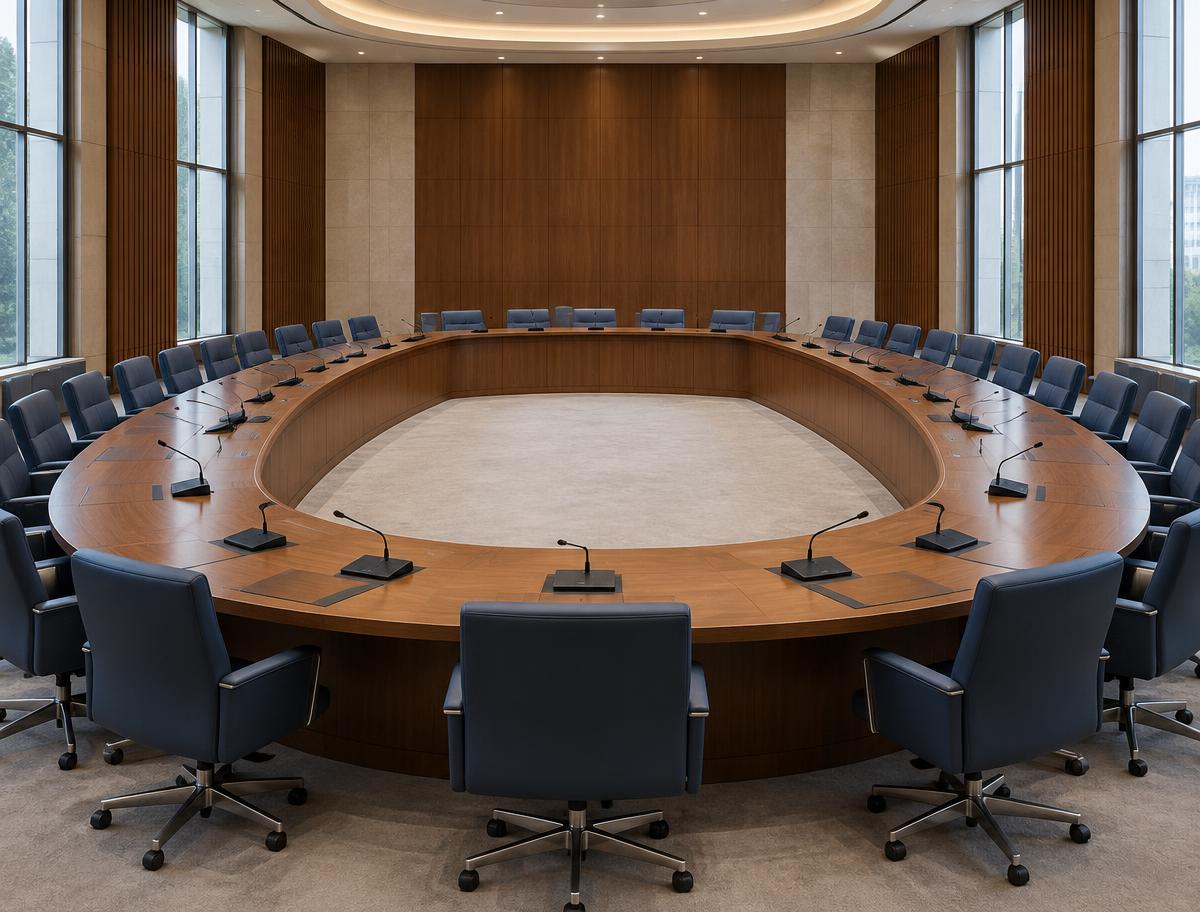
Greece has set out its programme of work for October as it takes over the rotating presidency of the UN Security Council, with debates on children in armed conflict and maritime security scheduled alongside efforts to choose the next UN secretary-general.
Greece’s ambassador to the UN, Aglaia Balta, briefed journalists on the month’s agenda, which includes a session on children affected by armed conflict planned for 26 October and a discussion on the implications of emerging technology for maritime security on 29 October.
A month focused partly on succession
Balta said she hoped October would bring meaningful progress in the process of selecting a successor to Secretary-General António Guterres, whose second term is due to end. Several informal straw polls, in which council members indicate their level of support for declared candidates without casting a binding vote, are expected to take place this month.
These polls are intended to narrow the field and give candidates and their sponsors a sense of where support lies within the council, but they are informal and non-binding. The Security Council’s eventual recommendation of a single candidate is the step that precedes a formal vote by the wider General Assembly, which under the UN Charter makes the final appointment.
The process of selecting a UN secretary-general has in recent decades included greater transparency than in the past, including public hearings with candidates, but the final choice still rests heavily on negotiations among the five permanent members of the Security Council, each of which holds a veto.
Children and armed conflict
The scheduled briefing on children and armed conflict will examine the council’s long-running agenda item on protecting young people caught up in war zones, an issue that has taken on renewed urgency amid conflicts in Ukraine, Gaza, Sudan and elsewhere where children have been killed, injured, recruited by armed groups or deprived of access to education and healthcare.
Maritime security and new technology
The debate planned for late October on maritime security will consider how emerging technologies, including autonomous vessels and cyber capabilities, are changing the risks faced at sea, from piracy to sabotage of undersea cables and attacks on shipping lanes such as those seen in the Red Sea and the Strait of Hormuz in recent years.
A presidency without guarantees
Holding the Security Council presidency allows a member state to set the schedule and chair meetings for the month, and Greece, as a non-permanent member, has used the position to spotlight issues it considers underexamined. But the role carries no power to compel agreement among the council’s fifteen members, several of whom remain divided over how to handle the war in Ukraine and other crises.
What happens next
The published October programme is therefore best understood as a guide to what the council intends to discuss rather than a guarantee of outcomes. Whether the straw polls on the secretary-general produce real momentum, and whether the scheduled debates lead to any new council action, will become clearer as the month progresses.
How the rotating presidency works
The presidency of the UN Security Council rotates monthly among its 15 members, in English alphabetical order of their country names, giving each member state, whether permanent or temporarily elected, an opportunity to set the council’s agenda and chair its formal and informal meetings for that month. While the presidency carries prestige and the ability to prioritise certain issues for discussion, it does not grant the holding country any additional voting power or the ability to override the positions of other council members, including the five permanent members who each retain a veto.
Greece currently holds one of the council’s ten non-permanent seats, elected by the wider UN General Assembly for a two-year term, a position that smaller and medium-sized states often use to spotlight issues of particular concern to them or to the wider international community that might otherwise receive less sustained attention from the council’s permanent members.
The secretary-general selection process
Choosing a new UN secretary-general is one of the most closely watched processes in international diplomacy, given the influence the position carries over the direction of the organisation. The process formally begins with the Security Council agreeing to recommend a single candidate, a recommendation that requires the backing of at least nine of the council’s 15 members and, crucially, no veto from any of the five permanent members: the United States, United Kingdom, France, China and Russia.
In recent selection cycles, informal straw polls conducted among council members have played a significant practical role in narrowing the field, even though they are not part of the UN Charter’s formal procedure and carry no binding weight. Candidates whose straw poll support is weak, particularly if a permanent member signals opposition through a discouraging vote, often withdraw or lose momentum well before any formal vote takes place, making the polls a closely watched barometer of where real support lies.
Guterres’s second term as secretary-general runs out at the end of this year, meaning the Security Council faces pressure to reach consensus on a successor relatively soon if the transition to a new secretary-general is to proceed smoothly at the start of next year.
Children in armed conflict as a standing council concern
The council has maintained a dedicated working group and reporting mechanism on children and armed conflict for more than two decades, tracking violations including the recruitment of child soldiers, attacks on schools and hospitals, and the killing and maiming of children in conflict zones. Although the mechanism has been credited with raising international awareness and securing some commitments from warring parties, in some conflicts rates of harm to children documented by UN monitors have continued to rise, reflecting the limits of international pressure where parties to a conflict show little willingness to change their conduct.
Maritime security in a changing technological landscape
The planned debate on technology and maritime security reflects growing international concern about threats to global shipping and undersea infrastructure, including attacks on vessels in chokepoints such as the Red Sea and the Strait of Hormuz, and sabotage or suspected sabotage of undersea cables and pipelines in various parts of the world in recent years. Council members are expected to discuss how existing international maritime law and cooperation frameworks may need to adapt to address risks posed by autonomous vessels, cyberattacks on shipping and port systems, and other emerging technological threats at sea.


