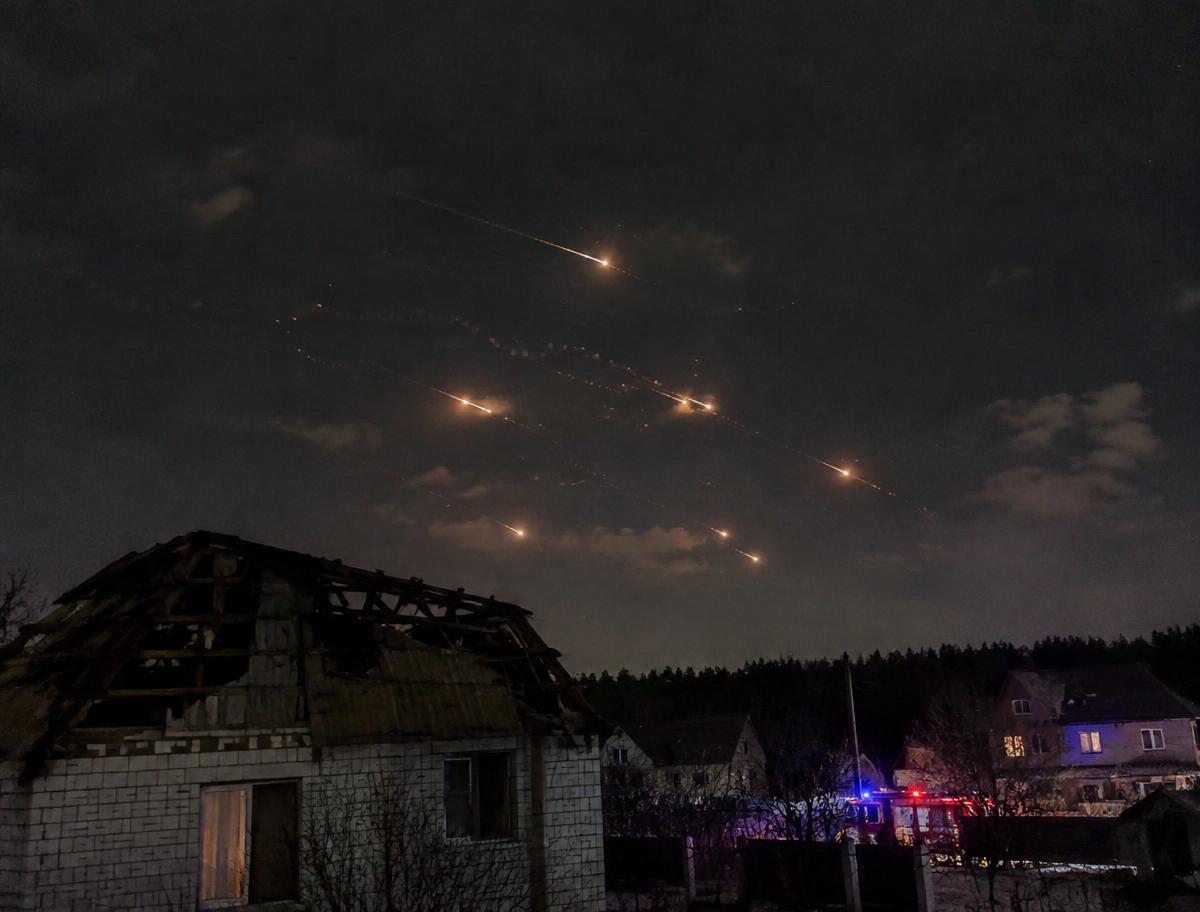
Ukraine launched one of its largest drone attacks on Moscow in two years overnight, killing two people and injuring nine others in the Russian capital region, according to Russian officials.
Moscow mayor Sergei Sobyanin said on Telegram that 650 drones had been launched towards the Moscow region, adding that most had been destroyed by air defences at long range.
Russia's state news agency TASS described it as the second largest drone attack on the capital and its surrounding region in the past two years.
Deaths on the outskirts
Moscow region governor Andrei Vorobyov said 185 drones had been destroyed or neutralised over 16 municipalities in the region. He said the attack killed two men, aged 71 and 20, in two different locations on the outskirts of the capital.
Forty-seven houses in seven municipalities were damaged, he said, along with four flats in a residential building in the village of Lobanovo.
The figures could not be independently verified. Ukraine did not immediately comment on the specific targets of the overnight operation, though it has previously said its long-range strikes are aimed at military, energy and industrial facilities supporting Russia's war effort.
Airports disrupted
Operations at Moscow's four airports were disrupted by the attack. Russia's civil aviation agency, Rosaviatsia, said air traffic restrictions were imposed several times through the night and into the morning.
Such disruption has become a recurring feature of the war. Airport closures cause delays for thousands of passengers and serve as a reminder to Russians in the capital, hundreds of kilometres from the front line, that the conflict can reach them directly.
A war of long-range strikes
Both Ukraine and Russia have stepped up long-range strikes in recent months, hitting civilian and industrial targets including energy, transport and port infrastructure.
Russia has repeatedly carried out large-scale missile and drone attacks on Ukrainian cities, damaging power stations and homes and killing civilians. Moscow says its strikes target military and military-linked infrastructure. Kyiv says Russian attacks deliberately target civilians and the energy system ahead of winter.
Ukraine, in turn, has developed a growing fleet of long-range drones capable of reaching deep inside Russia. In August, an FP-1 drone carrying up to 100kg of explosives was launched from the Poltava region to target a logistics warehouse in the Moscow region. Kyiv argues that such strikes are a legitimate response to Russia's invasion and aim to degrade its ability to wage war.
The Kremlin describes Ukrainian attacks on Russian territory as terrorism and has vowed to respond. Ukraine rejects that characterisation, saying it is defending itself against an invasion that began in February 2022.
The human cost on both sides
Whatever the targets, civilians continue to bear much of the cost. The two men killed on the outskirts of Moscow join a long list of civilians who have died far from the battlefields, on both sides of the border.
The scale of the attack, with hundreds of drones in a single night, underlines how the war has evolved into a contest of mass-produced, relatively cheap weapons and the expensive air defence systems needed to stop them. Each side is racing to produce more drones and to find new ways of intercepting the other's.
Diplomatic efforts to end the war have so far failed to produce a ceasefire. Until they do, overnight attacks of this kind, on Moscow and on Ukrainian cities alike, are likely to continue, with each escalation raising fears of a further response.
Military analysts note that even when most drones are shot down, mass attacks can strain air defences, exhaust interceptor stocks and force costly disruption to normal life. That logic applies to both countries, which is why each continues to invest heavily in drones and in the means to counter them.
For residents of the Moscow region, Tuesday brought damaged homes, disrupted flights and two funerals. For both countries, it brought another sign that the war is far from over.