
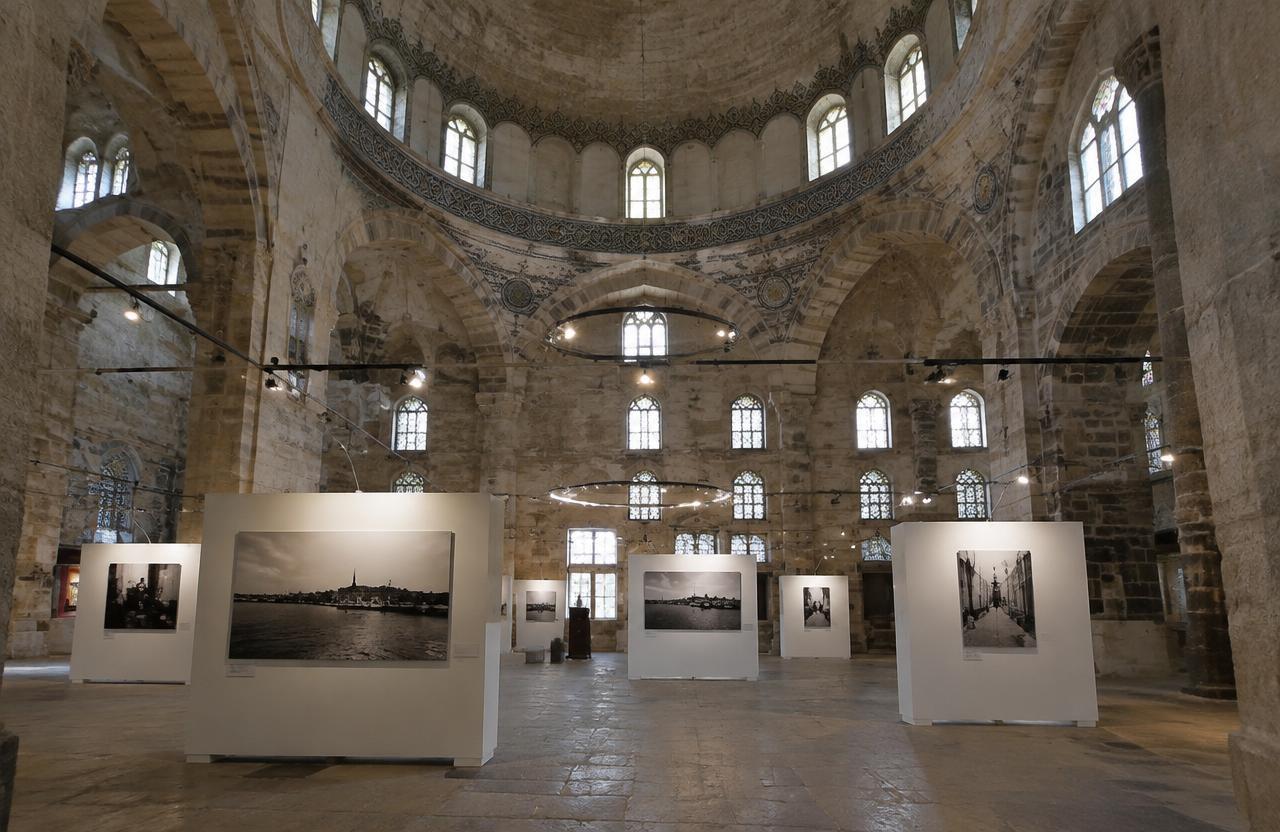
One of the most remarkable Ottoman buildings in the Balkans has reopened to the public in the Greek city of Thessaloniki, after nearly two decades of painstaking conservation work.
The 15th-century Hamza Bey Mosque, widely known locally as Alcazar, opened its doors last weekend as an exhibition space and cultural centre.
Five centuries of history
The mosque was commissioned in 1467 by the daughter of the Ottoman admiral Hamza Bey. A century later it was expanded to include a portico, a minaret and a four-sided courtyard, making it architecturally exceptional among mosques in the wider Balkan region.
It was later damaged by fires and earthquakes and rebuilt in 1620, when a madrasa, or religious school, was added.
Following the population exchange between Greece and Turkey in 1923, in which around two million people were forcibly moved on the basis of their religion, the building ceased to function as a mosque. It became the property of the National Bank of Greece and briefly housed a military barracks.
For much of the 20th century it served commercial purposes, including as a cinema, from which its popular name Alcazar is said to derive.
A long restoration
The former mosque, which stands at the busy junction of Egnatia and Venizelou streets in the city centre, came under the protection of the Greek culture ministry in 2006. Structural stabilisation began the following year.
The final phase of work, supported by the European Recovery Fund, took place between 2024 and 2026 and completed all the interior and exterior conservation needed for the building's new role.
A new purpose
The site will now be run by the Metropolitan Organisation of Museums of Visual Arts of Thessaloniki (MOMus), with some decisions taken jointly with the city's Ephorate of Antiquities.
It will operate as a permanent exhibition space as well as a cultural centre hosting heritage-themed events and activities.
The opening exhibition
Fittingly, the first exhibition looks at a city in transformation. Thessaloniki: The Footprint of Transition (1960-1980), through the photographs of Pete Marifoglou, offers a visual journey through two decades of rapid modernisation.
In the black-and-white images, according to the organisers, the city "is revealed as a living organism in transition, where tradition coexists and clashes with the new".
The exhibition is divided into three thematic sections, each representing part of the mosaic of the city, the main cultural and economic hub of Greek Macedonia.
A city of many layers
Thessaloniki has one of the richest multicultural histories in Europe. Over the centuries it has been home to large Greek Orthodox, Jewish and Muslim communities, and its streets are layered with Roman, Byzantine and Ottoman monuments.
The city was also the birthplace of Mustafa Kemal Atatürk, the founder of modern Turkey, whose childhood home is now a museum.
Restoring Ottoman monuments in Greece has sometimes been politically sensitive, given the long and difficult history between the two countries. Heritage experts say giving such buildings a new public use is one of the best ways to protect them for future generations.
Why it matters
The reopening of Hamza Bey adds a major new cultural venue to the heart of Thessaloniki and returns a landmark that many residents have walked past for years without being able to enter.
Conservators faced the challenge of preserving traces of each phase of the building's long life, from its Ottoman decoration to later alterations made when it served commercial uses, while making the interior suitable for exhibitions and visitors.
The minaret, like many in Greece, did not survive, but the portico and the main prayer hall beneath its dome have been carefully restored.
For visitors, it offers the chance to stand beneath a dome that has watched over the city for more than five centuries, and to see, in Marifoglou's photographs, how much the streets outside have changed.


