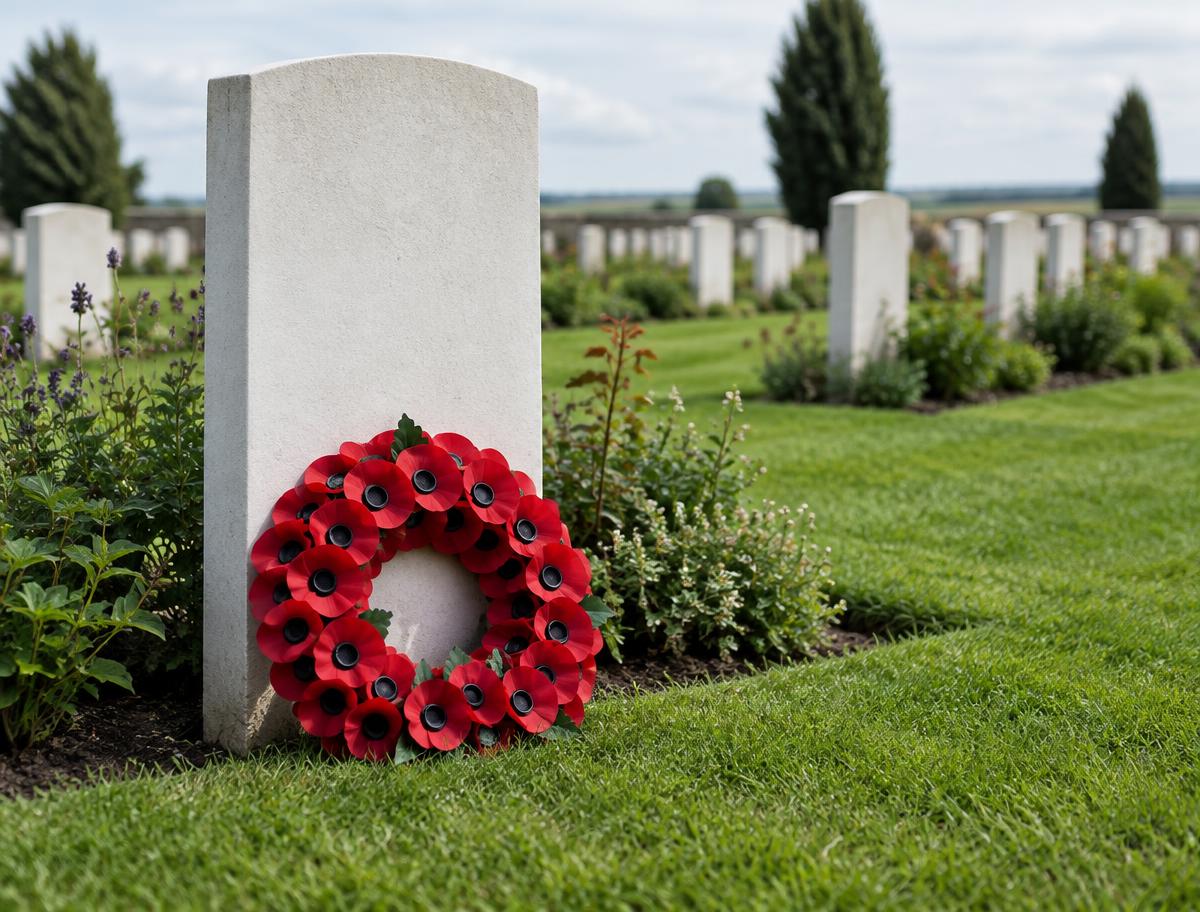
Two identified Scottish soldiers and four of their unknown comrades from the First World War have been buried with full military honours in France, 108 years after they were killed during the German Spring Offensive of 1918.
Relatives gathered at the graveside as Private George Fleming Brock and Private Percy Todd, both of the 11th Battalion, Argyll & Sutherland Highlanders, were laid to rest alongside the four unidentified soldiers, with serving personnel from the 4th Battalion The Royal Regiment of Scotland bearing the coffins.
Who the soldiers were
Private Brock, from Dunipace in West Falkirk, had been serving an architectural apprenticeship with the Stirling firm Messrs Bruce & Livingston before enlisting in June 1916. He was seriously wounded by gunshot only a month after joining his battalion in France and spent months recovering in hospital before rejoining in January 1918.
Two months after he rejoined, Germany launched its major spring offensive on the Western Front. On 28 March 1918, Brock’s battalion was holding positions near Tilloy-les-Mofflaines, close to Arras, when it was overwhelmed by intense bombardment. Brock was killed that day, aged just 19.
Private Todd, originally from Radford, Nottinghamshire, had been working as a draper’s manager at Bryan’s Drapery in Isleworth, London, before he enlisted in November 1915.
How the remains were found and identified
According to reporting on the service, the six soldiers were recovered during an archaeological survey at Tilloy-les-Mofflaines in 2023. Artefacts found alongside the remains, including regimental insignia linked to the Argyll & Sutherland Highlanders and the Gordon Highlanders, helped narrow the identification process.
The identification work was carried out by the Ministry of Defence’s Joint Casualty and Compassionate Centre, known informally as the “MOD War Detectives,” who used a combination of historical research and DNA testing to confirm the identities of Brock and Todd. The four other soldiers could not be conclusively identified, though evidence suggested one had served with the Argyll & Sutherland Highlanders and the other three likely served with the Gordon Highlanders.
A continuing effort to find the missing
The burial is part of a long-running programme by the MOD and the Commonwealth War Graves Commission to locate, identify and formally bury British and Commonwealth service personnel whose remains are still being uncovered more than a century after the First World War, often during construction or agricultural work in former battlefield areas of France and Belgium.
Similar services have taken place in recent years, including the burial of eight Scottish soldiers at Loos British Cemetery Extension in September 2025 on the 110th anniversary of their deaths, and the reburial of four Grimsby soldiers near Lens in October 2025, underlining how frequently remains from the war continue to be discovered.
What happens next
The MOD’s war detectives said that with an estimated half a million servicemen from the First and Second World Wars still unaccounted for, each successful identification is considered a significant achievement. Further burials are expected to follow as more remains are discovered and researched in the years ahead.
The Spring Offensive of 1918
The German Spring Offensive, also known as the Kaiserschlacht, was launched in March 1918 and represented Germany's last major attempt to win the First World War on the Western Front before American troops could arrive in large enough numbers to tip the balance decisively in the Allies' favour. The offensive initially achieved significant territorial gains against overstretched British and French lines, including the positions near Arras and Tilloy-les-Mofflaines where the Argyll & Sutherland Highlanders were overwhelmed, before Allied forces eventually stabilised the front and began the counteroffensives that led to Germany's defeat later that year.
The Argyll & Sutherland Highlanders
The regiment, recruited largely from Argyll, Stirlingshire and the surrounding areas of western and central Scotland, raised numerous battalions during the First World War and suffered heavy casualties across multiple major engagements, from the early battles of 1914 and 1915 through to the Spring Offensive in 1918. The 11th Battalion, in which both Private Brock and Private Todd served, was one of several Kitchener's Army battalions raised specifically for wartime service rather than drawn from the regiment's pre-war regular or territorial units.
The work of the War Detectives
The Ministry of Defence's Joint Casualty and Compassionate Centre, established to handle both historic and contemporary casualty cases, continues to investigate reports of newly discovered remains from both world wars, often prompted by construction projects, farming activity or deliberate archaeological surveys in former battlefield areas of France and Belgium. The identification process typically combines archival research into unit movements and casualty records with forensic techniques including DNA analysis, matched where possible against samples provided by descendants traced through genealogical research.
The scale of the unresolved
Historians estimate that hundreds of thousands of British and Commonwealth service personnel from the First and Second World Wars remain without a known grave, a legacy of the industrial scale of casualties in both conflicts and the often chaotic conditions in which battlefield burials took place. The Commonwealth War Graves Commission maintains cemeteries and memorials across the world listing the names of the missing, with soldiers whose remains are later identified moved from a 'known unto God' headstone to one bearing their full name and details, a change that can carry deep significance for descendants who may have waited generations for closure.
A recurring pattern of discovery
The Tilloy-les-Mofflaines find is one of several similar discoveries in recent years across the former Western Front, often coinciding with infrastructure or agricultural work that disturbs ground untouched since the war. Such finds frequently include groups of soldiers buried together, reflecting the hurried battlefield burial practices common during periods of intense fighting, when units often had little time to record individual burial locations accurately.
Why these ceremonies continue
Military tradition places significant weight on ensuring that no service member is forgotten, however long after their death, and formal reburial ceremonies with full military honours are intended to reflect that commitment regardless of the passage of time. For regiments such as the Argyll & Sutherland Highlanders, now amalgamated into the Royal Regiment of Scotland, these ceremonies also serve to connect serving soldiers with the history and sacrifice of their forebears.