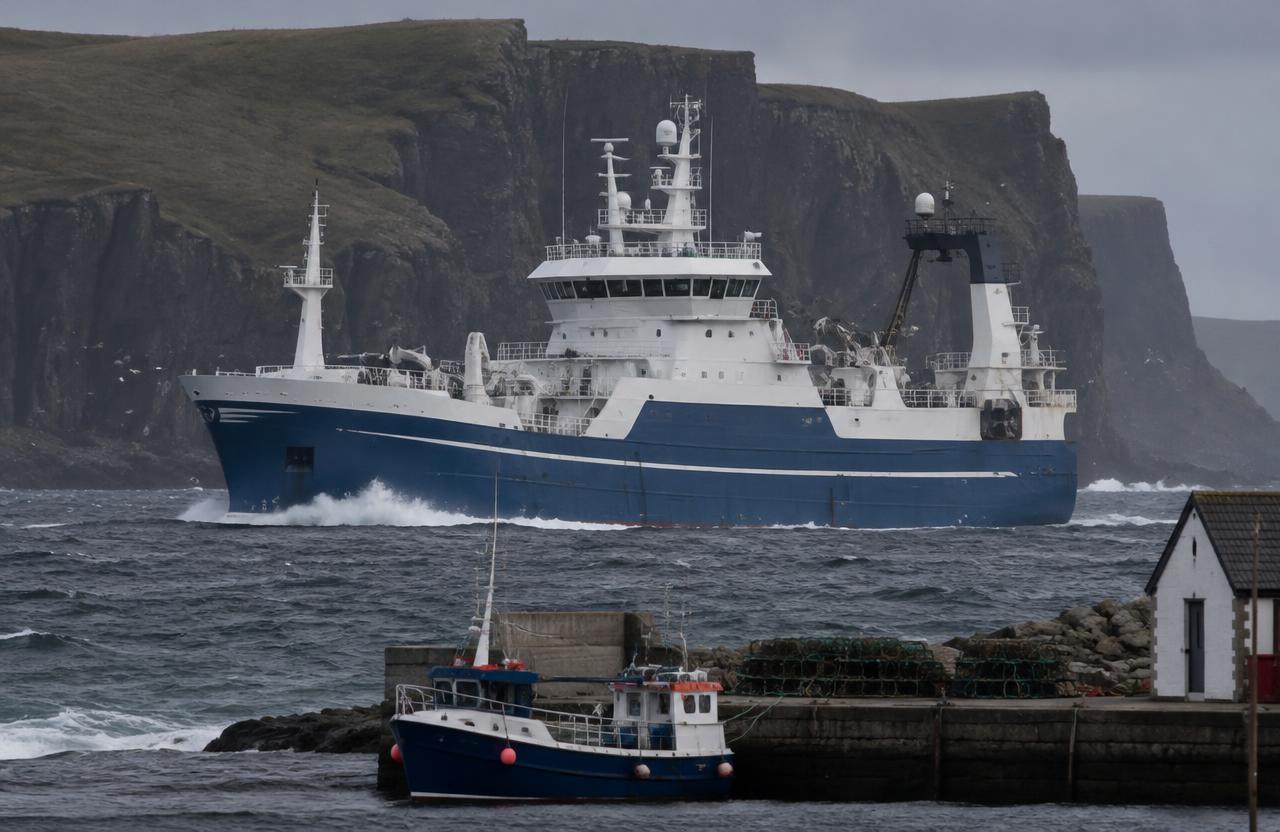
Shetland's fishermen have demanded urgent government action after a single Norwegian trawler landed more than half the islands' annual saithe quota from one fishing trip in the waters around the isles.
The Shetland Fishermen's Association (SFA) said the 70-metre freezer trawler Havstrand landed 787 tonnes of saithe at Ålesund, in Norway, on 17 August after fishing close to Shetland.
According to the association, that one catch was equivalent to nearly 12% of the UK's entire North Sea saithe quota for 2026.
The figures have sharpened anger in island communities that have already been asked to accept deep cuts to their own catches of the same species.
Cuts at home
Scottish fishermen have seen their saithe quota reduced by 25% this year, falling to 6,746 tonnes from 8,940 tonnes in 2025. A further cut of about 20% has been proposed for next year as scientists press for the stock to be protected.
The SFA said the Havstrand landing was "a stark illustration of a much wider imbalance in the fishing access arrangements between the UK and Norway".
Under the current deal, each country may catch up to 30,000 tonnes of whitefish in the other's waters. But the association says the arrangement works far more in Norway's favour in practice.
In 2025, Norwegian vessels caught 22,581 tonnes of whitefish in UK waters, compared with 9,496 tonnes caught by UK boats in Norwegian waters. Provisional figures show Norwegian vessels took 16,514 tonnes of saithe alone in the UK zone, against just 2,064 tonnes landed by UK vessels from Norwegian waters.
Norwegian saithe catches in UK waters almost doubled between 2024 and 2025, with much of that effort concentrated around Shetland.
'A wake-up call'
SFA executive officer Daniel Lawson said the figures should be "a wake-up call for both the UK and Scottish governments".
"At a time when our own fishermen are being asked to accept substantial quota reductions to protect fish stocks, enormous Norwegian freezer trawlers are being allowed to catch vast quantities of the same fish in the waters around Shetland," he said.
"One Norwegian vessel has landed more than half Shetland's entire annual saithe quota in a single trip. That ought to make everyone stop and question whether the present arrangements are serving the interests of Scotland's fishing communities."
Mr Lawson stressed that the islands' fishermen were not accusing the Norwegian crews of wrongdoing. "Nobody is suggesting that the Norwegian vessels are breaking the rules," he said. "The question is whether those agreements are fair, sustainable or remotely in the interests of our fishing communities."
Owner disputes the figure
The trawler's owner, Janne Grethe Strand Aasnæs, has disputed the association's calculation. She told the Norwegian fishing newspaper Kyst og Fjord that the Havstrand had landed 606 tonnes of round saithe, and that the catch was within the share allocated to Norwegian vessels.
The difference reflects, in part, the way fish are weighed and recorded once processed on board large freezer vessels – a technical point that has become central to the dispute.
Talks ahead
The SFA wants the reciprocal access arrangement reviewed and a lower ceiling set that reflects what UK boats actually catch in Norwegian waters. It is also calling for stronger monitoring and enforcement at sea by the Scottish government.
The Department for Environment, Food and Rural Affairs said consultations with Norway on next year's arrangements were due later this autumn.
The annual talks between the UK, Norway and the EU on shared North Sea stocks usually conclude in December, setting quotas and access rights for the following year.
For Shetland, where fishing supports hundreds of jobs at sea and in processing factories ashore, the outcome matters enormously. The islands land more fish than any other port area in the UK, and the industry is woven into almost every community from Lerwick to Whalsay and Scalloway.
Skippers say they will be watching closely to see whether ministers are willing to take a tougher line when they sit down with their Norwegian counterparts in the weeks ahead.