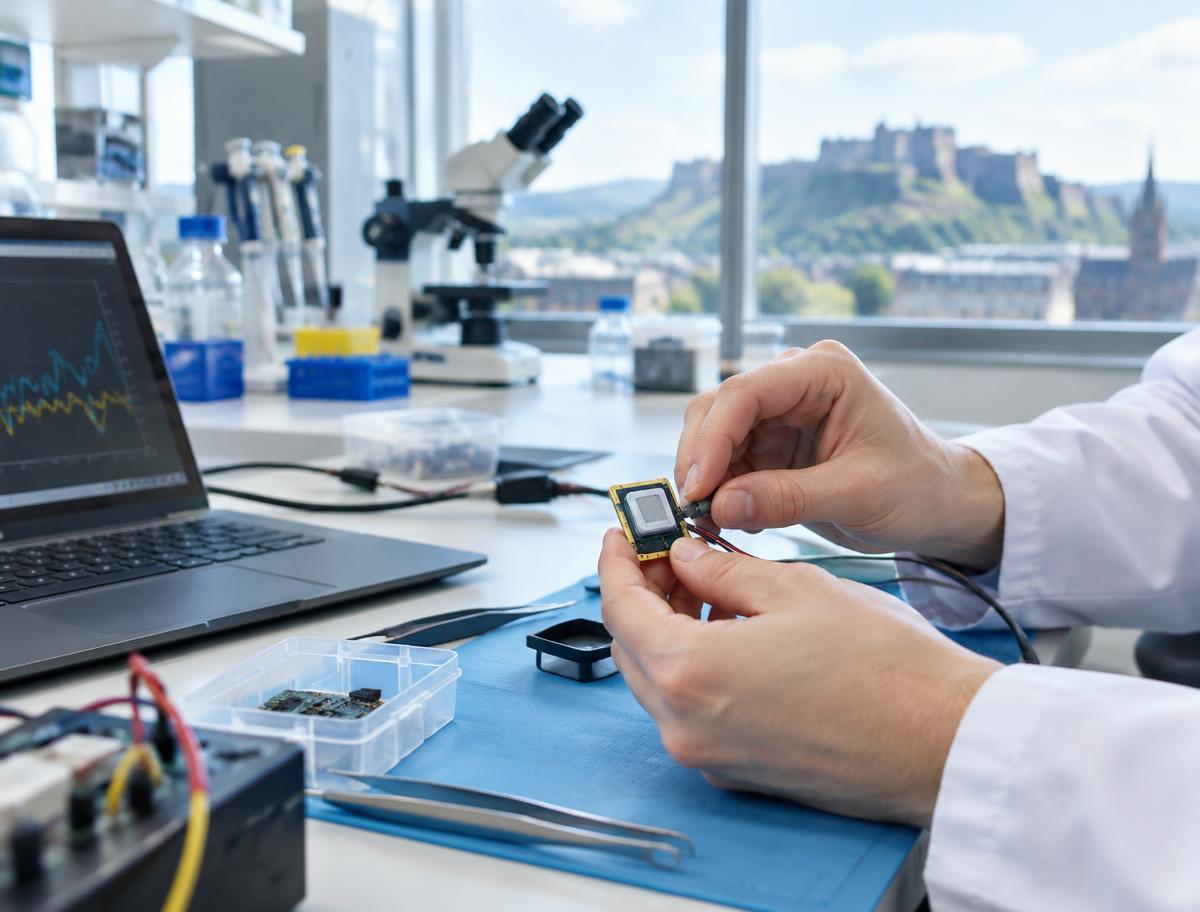
Seventeen research projects at seven Scottish universities are to share £2.92 million to test whether their work can lead to commercial products and businesses. The Scottish Government announced the latest awards from its Proof of Concept fund on 2 October, naming potential applications ranging from Parkinson's disease monitoring to marine data collection and a test for gastrointestinal disorders.
The money is directed at an early stage of the spinout process. It can pay for prototype development, market analysis and preparing pitches to investors. It is not an announcement that 17 companies have been launched, that any device has received medical approval, or that a product is ready for customers.
Projects crossing medicine and environmental science
Kinera, a project at Heriot-Watt University, is developing a wearable monitoring device for people with Parkinson's disease. The government says its purpose is to help clinicians make more personalised treatment decisions. The announcement describes the aim of the work but does not provide clinical trial results, a launch date or a claim that the device is already in routine use.
At the University of St Andrews, Merra-log is developing a lower-cost environmental monitoring system designed to collect and transmit marine and freshwater data in near real time. Those are different settings from a medical clinic, but the commercial question is similar: can a research concept be developed into something that users can deploy and maintain outside a university project? The government has not published a customer list or sales figures for Merra-log.
Scensai at the University of Aberdeen is working on an affordable handheld chemical-sensing device for the drinks industry. Another Aberdeen project has received a specific award of £124,000 for work on a simple lateral-flow test for chronic gastrointestinal disorders. The latter project will develop and validate prototype tests with potential use in primary care, according to the government announcement.
The Aberdeen test project is led by Dr Sergio Dall'Angelo. He said the support could bring the team closer to a practical test that might offer patients earlier answers and help clinicians make more targeted treatment decisions. Those remain research objectives: the announcement does not establish that the test has been validated for clinical use or that it will replace existing investigations.
Why universities need proof-of-concept support
A scientific idea may be promising without having a working prototype, a reliable production process or evidence that prospective users will adopt it. The Proof of Concept fund is intended to address that interval, allowing teams to test feasibility and commercial potential before they seek larger investment. The range of funded work this year includes health, environmental monitoring and industrial sensing rather than a single technology category.
The fund began as a pilot in 2025–26, when 18 projects shared £2.95 million. With the latest £2.92 million allocation, the government says its investment over the two years is nearly £6 million. The number of projects differs slightly between the two rounds, and the totals are awards to research teams, not a count of successful future companies.
Economy, Tourism and Transport Secretary Stephen Flynn said Scotland's universities had produced ideas and inventions with worldwide impact and argued that new research should continue to receive support. That is the government's case for the spending. The announcement does not provide an independent assessment of the eventual economic return from the latest group of grants.
The pilot year's Glasgow example
To illustrate what earlier support enabled, the government highlighted the Critical Technologies Accelerator at the University of Glasgow. It received £125,000 in 2025–26 to develop a new coupler design for silicon-photonic microchips. Research Fellow Andrew Greer said the award helped the team work through what he called the 'valley of death' between academic research and an industrial application.
Greer said the project had doubled its grant income since that award, developed a foundry scale-up process and begun delivering demonstrators with commercialisation partner STL Tech. The account is from a researcher involved in the funded project, not a third-party evaluation of its financial performance. Demonstrators and an invitation to pursue a higher-growth spinout programme are steps along a development path, not proof that mass production has begun.
The next test for the 2026 projects
The current awards give the 17 teams resources to investigate whether their ideas work beyond the laboratory and have a plausible route to market. For the medical projects, that distinction also matters to patients: a proposed monitoring device or prototype test should not be confused with an available, clinically approved service. For the environmental and industrial projects, technical performance and user demand still have to be demonstrated.
The Scottish Government's release identifies examples from this year's awards but does not publish outcomes for the projects that have just received funding. Whether any eventually becomes a viable company will depend on work that follows these grants, including testing, investment and, where necessary, regulatory approval.