
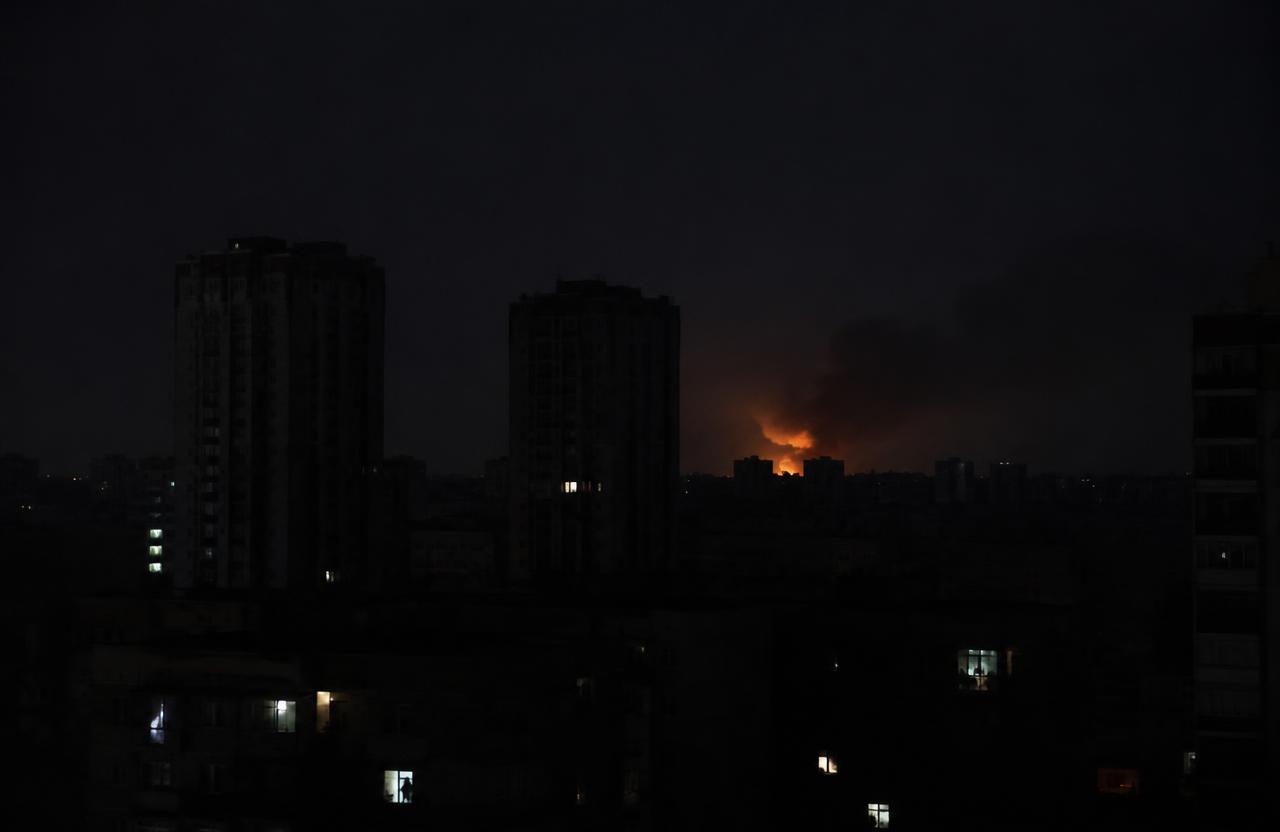
At least 600,000 people across Ukraine have been left without electricity after a large overnight Russian missile and drone attack, President Volodymyr Zelensky has said, just days after Donald Trump declared an "energy ceasefire" between the two countries.
Zelensky said "critical" energy infrastructure had been hit in Kyiv and the surrounding region, as well as in the north-eastern city of Kharkiv.
In Kyiv, at least three people were killed and 21 injured, according to Ukraine's state emergency service. Other reports put the overall death toll across the country at six or more.
Rival accounts
Russia's defence ministry described its strikes as "massive" and said they had targeted communications and energy facilities in the Kyiv and Kharkiv regions that were being used by Ukraine's military.
It also said its air defences had shot down 902 Ukrainian drones overnight over several Russian regions, including Moscow and Crimea, the peninsula Russia annexed from Ukraine in 2014.
Ukraine's air force said Russia had launched 39 ballistic and cruise missiles and 128 drones, of which four missiles and 115 drones were shot down. The figures from both sides could not be independently verified.
A ceasefire in doubt
On Sunday, Trump had announced on social media: "Effective immediately, there is an ENERGY CEASEFIRE in the War between Russia and Ukraine. Both parties have agreed. Do not break it!"
Zelensky has since repeatedly said Ukraine is ready to halt its attacks on Russian oil refineries and other energy facilities if Moscow does the same.
But Russia's foreign minister, Sergey Lavrov, has said Ukraine does not deserve the "respite" a ceasefire would bring. He argued that under any truce Europe would be able to "pump [Ukraine] with new weapons" to continue the war.
The overnight attacks raise serious questions about whether any energy truce exists in practice, and whether either side regards it as binding.
Winter fears
The strikes come as temperatures fall across Ukraine. Repeated attacks on the power grid in previous winters left millions facing long blackouts, without heating or running water, and forced the country to rely heavily on emergency generators and electricity imports from Europe.
Energy officials warn that each strike makes repairs harder, as spare equipment runs short and engineers race to restore damaged substations before the coldest months.
In Kyiv, residents again spent the night in shelters and metro stations as air raid sirens sounded. Emergency crews worked through the morning at the site of a damaged residential building.
Ukraine's long-range campaign
Ukraine has in recent months stepped up drone attacks on Russian oil refineries, fuel depots and other energy targets deep inside Russia. Kyiv says these facilities fund and supply Moscow's war effort; Russia describes the attacks as terrorism and says they endanger civilians.
Trump last week demanded that Zelensky stop hitting Russian refineries, as relations between Washington and Kyiv came under strain over a separate deal allowing Russia to supply diesel to world markets.
Diplomacy continues
US envoys have been working on proposals to end the war, with talks involving both sides in recent weeks. Russian state media has reported that American negotiators could visit Moscow soon.
European governments have said they will maintain sanctions on Russia and continue supporting Ukraine's air defences, which they regard as essential to protecting civilians and infrastructure through the winter.
Russia launched its full-scale invasion of Ukraine in February 2022 and currently controls about a fifth of Ukrainian territory.
Humanitarian agencies have warned that older people and families with young children are most at risk when power and heating fail during the winter months.
For now, the night's events suggest that the energy war, fought by both sides with missiles and drones, is far from over, and that the people of Ukraine face another winter in the dark.


