
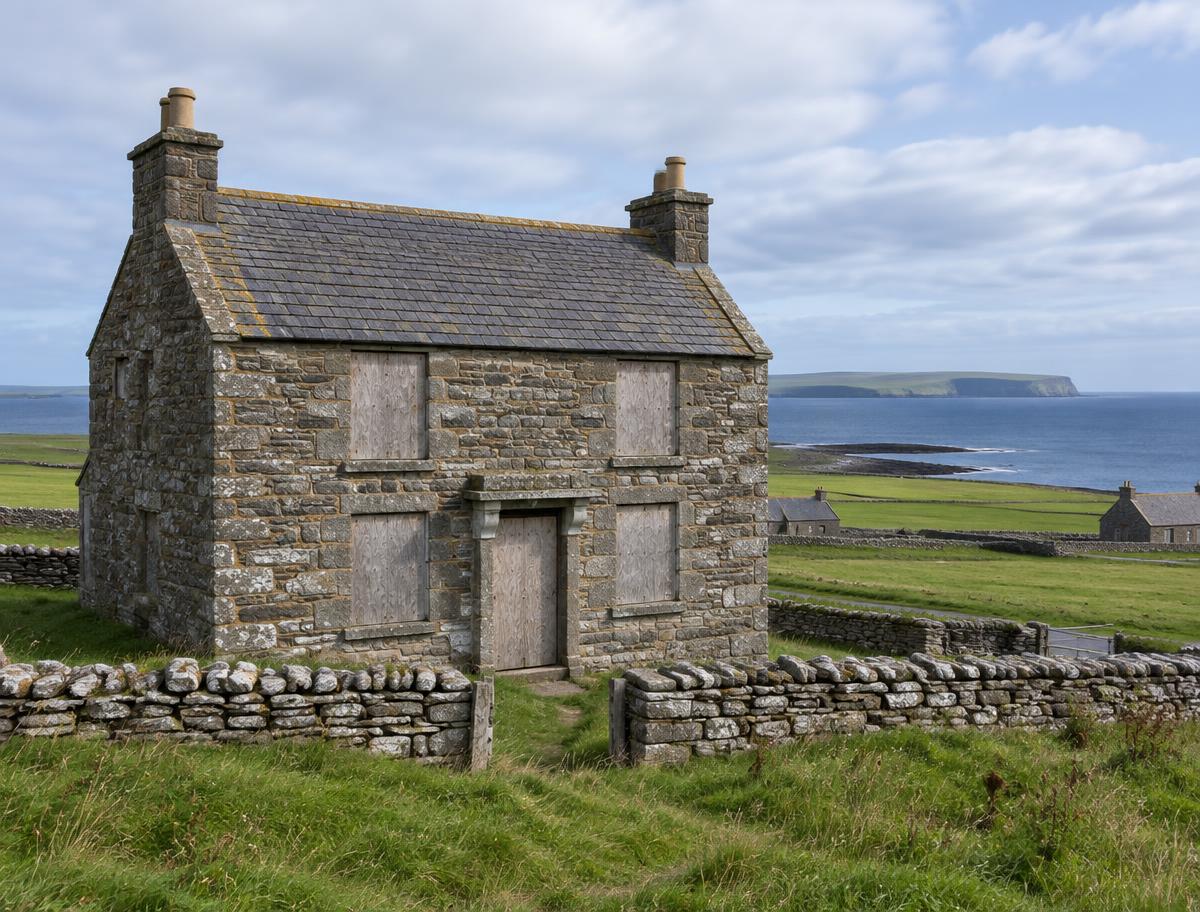
Orkney Islands Council has launched a loan scheme offering up to £25,000 to owners of long-term empty homes, aiming to bring properties back into use for the islands’ essential workers amid what the council describes as a severe housing shortage.
Under the Empty Homes Loan Scheme, owners of homes that have been empty for at least 12 months can apply for a loan to fund repairs and renovation, with the loan secured against the property and repaid over a maximum of five years at an interest rate of 5.5%, described by the council as affordable compared with market rates.
The scale of the problem
According to data published by the Scottish Government in December 2025, 727 properties across Orkney are sitting empty, including 325 that have been empty for six months or more and are liable for council tax, and 402 that currently hold a council tax exemption.
Not all of those properties will be eligible or suitable for the loan scheme, since some will have only recently become vacant or may not meet the criteria set by the council, but the figures illustrate the extent of underused housing stock on the islands.
Gwenda Shearer, chair of the council’s Education, Communities and Housing Committee, has previously described the housing shortage as the biggest challenge facing Orkney, with a need for workers in key sectors complicated by a lack of available homes for them to live in.
Orkney’s housing pressures have been linked to a combination of factors, including a limited supply of new housebuilding, the cost and logistics of transporting building materials to the islands, and competition for properties from the tourism and short-term let sectors during peak season.
How the scheme works
The work funded by the loan must bring the whole property up to the legal Repairing Standard, the minimum condition a rented home must meet in Scotland, covering issues such as damp, heating, electrics and structural repairs. If the cost of the work exceeds the loan amount, the owner must cover the difference themselves.
Priority will be given to one and two-bedroom properties in Kirkwall and Stromness, Orkney’s two largest towns, though the council says it will consider other property sizes and locations on a case-by-case basis.
Applicants are expected to work with the council’s Empty Homes Officer, who assesses the property alongside a building inspector before issuing a list of eligible works. Applicants must then submit at least two itemised quotations as part of a completed application, which the council aims to assess within 30 days.
The requirement to obtain multiple quotations is intended to ensure value for money on the publicly funded loan, while the involvement of a building inspector helps confirm that the proposed works are sufficient to bring the property up to the required standard before any funding is released.
Targeting essential workers
As a condition of the scheme, priority will be given to housing essential workers, with eligible occupations including staff in health and social care, council services, construction and hospitality — sectors the council says are vital to Orkney’s economy and communities.
The council had earlier set aside £1 million from its strategic reserve fund to support the loans, a decision agreed by councillors on the Monitoring and Audit Committee, with the scheme intended to be reviewed regularly given the uncertainty over how many property owners will take it up.
Housing for essential workers has become a particular concern in rural and island parts of Scotland, where employers in sectors such as healthcare have reported difficulty recruiting and retaining staff partly because of a lack of suitable, affordable local housing, a challenge the loan scheme is explicitly designed to help address.
Why it matters
Orkney has one of the highest rates of empty homes in Scotland, with the council noting that properties typically fall vacant for reasons including an owner struggling to fund repairs, legal disputes or difficulty finding a buyer or tenant. An empty home can also lower nearby property values and weaken the viability of small communities, the council has said, making schemes to bring them back into use a priority for local housing policy.
The council will monitor uptake of the scheme closely in its first year, with the limited £1 million fund meaning that only a certain number of properties can be supported before further funding decisions would need to be made to continue or expand the initiative.


