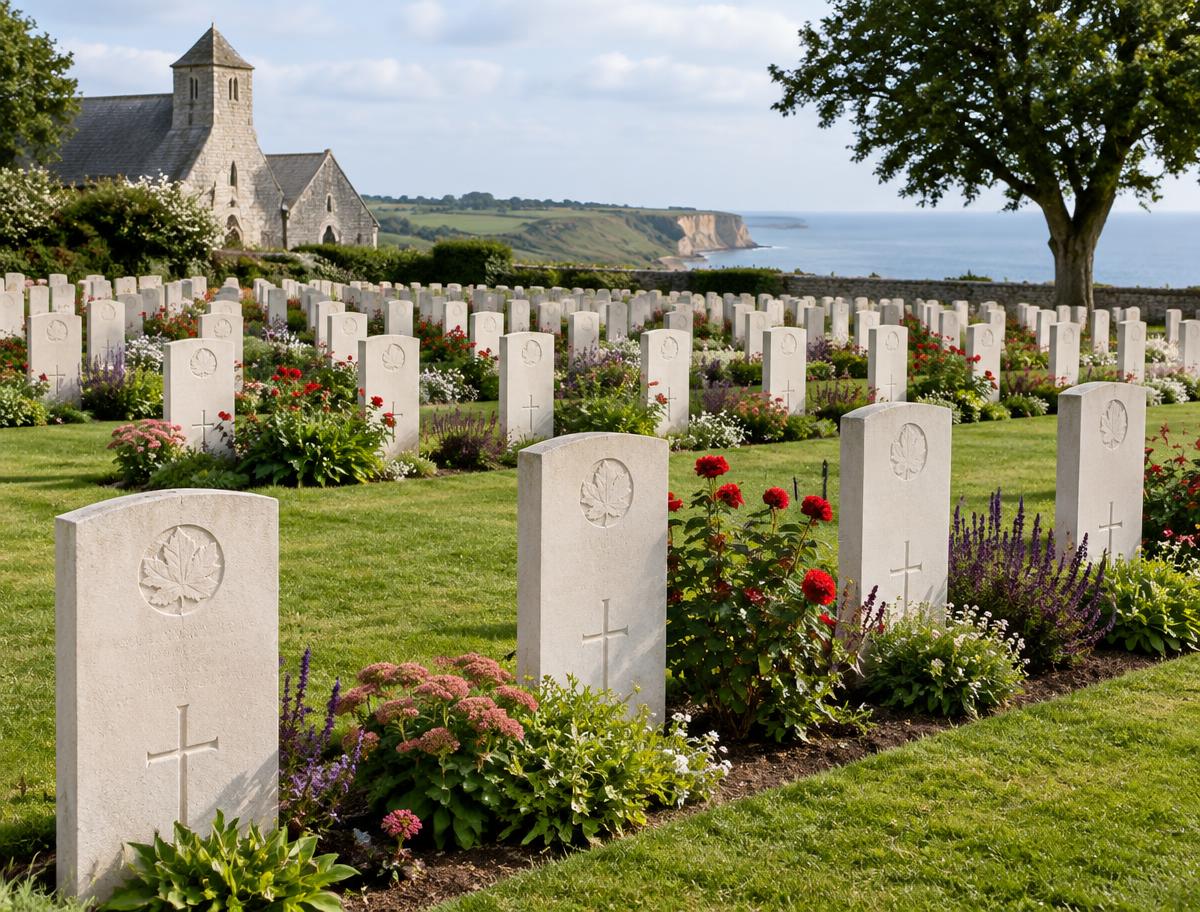
The graves of five British soldiers who went missing during the Battle of Normandy more than 80 years ago have finally been identified and marked with their names, following rededication ceremonies held between 29 September and 1 October.
The Ministry of Defence said the men, who had lain in graves marked only as unknown soldiers since the Second World War, were identified through historical and forensic research carried out by the Ministry of Defence’s Joint Casualty and Compassionate Centre, working with the Commonwealth War Graves Commission.
Who the soldiers were
The five men named are Private George Chapman of the Herefordshire Regiment, Private Vincent Coia of the 7th Battalion, The Seaforth Highlanders, Lance Corporal Reginald Cyril Dewey of the Lincolnshire Regiment, Serjeant Frederick Albert Harrison of the Dorsetshire Regiment, and Corporal Henry Thomas Read of the Rifle Brigade.
Private Coia’s connection to the Seaforth Highlanders gives the story a particular resonance in Scotland, where the regiment recruited heavily from the Highlands and north-east before it was amalgamated into the Queen’s Own Highlanders in the 1960s. Units like the 7th Battalion fought through some of the fiercest engagements of the Normandy campaign in the summer of 1944, including the advance through the Odon valley and operations around Caen, which produced heavy casualties on both sides.
How the identifications were made
The Battle of Normandy, which began with the D-Day landings on 6 June 1944 and continued for months afterwards, left tens of thousands of Allied and German soldiers dead, with many bodies recovered in conditions that made identification at the time impossible. Decades on, specialist teams continue to work through archival unit records, burial reports and forensic evidence such as dental records and artefacts recovered from graves, gradually matching unidentified remains to specific missing servicemen.
The Ministry of Defence’s casualty and compassionate centre handles dozens of such cases each year across all conflicts involving British and Commonwealth forces, from the two world wars through to more recent operations. Each identification triggers a formal rededication service, at which the Commonwealth War Graves Commission replaces a headstone inscribed “known unto God” with one bearing the soldier’s name, rank, regiment and age where known.
The ceremonies
The five rededication services took place in French cemeteries associated with the Normandy campaign, attended by regimental representatives, serving soldiers and, in at least one case, surviving family. A message from Reg Harrison, the 95-year-old younger brother of Serjeant Frederick Albert Harrison, was read out at the graveside during the ceremony marking his identification, giving a direct family voice to an event separated from the soldier’s death by more than eight decades.
A further commemorative service was held at the British Normandy Memorial in Ver-sur-Mer, which lists the names of the more than 22,000 service personnel under British command who died during the Normandy campaign. The memorial, opened in 2021, was built specifically to ensure every such casualty was formally commemorated by name, following years of campaigning by veterans’ groups who felt Britain lacked an equivalent to memorials in other Allied nations.
Why identification still matters
Officials involved in this work argue that identifying soldiers more than eighty years after their deaths still carries real significance, both for military tradition and for the families concerned. For relatives such as Reg Harrison, it offers a tangible place of remembrance where previously there was only a question mark. For regiments, it is a reaffirmation of the debt owed to those who served and never returned.
The Ministry of Defence said further cases remain under investigation, and it expects more Normandy-era identifications to be announced as research continues. Each case depends on the survival of sufficiently detailed records and, where possible, DNA samples from living relatives, meaning the pace of identification is likely to remain slow and uncertain even as techniques improve.
The scale of the Normandy campaign
The Battle of Normandy, fought between June and August 1944, was one of the largest and most costly campaigns of the Second World War, involving millions of Allied and German troops and resulting in tens of thousands of casualties on all sides. British and Commonwealth forces, fighting alongside American, Canadian, Polish and other Allied troops, played a central role in the campaign, particularly in the fierce fighting around Caen, which proved far more protracted and costly than initially anticipated by Allied planners.
The Seaforth Highlanders' role
The Seaforth Highlanders, the regiment in which Private Vincent Coia served, recruited extensively from the Scottish Highlands and north-east, and its battalions were heavily engaged throughout the Normandy fighting, including operations in the Odon valley that produced some of the campaign's fiercest close-quarters combat. The regiment's long history, stretching back to the eighteenth century, made it one of the most storied in the Highland regimental tradition before it was amalgamated with the Queen's Own Cameron Highlanders to form the Queen's Own Highlanders in 1961.
Methods of identification
Specialist researchers working on behalf of the Ministry of Defence rely on a combination of archival records, including unit war diaries, burial reports compiled at the time and immediately after the war, and forensic evidence recovered alongside remains, such as uniform buttons, identity discs and personal effects. Where DNA testing is possible, samples recovered from remains are compared against genetic material provided by traceable descendants, a process that can take years given the difficulty of locating living relatives from service records more than eight decades old.
The British Normandy Memorial
The memorial at Ver-sur-Mer, which lists more than 22,000 names of personnel who died under British command during the Normandy campaign, opened in 2021 following a long campaign by veterans' groups who argued that Britain lacked an equivalent to the prominent American and Canadian memorials already established in the region. Its creation reflected growing recognition that formal, named commemoration matters not only to the historical record but to the families of those who served, many of whom had no single site at which to mark their relative's sacrifice.
Family connections across generations
The reading of a message from Reg Harrison, the 95-year-old brother of one of the identified soldiers, at the rededication ceremony illustrates how these identifications, though arriving more than eight decades after the deaths concerned, can still carry profound personal significance for surviving relatives. Such moments have become a recurring feature of rededication ceremonies in recent years, as the generation with direct memories of the war dwindles, making each surviving family connection increasingly rare and valued.
Ongoing identification work
The Ministry of Defence's casualty and compassionate centre continues to investigate cases from both world wars and more recent conflicts, with the pace of new identifications dependent on the quality of surviving records and the availability of DNA samples from descendants. Officials say they expect further Normandy-era cases to be confirmed as research continues, though each identification typically requires painstaking cross-referencing of historical and forensic evidence that can take years to complete.