
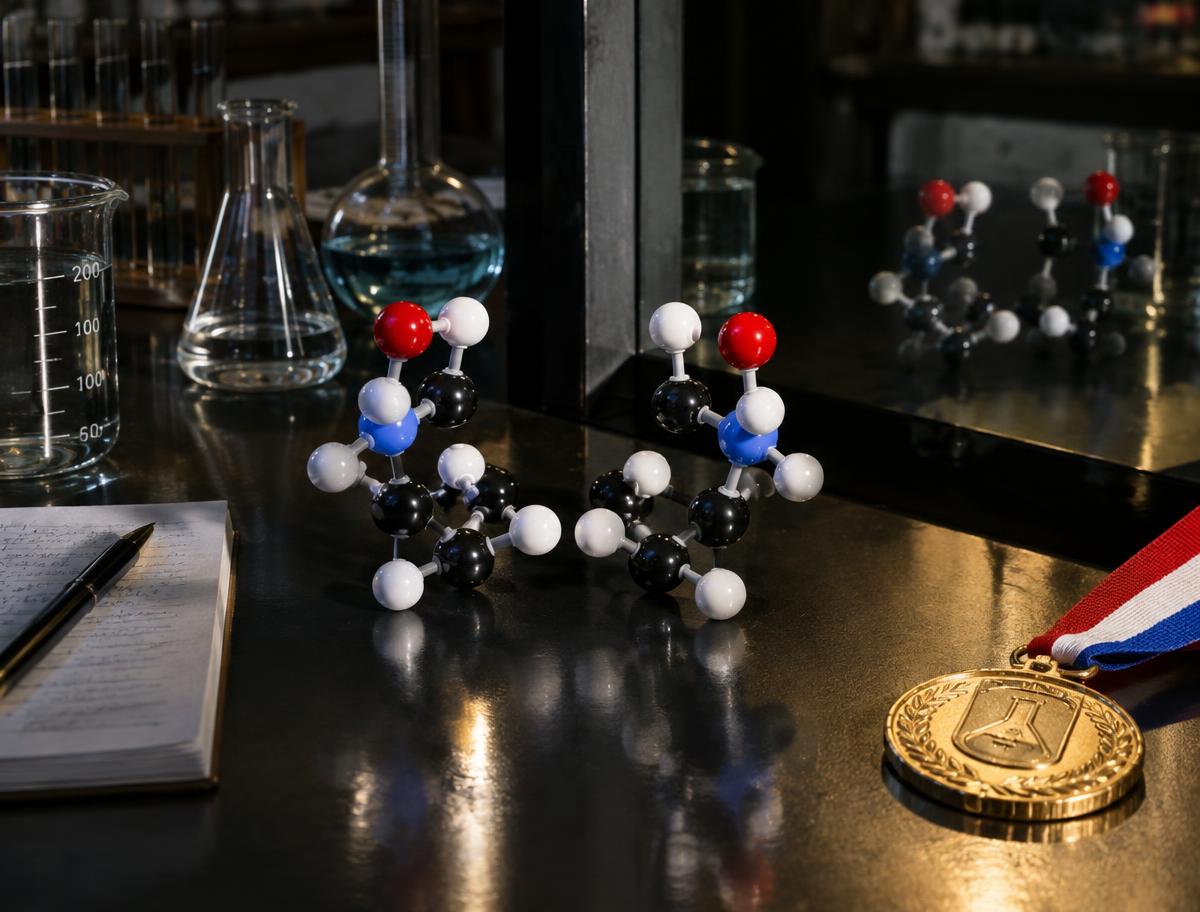
The Nobel Prize in Chemistry has been awarded to French scientist Henri B. Kagan and Japan's Kenso Soai for solving one of the deepest puzzles in chemistry: why life favours one mirror-image version of its molecules over the other.
The announcement was made in Stockholm on Wednesday. The laureates will share prize money of 12 million Swedish kronor, about £900,000.
Their work explains how nature exclusively produces the correct version of a molecule rather than its mirror image, a question that has fascinated scientists since the 19th century and has direct consequences for how medicines are made.
Left hands and right hands
Many molecules exist in two forms that are mirror images of each other, much like a pair of human hands. They contain the same atoms connected in the same way, but they cannot be placed on top of each other perfectly.
Chemists call this property chirality, from the Greek word for hand. Chiral molecules come in left-handed and right-handed forms.
Amino acids, the building blocks of proteins, are a classic example. Both forms exist, yet living organisms on Earth function almost entirely with only one of them. The same is true of sugars and many other molecules essential to life.
The puzzle is that ordinary chemical reactions in a laboratory usually create a 50-50 mixture of left- and right-handed molecules. Nature, somehow, does not.
Breaking the symmetry
The two laureates provided an answer to how that imbalance can arise and be amplified. Their research showed how a small initial excess of one form can be magnified until one version dominates.
Professor Soai is known for a reaction, named after him, in which a molecule acts as a catalyst for producing more of itself in the same handed form. A tiny imbalance at the start can snowball into an overwhelming majority of one version.
Professor Kagan helped establish the principles of how chirality can be amplified in chemical reactions, work that underpins much of modern asymmetric synthesis, the field that deliberately makes one handed form rather than a mixture.
Together, their discoveries offer a plausible chemical pathway for how early Earth chemistry could have tipped towards the single-handedness seen in all living things.
Why it matters for medicine
The question is not just of academic interest. When drugs interact with the body, the two mirror-image forms of the same molecule can behave very differently. One can treat disease while the other does nothing or even causes harm.
The thalidomide tragedy is the most notorious example. In the 1950s the drug was prescribed to pregnant women to ease morning sickness. It is a chiral molecule: one form was an effective treatment, while the other was toxic. The drug given to patients was a mixture of both, and it was later linked to severe birth defects in thousands of babies.
Since then, regulators and pharmaceutical companies have paid close attention to chirality. Many modern medicines are produced as a single handed form to make them safer and more effective, using techniques built on the kind of chemistry the laureates helped develop.
A long scientific quest
The mystery of molecular handedness dates back to the French chemist Louis Pasteur, who in 1848 separated left- and right-handed crystals of a salt by hand under a microscope. The question of why life chose one hand has remained open ever since.
Previous Nobel prizes have recognised related advances, including the 2001 chemistry prize for methods of making single-handed molecules using catalysts. This year's award focuses on the fundamental question of how the asymmetry of life arose.
Week of Nobel announcements
The chemistry prize follows the announcements of the prizes in medicine and physics earlier this week. The literature, peace and economics prizes are still to come.
The laureates will receive their medals at a ceremony in Stockholm in December, on the anniversary of the death of Alfred Nobel, the Swedish inventor who founded the prizes in his will.
For a field often seen as remote from everyday life, this year's award is a reminder that some of chemistry's most abstract questions sit behind the safety of the medicines millions of people take every day.