
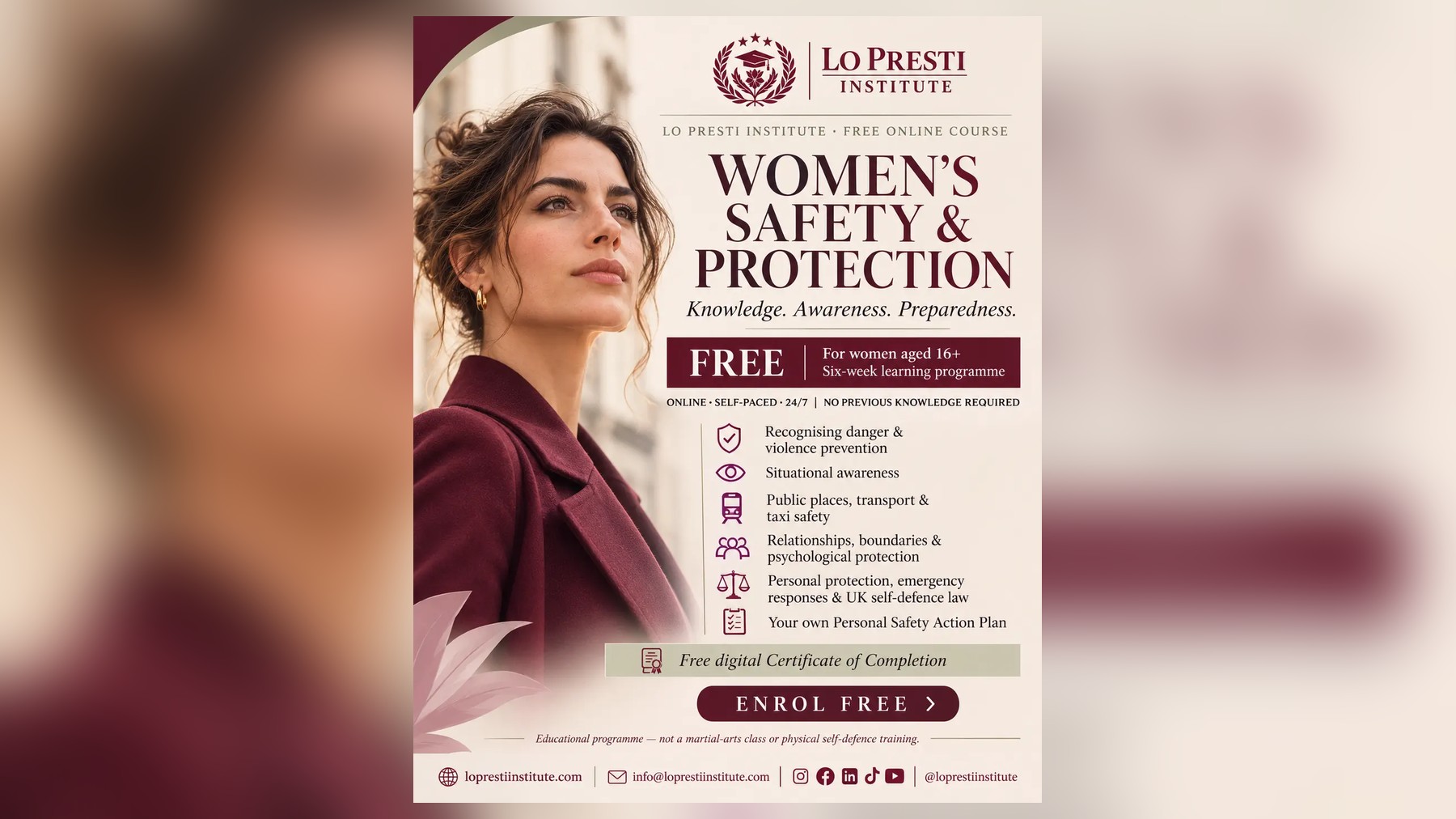
A Scottish charity has launched a free online course designed to teach women how to recognise danger before it escalates, protect themselves within the law and build a personal safety plan for daily life.
Women's Safety & Protection, created by the Lo Presti Institute, is open to any woman aged 16 or over, costs nothing to take and leads to a digital Certificate of Completion. It is studied entirely online, at the learner's own pace, from a phone, tablet or computer.
The institute's message is direct: a woman should never have to wait until she becomes a victim of violence to learn how to protect herself.
Not a martial-arts class
The organisers stress that the programme does not teach fighting techniques. Instead it focuses on prevention, situational awareness, psychological manipulation, harassment, stalking, domestic abuse, sexual violence, public transport and taxi safety, online threats and the legal framework surrounding self-defence in the United Kingdom.
Its material draws on published figures from the Office for National Statistics, the Scottish Government and Transport for London, combined with realistic scenarios and interactive exercises. One of these walks learners step by step through a taxi journey, asking them to choose how to respond as the situation develops.
The course is led by Dr Gaetano Lo Presti, the Messina-born, North Lanarkshire-based founder of Contemporary Marketing, whose institute is a registered Scottish charity. He puts the philosophy behind the course bluntly: "Better a bad criminal trial than a nice funeral."
The course materials add that women should not feel guilty for protecting their personal safety, and that everyone has the right to take reasonable and lawful steps to protect themselves from someone who intends to harm them.
Six weeks, step by step
The programme is divided into six weeks, each containing fourteen lessons, a full-screen presentation and a five-question assessment. Learners need four correct answers out of five to unlock the next week, with unlimited retakes and every answer explained.
The first week examines the forms violence against women can take — physical, sexual and psychological abuse, coercive control, economic abuse, stalking, online abuse, honour-based abuse, trafficking and harassment at work or in public — along with the myths that surround them and the effects of trauma.
Week two turns to situational awareness: reading environments, behaviour and boundaries, recognising manipulation and grooming, the risks of alcohol and drink spiking, and making decisions under stress. It also covers what body language can, and cannot, reveal.
The third week deals with public places and travel, including walking alone, what to do if followed, the difference between licensed taxis, private hire and unlicensed cars, how to verify a booking and how to respond to driver misconduct, as well as safety on public transport and at nightlife and events.
Week four looks at relationships and psychological protection: early warning signs, love bombing, jealousy, isolation, digital control, consent, stalking by someone known to the victim, and how to leave an abusive relationship safely.
The law across the UK
Week five covers escalation, de-escalation and escape, how to make emergency calls — including the Silent Solution, which lets a caller who cannot speak on a mobile press 55 after dialling 999 — and how to gather evidence and find support.
It also explains how self-defence law differs between Scotland, England and Wales, and Northern Ireland. The course makes clear that pepper spray, CS and PAVA sprays and stun guns are prohibited weapons in the UK under the Firearms Act 1968, and explains what can lawfully be carried instead and when reasonable force is permitted.
The final week brings everything together into a Personal Safety Action Plan covering routines, travel, digital privacy, dating, work, support services and legal rights.
Designed with care
No previous knowledge is needed, and participants never have to share personal experiences. Content notes appear before sensitive lessons and links to support services are available from every page. An optional final questionnaire allows anonymised answers to be used for research, a choice the institute says never affects access or certification.
Each certificate carries a unique authenticity code that employers or others can check through the institute's online verification page.
While the legal content focuses on the four UK nations, the organisers say the safety principles apply wherever learners live.
The launch comes amid continuing concern across Scotland and the wider UK about violence against women and girls, harassment on public transport and the growth of online abuse — issues that campaigners have long argued require better public education alongside policing and the courts.
Anyone in immediate danger should call 999. In Scotland, the Domestic Abuse and Forced Marriage Helpline is available 24 hours a day on 0800 027 1234; in England, the National Domestic Abuse Helpline is 0808 2000 247.


