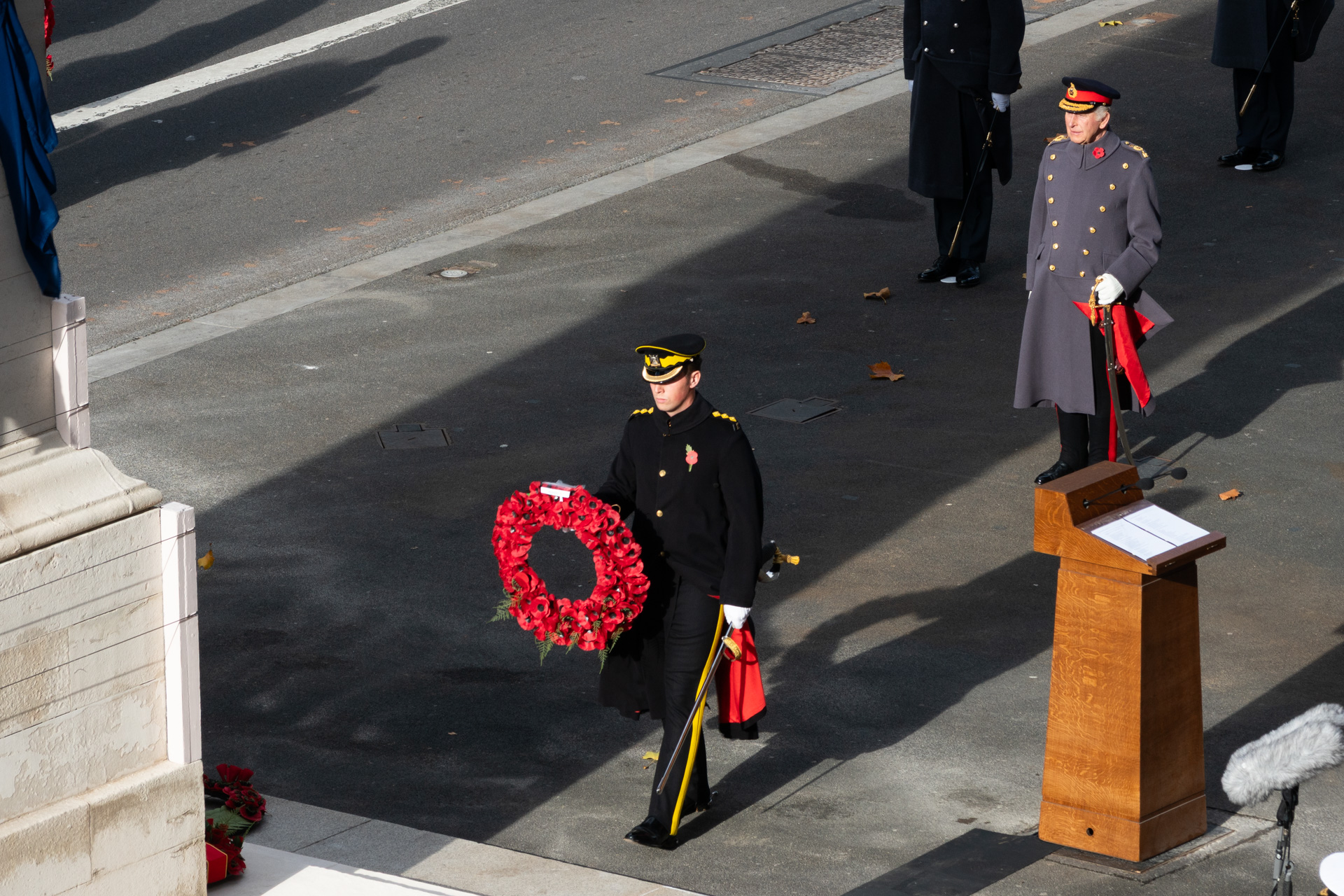
The King has led the nation in a two-minute silence at the Cenotaph in Whitehall, as the United Kingdom marked Remembrance Sunday with services at war memorials in every part of the country.
King Charles III laid the first wreath at the National Service of Remembrance in central London, followed by members of the Royal Family, senior politicians and representatives of the armed forces and Commonwealth. The silence began at the first stroke of Big Ben at 11 o'clock, observed by thousands gathered along Whitehall and by millions more watching and listening at home.
Some 10,000 armed forces veterans took part in the Royal British Legion's march-past through Whitehall, among them about 20 surviving veterans of the Second World War — a number that falls with every passing year. The Prince and Princess of Wales were among the senior royals in attendance, a day after joining the King and Queen at the Royal British Legion's Festival of Remembrance at the Royal Albert Hall.
The service at the Cenotaph
The National Service of Remembrance, organised by the Department for Culture, Media and Sport with the Ministry of Defence, commemorates the contribution of British and Commonwealth military and civilian servicemen and women in the two World Wars and in every conflict since.
The order of service at the Cenotaph invited those present to remember "those who made the great sacrifice during the two World Wars", those who have given their lives in other conflicts, those who suffer at this time and those who have been bereaved — and to pray for peace. Wreaths were laid on behalf of the government, the opposition, the devolved administrations, the Commonwealth high commissions and the services.
The Prime Minister, Andy Burnham, was among the senior figures attending, alongside the leaders of the other main parties and the First Ministers of Scotland, Wales and Northern Ireland. Faith leaders and representatives of the emergency services and civilian organisations also took part in the ceremony.
Scotland remembers
In Scotland, the national service of remembrance was held at the Stone of Remembrance on the Royal Mile in Edinburgh, with veterans, serving personnel, civic leaders and members of the public in attendance. Wreaths were laid at war memorials in cities, towns and villages across the country, from Glasgow's George Square to the smallest island communities.
This year's commemorations have carried a particular poignancy in Scotland following the death, announced on Saturday, of Charlie Horne, one of the country's last surviving D-Day veterans. Mr Horne, who served at 18 on a small wooden minesweeper clearing sea mines off Omaha Beach during the Normandy landings, died at the Erskine Veterans Charity's home in Edinburgh aged 100, just days before the remembrance weekend.
Erskine, which has cared for Scottish veterans since 1916, said it would be remembering Mr Horne and all the veterans it has supported over the past century at its own services. The charity, founded in the aftermath of the First World War, now looks after former servicemen and women from every conflict since, from Normandy to Afghanistan.
A dwindling generation
The presence of about 20 Second World War veterans in this year's march-past underlined how quickly the generation that fought in that conflict is passing. More than 80 years on from the end of the war, the youngest of those who served are now in their late nineties, and veterans' charities have urged the public to hear and record their testimony while it is still possible.
The Royal British Legion, which organises the march-past and the annual poppy appeal, said this year's commemorations were an opportunity to honour not only the fallen of the two World Wars but all those who have served in more recent conflicts, and the families who stand behind them.
Poppy appeals across the UK reported strong support in the run-up to the weekend, with volunteers collecting in stations, shopping centres and high streets. The appeal funds the Legion's year-round work supporting serving personnel, veterans and their families.
Services across the country
Beyond Whitehall, acts of remembrance took place at tens of thousands of memorials. In Manchester, crowds gathered at the Cenotaph in St Peter's Square; in Belfast, at the Cenotaph at City Hall; and in Cardiff, at the Welsh National War Memorial in Cathays Park. Churches of every denomination held remembrance services, and many communities observed the two-minute silence at their local memorials.
The BBC broadcast live coverage of the Cenotaph service and Saturday's Festival of Remembrance, part of a week of programming marking the commemorations across television, radio and online.
The Festival of Remembrance at the Royal Albert Hall on Saturday evening brought together serving personnel, veterans and their families for an evening of music, testimony and reflection, culminating in the traditional falling of poppy petals from the dome — one petal for each life lost in service.
Remembrance events continue through the week, with Armistice Day itself falling on Wednesday, when a further two-minute silence will be observed at 11am, marking the moment the guns fell silent on the Western Front in 1918.