
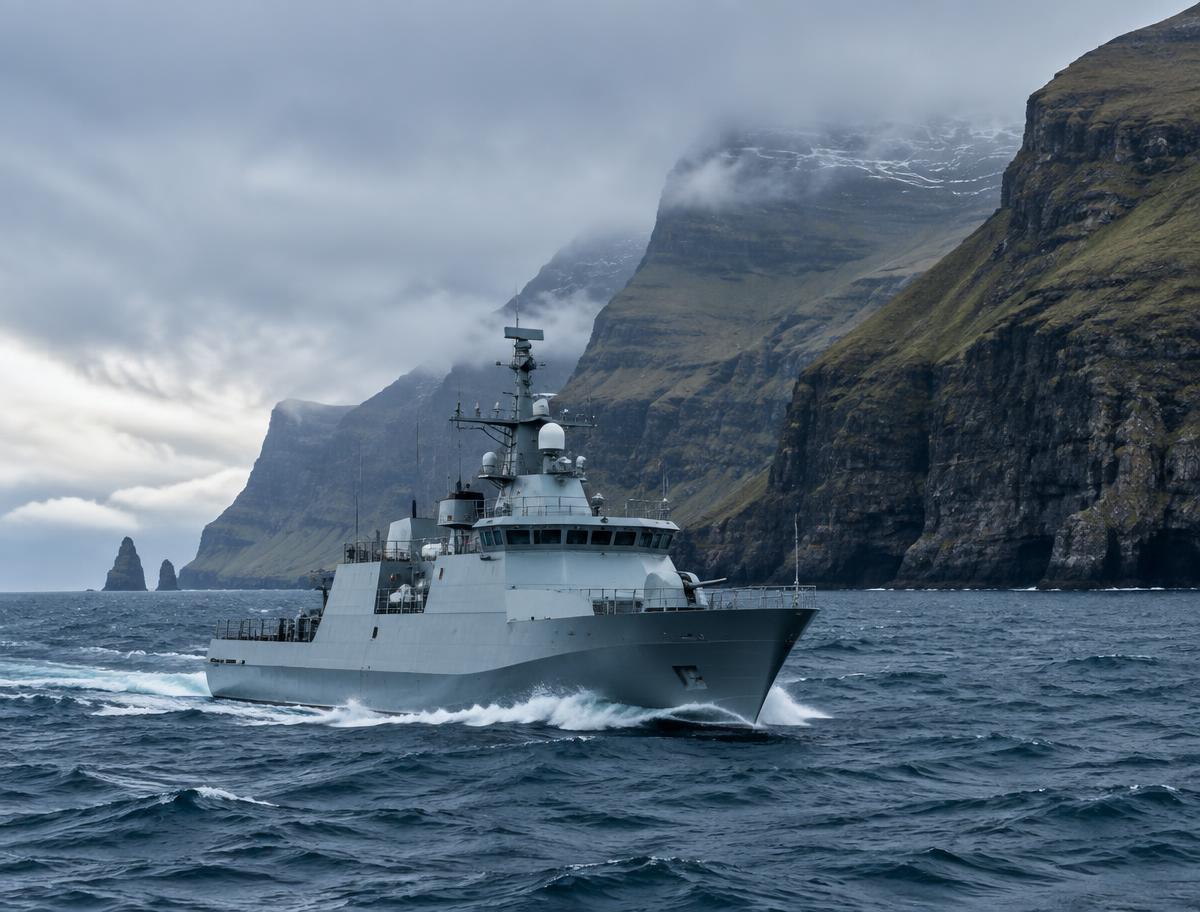
The UK has led a major military exercise across the North Atlantic, High North and Baltic Sea involving hundreds of personnel from the Joint Expeditionary Force, as Defence Secretary Wes Streeting met counterparts from the alliance at a summit in Iceland.
Exercise Lion Protector 26, involving forces from the UK-led Joint Expeditionary Force, or JEF, was designed to test the protection of critical national infrastructure, strengthen joint command and control between allied militaries, and counter what the Ministry of Defence described as emerging Russian hybrid threats in the region.
First Royal Marines deployment to the Faroes since the war
A notable element of the exercise saw Royal Marines conduct training in the Faroe Islands for the first time since the Second World War, working alongside Danish forces in the self-governing territory, which sits in the centre of the Greenland-Iceland-UK Gap, a stretch of ocean considered one of NATO’s most important maritime approaches.
Marines from the UK’s Special Operations Maritime Task Group carried out maritime interdiction drills, amphibious landings and small boat missions during the deployment, exercises intended to test the ability of allied forces to board, inspect and seize vessels, as well as operate on the Faroes’ difficult coastal terrain.
General Sir Gwyn Jenkins, First Sea Lord and Commandant General Royal Marines, said the Faroe Islands formed “a critical part of the northern approaches for both the UK and NATO,” and that defending the Atlantic was “fundamental to our economy, national security and way of life”.
Ministers meet in Keflavik
Alongside the exercise, Streeting travelled to Keflavik, Iceland, for a summit with his JEF counterparts, where discussions focused on Canada’s application to join the JEF framework, deepening cooperation against hybrid threats, and further support for Ukraine through what the MoD called the JEF-Ukraine Enhanced Partnership. Canadian and Ukrainian ministers attended the summit as observers.
Streeting said: “The North Atlantic, High North, and Baltic are the frontline of the UK’s security, which is why British leadership of the Joint Expeditionary Force is so vital to our defence,” adding that recent JEF exercises, from amphibious landings in the Faroes to a standing headquarters deployed north of the Arctic Circle, showed how Britain was working with allies “to enhance NATO’s defence of the region in the face of rising Russian threats”.
Growing concern over Russian activity
The exercise reflects mounting Western concern about Russian activity in the High North and around undersea infrastructure, including data cables and energy pipelines, which the MoD said were vital to the UK’s connectivity and energy supply. The JEF, a ten-nation alliance led by the UK and including the Nordic and Baltic states alongside the Netherlands and Iceland, has increasingly focused its exercises on hybrid threats such as sabotage and cable-cutting, rather than conventional military confrontation alone.
The exercise builds on a February 2026 announcement that the UK would double the number of troops deployed to Norway from 1,000 to 2,000 over three years, as part of a wider effort to strengthen Arctic and High North defences, including UK participation in NATO’s Arctic Sentry mission.
What happens next
Discussions on Canada’s membership of the JEF are expected to continue following the Keflavik summit, while the alliance is likely to hold further exercises in the region as it seeks to demonstrate a credible deterrent against Russian activity in the North Atlantic and Arctic.
What is the Joint Expeditionary Force
The Joint Expeditionary Force was established in 2014 as a UK-led coalition bringing together Nordic and Baltic allies, alongside the Netherlands and Iceland, to enable rapid joint military action in Northern Europe outside formal NATO structures when needed. Unlike NATO, which requires consensus among all 32 member states to act, the JEF's smaller membership, currently ten nations, allows for faster decision-making and more flexible deployment, making it a useful complement to NATO's broader collective defence arrangements, particularly for responding to grey-zone or hybrid threats that fall short of outright armed conflict.
Hybrid threats in the High North
Western security officials have grown increasingly concerned in recent years about what they describe as Russian hybrid activity targeting undersea infrastructure, including damage to data cables and gas pipelines in the Baltic and North Seas, incidents that have been difficult to attribute definitively but which have prompted a significant increase in allied naval patrols and surveillance in the region. The Nord Stream pipeline explosions of 2022 remain the most prominent example of this kind of infrastructure attack, and subsequent incidents involving damaged telecommunications cables have kept the issue high on the agenda for JEF and NATO planners alike.
Strategic value of the Faroe Islands
The Faroe Islands, a self-governing territory of Denmark situated in the North Atlantic, sit within the Greenland-Iceland-UK Gap, a maritime chokepoint that Soviet and later Russian submarines have historically had to pass through to reach the open Atlantic from bases in the Arctic. NATO planners have long regarded control of this gap as essential to any effort to track or constrain Russian naval movements, giving the islands outsized strategic significance despite their small population and limited size.
The UK's wider Arctic push
The Lion Protector exercise builds on a series of UK announcements over the past year aimed at strengthening its presence in the Arctic and High North, including the planned doubling of troop deployments to Norway and participation in NATO's Arctic Sentry mission, both reflecting a broader recognition among Western defence planners that melting Arctic ice is opening new shipping routes and resource opportunities that Russia, and increasingly China, are seeking to exploit.
Canada's potential membership
Canada's interest in joining the JEF reflects its own Arctic territory and growing concern about Russian activity near North American Arctic waters, as well as a broader trend of Western nations seeking closer coordination on Arctic security as the region becomes more geopolitically contested. If approved, Canadian membership would expand the JEF beyond its current European focus for the first time.
Support for Ukraine
The JEF-Ukraine Enhanced Partnership discussed at the Keflavik summit reflects the alliance's continued role in coordinating military and other support for Kyiv, alongside broader NATO and bilateral assistance programmes, as the war with Russia continues. Ukrainian officials attending the summit as observers underscored the JEF's role as one of several multilateral forums through which Kyiv seeks sustained Western backing.
What happens next
Further JEF exercises are expected in the coming months as the alliance seeks to demonstrate credible deterrence in the High North, while the outcome of discussions on Canadian membership could reshape the grouping's footprint and remit if formally agreed.


