
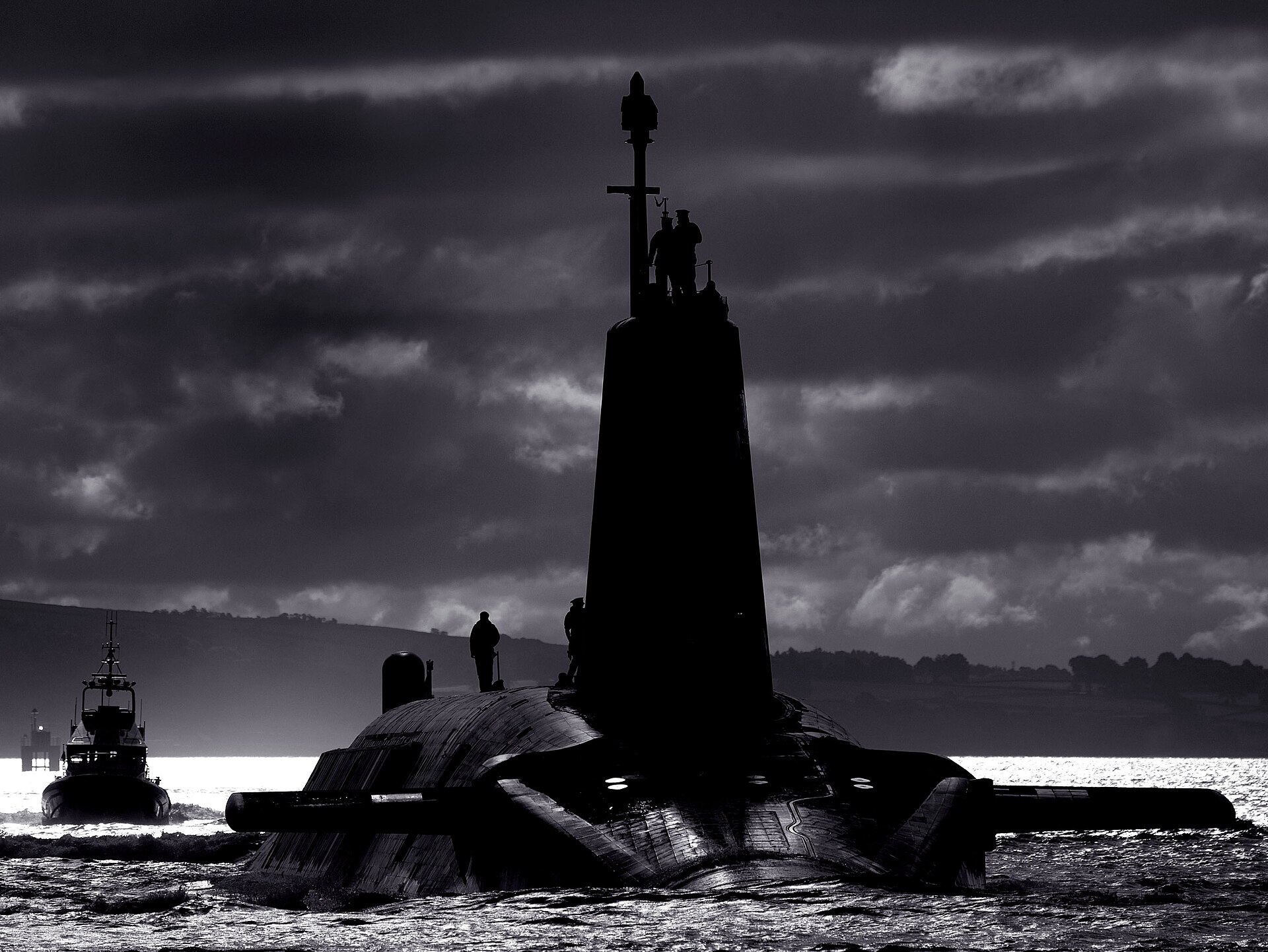
A Royal Navy submarine carrying Trident nuclear missiles has returned to its base on the Clyde after a record-breaking 217 days continuously submerged — the longest patrol ever completed by a British vessel.
HMS Vengeance sailed up Gare Loch into HM Naval Base Clyde at Faslane, near Helensburgh in Argyll and Bute, on Sunday morning, seven months and five days after slipping beneath the waves on 12 April. Crew members could be seen standing on the casing as the boat was escorted home by tugs and smaller naval support vessels, its hull encrusted with marine growth and some of its sound-absorbing tiles missing after more than half a year under the sea.
The 140-strong crew have spent the entire deployment in almost total isolation. Submariners on deterrent patrol receive only short, one-way messages from home — no replies are possible — and live without daylight, fresh air or any contact with the outside world beyond the boat's own company.
Defence Secretary Wes Streeting was at Faslane to welcome the crew home, and used the occasion to deliver a blunt message to Moscow. It emerged this weekend that Kremlin negotiators have said Russia would only end its war in Ukraine if Britain agreed to stop protecting Europe with its nuclear weapons — a demand Streeting flatly rejected.
"The fact that Putin has made these demands demonstrates what the nuclear deterrent is, and the deterrence effect it is having in the Kremlin," he said. "At a dangerous time for our continent, our nuclear deterrent is not up for negotiation, and we will not abandon our allies in Nato."
A patrol length that has more than doubled
HMS Vengeance is one of four Vanguard-class ballistic missile submarines which between them maintain Britain's continuous at-sea deterrent — the policy, in place since 1969, of always having at least one nuclear-armed boat on patrol. Each Vanguard can carry up to 16 Trident missiles, each capable of delivering multiple warheads.
But the record length of this patrol lays bare the strain on the fleet. The typical patrol duration has more than doubled in recent years, with six-month deployments now routine, because too few of the boats are seaworthy at any one time. Vengeance was itself expected home last weekend, but its return was delayed when the submarine due to relieve it on patrol had to come back to base to fix a technical fault.
The head of the navy, First Sea Lord General Sir Gwyn Jenkins, praised the dedication of submariners in keeping Nato safe at a conference in Oslo last week, but warned that the UK must do better at maintaining the fleet. Streeting conceded that the lengthening patrols weigh on him.
"It doesn't sit lightly with me that crews are being asked to serve longer than intended," he said. "It makes me feel even more indebted to the crew for the service they've given to the country, for the commitment they show, the dedication, the professionalism, the expertise. I think the whole country can be extraordinarily proud of them."
Life 217 days beneath the surface
Life on a deterrent patrol is unlike any other posting in the armed forces. The crew work six-hour shifts around the clock in a sealed steel tube, breathing recycled air and drinking distilled water, with no way of knowing whether it is day or night above them except by the boat's clock. Space is so tight that junior submariners can find themselves sharing bunks in rotation, a practice known as hot-racking.
Food is loaded for the full length of the deployment, with fresh produce running out within the first few weeks. Exercise is confined to a few machines squeezed between machinery and missile tubes. The boat's company becomes, in effect, the only world its members know — which is why the sight of families waiting on the jetty at Faslane is such a charged moment at the end of every patrol.
For the families themselves, the homecoming ends months of silence. Partners and parents receive no phone calls and no video messages for the duration, only the knowledge that the boat is somewhere in the ocean, on station.
Scotland at the centre of the deterrent debate
The homecoming also lands in the middle of Scotland's long-running argument over the nuclear weapons based on its soil. HM Naval Base Clyde, combining the Faslane submarine base and the Coulport armaments depot, is one of the largest single-site employers in Scotland, supporting thousands of jobs in Argyll and Bute and the wider west of Scotland economy.
The SNP has long committed an independent Scotland to removing Trident from the Clyde, arguing that weapons of mass destruction have no place in Scottish waters. Unionist parties counter that the deterrent underwrites the security of the whole of the UK and its Nato allies, and that the Kremlin's latest demands show exactly why it matters.
The four Vanguard-class boats are due to be replaced from the early 2030s by the new Dreadnought class, now under construction at Barrow-in-Furness, in a programme expected to cost more than £30 billion. Until the first Dreadnought enters service, the ageing Vanguard fleet — and crews like that of HMS Vengeance — must keep stretching patrols ever longer to keep the continuous deterrent at sea.
For now, though, the focus at Faslane is on 140 submariners coming home. After 217 days without sunlight, fresh air or a word from their families, Sunday's arrival on the Gare Loch marks the end of the longest underwater patrol in the history of the Royal Navy.


