
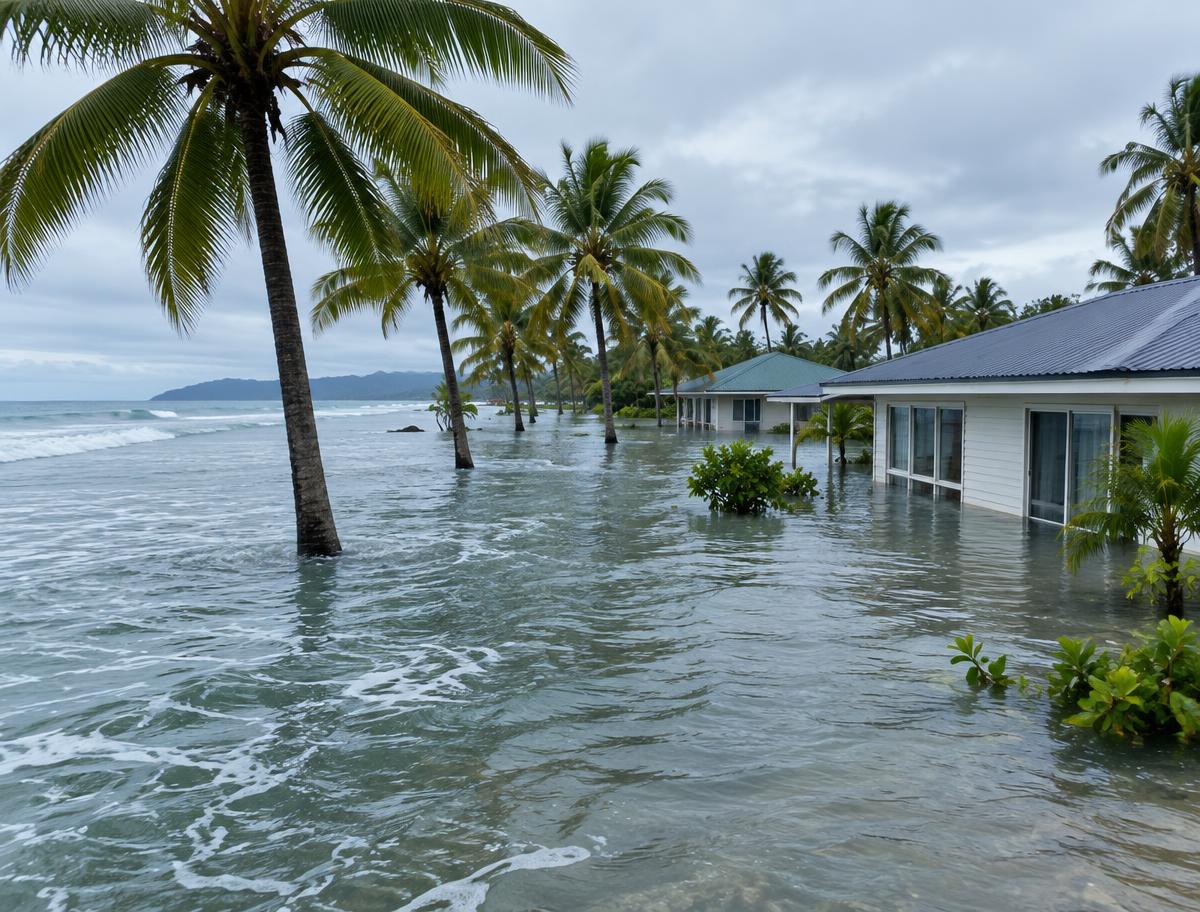
The UN General Assembly has adopted a declaration calling for stronger international cooperation to address rising sea levels, as Secretary-General António Guterres warned that the climate crisis has become “a daily reality” for communities around the world rather than a distant threat.
The declaration, agreed by member states in New York, sets out the cumulative and potentially irreversible risks facing low-lying nations and coastal communities as oceans continue to rise, and calls for greater support, including finance, for the countries most exposed.
Protecting statehood as coastlines shrink
A significant element of the text addresses the legal status of countries whose territory could eventually become uninhabitable or submerged because of sea-level rise. It affirms that such states should retain their legal existence, sovereignty and international rights even if part or all of their land is lost to the sea, a principle of particular importance to small island nations in the Pacific and elsewhere whose future existence as sovereign states has been called into question by rising waters.
The scale of the exposure
Guterres told the Assembly that global sea levels rose by nearly six millimetres in 2024, the largest annual increase on record, underscoring the pace at which the problem is accelerating. The UN has previously estimated that around 770 million people live in areas vulnerable to rising seas, a figure cited again in discussions around the declaration.
Officials caution that these global figures describe long-term trends rather than a precise forecast for when or how severely any particular coastline will be affected; local factors such as land subsidence, storm patterns and coastal defences all influence the risk faced by individual communities.
A political statement, not a funding guarantee
The declaration calls for follow-up work, including mobilising finance for adaptation measures such as sea walls, managed relocation and resilient infrastructure. As with similar UN declarations, it represents a statement of shared political intent rather than binding funding commitments, and its practical impact will depend on whether governments follow through with actual money and policy changes.
Climate amid a crowded global agenda
The discussion took place against a backdrop of multiple ongoing conflicts, debates over the regulation of artificial intelligence, and disputes about the distribution of power within international institutions. Guterres, who is approaching the final year of his second term as secretary-general, used his address to link these issues, arguing that climate change compounds instability elsewhere even as it competes for diplomatic attention.
His successor as secretary-general has not yet been chosen, with the Security Council only beginning to test support for candidates through informal straw polls this autumn. Guterres’s own tenure has been marked by repeated warnings about the widening gap between the scale of climate change and the pace of the international response.
What happens next
Diplomats say the declaration’s real test will come in the months ahead, as countries decide whether to turn its language on finance and adaptation into concrete commitments at forthcoming climate negotiations. For the hundreds of millions of people living in vulnerable coastal areas, the declaration offers recognition of their predicament, but not yet the resources needed to adapt to it.
Why sea-level rise is different from other climate impacts
Unlike some climate impacts that might be partially reversed or mitigated over time, sea-level rise driven by melting ice sheets and the thermal expansion of warming oceans is widely regarded by scientists as effectively irreversible on human timescales, even if global greenhouse gas emissions were dramatically reduced in the near future. This makes it a particularly challenging issue for international diplomacy, since affected nations cannot simply wait for future emissions cuts to resolve the threat to their territory; adaptation and, in the most extreme cases, planning for the loss of habitable land, are considerations that must be addressed regardless of how quickly the world decarbonises.
The legal innovation at the heart of the declaration
The declaration’s provisions on statehood address a genuinely novel question in international law: what happens to a sovereign nation if its territory becomes uninhabitable or disappears entirely beneath rising seas. Traditional concepts of statehood under international law have generally assumed the continued existence of a defined territory, population and government, assumptions that low-lying Pacific nations such as Tuvalu and Kiribati have warned could be tested to breaking point within the lifetimes of people living today if sea levels continue to rise at current or accelerating rates.
Some Pacific nations have already begun taking steps to prepare for this possibility, including Tuvalu’s pursuit of a “digital nation” project intended to preserve its government, culture and records even if its physical territory becomes uninhabitable, alongside diplomatic efforts to secure international recognition that statehood should not be contingent on the survival of physical land.
Climate finance and the adaptation gap
International climate finance negotiations have repeatedly struggled to mobilise the sums that developing and climate-vulnerable nations say are needed to adapt to the effects of climate change already locked in by past emissions. Previous climate summits have produced various funding pledges and mechanisms, including a loss and damage fund agreed in principle at COP27, but disbursement has often lagged well behind the scale of need identified by vulnerable countries, a pattern that the sea-level declaration’s backers hope can be avoided this time, even as sceptics note that similar hopes have frequently gone unmet in the past.
Guterres’s wider climate advocacy
Secretary-General Guterres has used his position repeatedly over recent years to warn of what he has previously described as a tipping point for the planet, calling for accelerated action on emissions reductions as well as adaptation funding for the most vulnerable countries. His remarks at the General Assembly session continued a pattern of increasingly urgent language from the UN’s top official, reflecting mounting scientific evidence that several key climate indicators, including sea-level rise, ocean heat content and global average temperatures, have continued to break records in recent years.
The road to future climate talks
Diplomats involved in the negotiations say the declaration is intended to set a tone and establish shared principles ahead of further discussions at forthcoming UN climate conferences, where more detailed and binding commitments on adaptation finance are expected to be negotiated. Whether the political momentum generated by the declaration translates into concrete funding commitments will become clearer as those negotiations proceed, with vulnerable island and coastal nations likely to press hard for faster and more substantial action than has been delivered in the past.


