
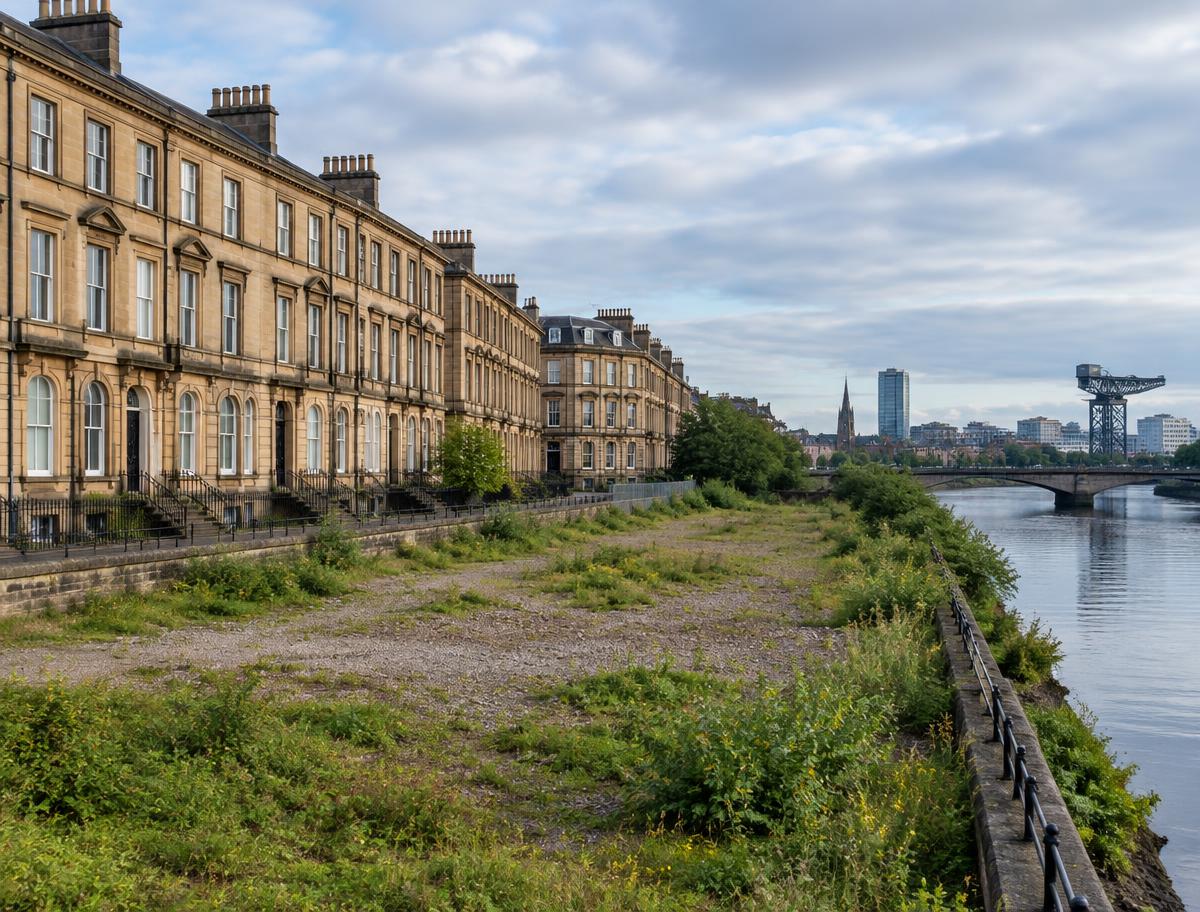
Glasgow City Council has approved a masterplan for North Laurieston, setting out a long-term vision for redeveloping vacant land and restoring historic buildings on the south side of the River Clyde.
The plan covers an area that has struggled with vacant sites and underused buildings for years, despite its proximity to the city centre just across the river, and is intended to reconnect the neighbourhood both physically and economically with the rest of Glasgow.
What the plan covers
Among the heritage assets identified for restoration are listed properties on Carlton Place, a row of Georgian townhouses overlooking the Clyde that has long been recognised as one of the area’s most significant architectural features but which has suffered from neglect and partial vacancy in recent years.
The masterplan also places emphasis on streets and public realm, an “infrastructure-first” approach under which improvements to roads, pavements and public spaces are intended to come before, or alongside, new building development, in order to make the area more attractive to investors and future residents from the outset.
North Laurieston’s recent history
The wider Laurieston area has already seen significant change over the past decade, with new housing developments built on previously derelict land as part of the Laurieston Transformational Regeneration Area, one of several such projects backed by the Scottish Government and city council aimed at tackling concentrated deprivation in parts of Glasgow. North Laurieston, closer to the river, has lagged behind in terms of redevelopment, and the new masterplan is intended to extend that regeneration effort northwards.
A framework, not a finished project
It is important to understand what approval of a masterplan actually means. It establishes a shared vision and set of principles to guide future development, rather than guaranteeing that every site within the area will be rebuilt or restored to a set timescale. Individual projects identified in the plan, including the restoration of the Carlton Place buildings, will still require their own planning permissions, funding packages and developers before work can begin.
This means some elements of the masterplan could take years to be delivered, and others may change in response to market conditions, available grant funding or further design work, as has happened with similar masterplans adopted elsewhere in Glasgow.
Why the area matters to the wider city
Empty plots and underused historic buildings can blight a neighbourhood, discourage footfall and leave listed buildings at growing risk of structural deterioration the longer they remain out of use. Council officers have argued that bringing North Laurieston’s historic stock back into productive use, alongside new housing on currently vacant sites, could improve how both residents and visitors experience the area and strengthen its connection to Glasgow city centre and the Clyde waterfront.
What to watch next
The key test of the masterplan’s success will be which of the sites it identifies progress from vision to funded, permitted development. Glasgow City Council has not set out a detailed timetable for individual projects, and local residents and heritage groups are likely to watch closely for the first concrete announcements, particularly concerning the future of the Carlton Place buildings.
Learning from the wider Laurieston project
The original Laurieston Transformational Regeneration Area, immediately to the south, delivered several hundred new homes over a number of years with backing from the Scottish Government and housing associations, offering a template the council hopes to extend into North Laurieston. That earlier project also illustrated how regeneration schemes in Glasgow can take considerably longer to complete than initially expected, a factor likely to inform expectations about the pace of change once the North Laurieston masterplan moves from approval into delivery.
The Clyde waterfront context
North Laurieston sits within the wider stretch of the Clyde waterfront that has been subject to successive regeneration ambitions over several decades, from the redevelopment of the former Garden Festival site to ongoing projects further downstream. Council officers have framed the North Laurieston masterplan as part of this longer arc of waterfront renewal, intended to knit together previously disconnected pockets of the south side with the city centre across the river.


