
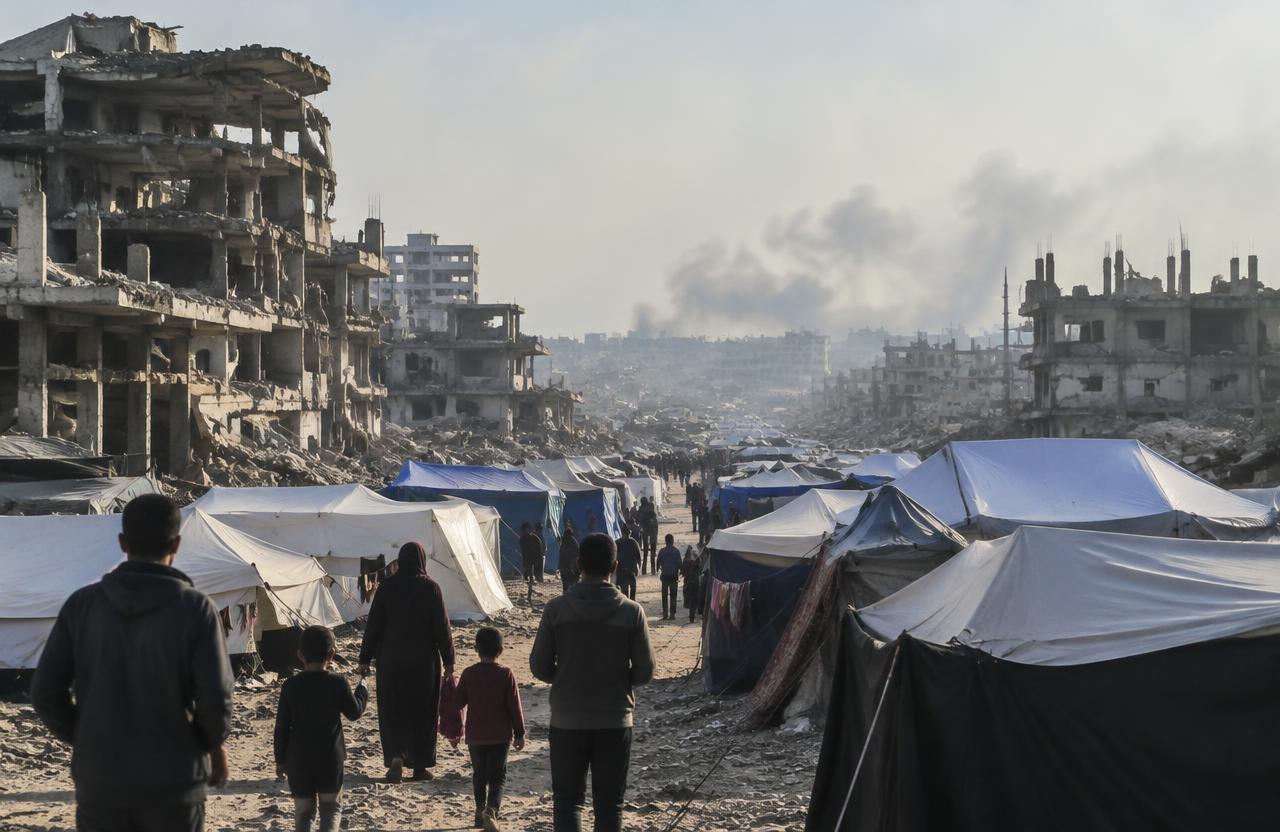
Families in eastern Gaza City have been forced to move once again after Israeli forces advanced and carried out demolitions, according to Palestinian witnesses, as gunfire and artillery shelling continued in several parts of the territory almost a year after a ceasefire came into force.
Eight Palestinians, including a pregnant woman, were wounded by Israeli fire on Sunday morning, according to Palestinian medical sources cited by the WAFA news agency.
Six of the injured were shot in Khan Younis in the southern Gaza Strip. Two more, including the pregnant woman, were hurt when Israeli military vehicles opened fire near tents sheltering displaced people close to the Shuja'iyya intersection, east of Gaza City, the sources said.
Shelling and demolitions
Palestinian sources reported continued artillery fire on eastern areas of Khan Younis, and demolition work by Israeli forces in the eastern part of the al-Tuffah neighbourhood, north-east of Gaza City.
Witnesses described a new wave of displacement from areas west of Shuja'iyya, saying Israeli forces had advanced to within roughly 10 metres of Salah al-Din Street, one of the main roads running the length of the Strip.
The Turkish news agency Anadolu separately reported that Israeli air strikes had destroyed four homes in Gaza. The Israeli military did not immediately comment on the specific incidents.
A ceasefire under pressure
The ceasefire between Israel and Hamas took effect last October after two years of devastating war that began with the Hamas-led attack on southern Israel on 7 October 2023, in which about 1,200 people were killed and around 250 taken hostage.
Israel's subsequent military campaign in Gaza killed tens of thousands of Palestinians, according to the territory's health ministry, and left much of the Strip in ruins.
Under the ceasefire arrangements, Israeli forces withdrew to a demarcation line inside Gaza while retaining control of large areas near the border. Incidents near that line have been frequent.
Palestinian officials and the governments of Qatar and other mediators accuse Israel of repeatedly violating the truce through air strikes, shelling and gunfire. Israel says its forces act against militants and against people who approach or cross the line and pose a threat to its troops, and accuses Hamas of breaching the agreement, including by refusing to disarm.
Life in the tents
For much of Gaza's population of more than two million people, daily life is still lived in tents and damaged buildings. Aid agencies say shelter, clean water and medical supplies remain scarce, and that each new advance or demolition uproots families who have already moved many times.
Humanitarian organisations have warned that the approaching winter will worsen conditions in overcrowded camps, where flimsy shelters offer little protection from rain and cold.
Hospitals, many of them only partially functioning, continue to receive casualties from shootings and strikes, as well as patients with illnesses linked to poor sanitation.
Diplomacy stalled
International efforts to move to the next phase of the ceasefire, covering reconstruction, governance and security arrangements, have made limited progress. Disputes over Hamas's disarmament, the extent of Israeli withdrawal and the role of an international stabilisation force remain unresolved.
Israeli leaders say they will not allow Hamas to rebuild its military capabilities. Hamas says it will not give up its weapons while Israeli forces remain in Gaza.
In Israel, families of victims of the 7 October attack and returned hostages continue to press for accountability, while the government faces domestic debate over the future of its military presence in the Strip.
What comes next
With neither side willing to concede on the core issues, the ceasefire has become a fragile holding pattern rather than a path to peace. For civilians on the ground, the distinction often matters little: Sunday's injuries and displacement are a reminder that, a year on, the guns in Gaza have not fallen silent.


