
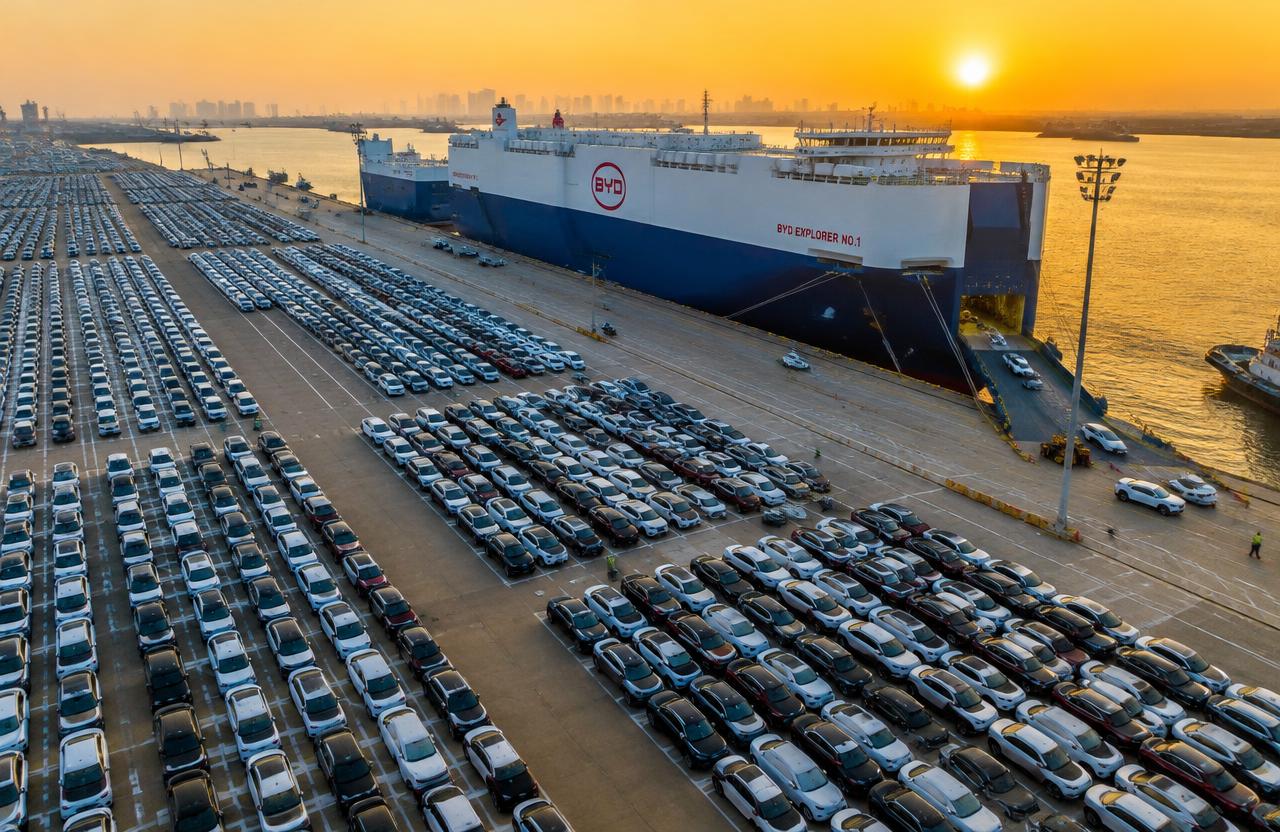
The European Union and China have agreed a broad initial trade deal that Brussels says could cut imports of Chinese electric and plug-in hybrid cars by up to half, in an attempt to cool a dispute that has threatened to spiral into a full trade war.
The preliminary agreement followed two days of talks in Beijing between the EU's trade commissioner, Maroš Šefčovič, and China's commerce minister, Wang Wentao, at the second meeting of a new China-EU trade and investment consultation mechanism.
"By this step we are actually preventing several millions of car exports from China to the European Union," Šefčovič said.
What the deal contains
Neither side published full details. Šefčovič said the package includes lower Chinese tariffs on some European goods, which he said would benefit "almost every" EU member state, as well as measures to stabilise supply chains for rare earths, the minerals vital to electric motors, wind turbines and defence equipment.
The deal will require approval from leaders across the 27-nation bloc, where governments have been divided over how hard to push Beijing.
Šefčovič also met China's vice-premier He Lifeng during the visit.
A huge imbalance
The talks aimed to address the drivers of China's trade surplus with the EU, which reached €360bn ($403bn) last year. European manufacturers, particularly in the car industry, have warned that a flood of cheaper Chinese vehicles, supported by state subsidies, threatens jobs and factories across the continent.
The EU imposed additional tariffs on Chinese-made electric vehicles in 2024 after an anti-subsidy investigation. Chinese carmakers responded by shifting towards plug-in hybrids, which were not covered by those duties, and by building plants inside Europe.
Beijing's concerns
China's commerce ministry said Wang had raised concerns about the EU's recent restrictive measures, and argued that China was not seeking a trade surplus for its own sake.
A ministry official said the two sides had reaffirmed their commitment to stable and balanced trade ties as key partners, and agreed to address differences "in a balanced manner within the framework of World Trade Organization rules".
The official described the meeting as "a new beginning rather than an end" and said its outcomes showed both sides had "the willingness and the wisdom" to manage disputes through dialogue and prevent tensions from escalating.
Mixed reaction in Europe
The prospect of a sharp reduction in Chinese car imports is likely to be welcomed by carmakers in France and Italy, which have pressed for tougher protection. Germany, whose manufacturers depend heavily on sales in China, has been wary of measures that might provoke retaliation, and will scrutinise the detail closely.
Consumer groups and some climate campaigners have warned that limiting cheaper Chinese electric vehicles could slow the switch away from petrol and diesel cars by keeping prices high.
Industry analysts said the key questions are how the reduction would be enforced, whether through quotas, minimum prices or other mechanisms, and what Europe has offered in return.
Rare earths at the heart
The rare earths element may prove just as significant as the car measures. China dominates global processing of the minerals, and export restrictions imposed by Beijing in recent years caused alarm among European manufacturers, some of whom warned of production stoppages.
Any agreement that guarantees steadier supplies would ease pressure on industries from cars to defence at a time when Europe is trying to rearm and electrify simultaneously.
A fragile truce
The deal comes against a backdrop of wider global trade tensions and as Europe seeks to reduce its dependence on China without severing an economic relationship worth hundreds of billions of euros a year.
Whether the initial agreement survives scrutiny in European capitals, and whether Beijing delivers on its side, will determine if this marks a turning point or merely a pause in one of the world's most consequential trade disputes.


