
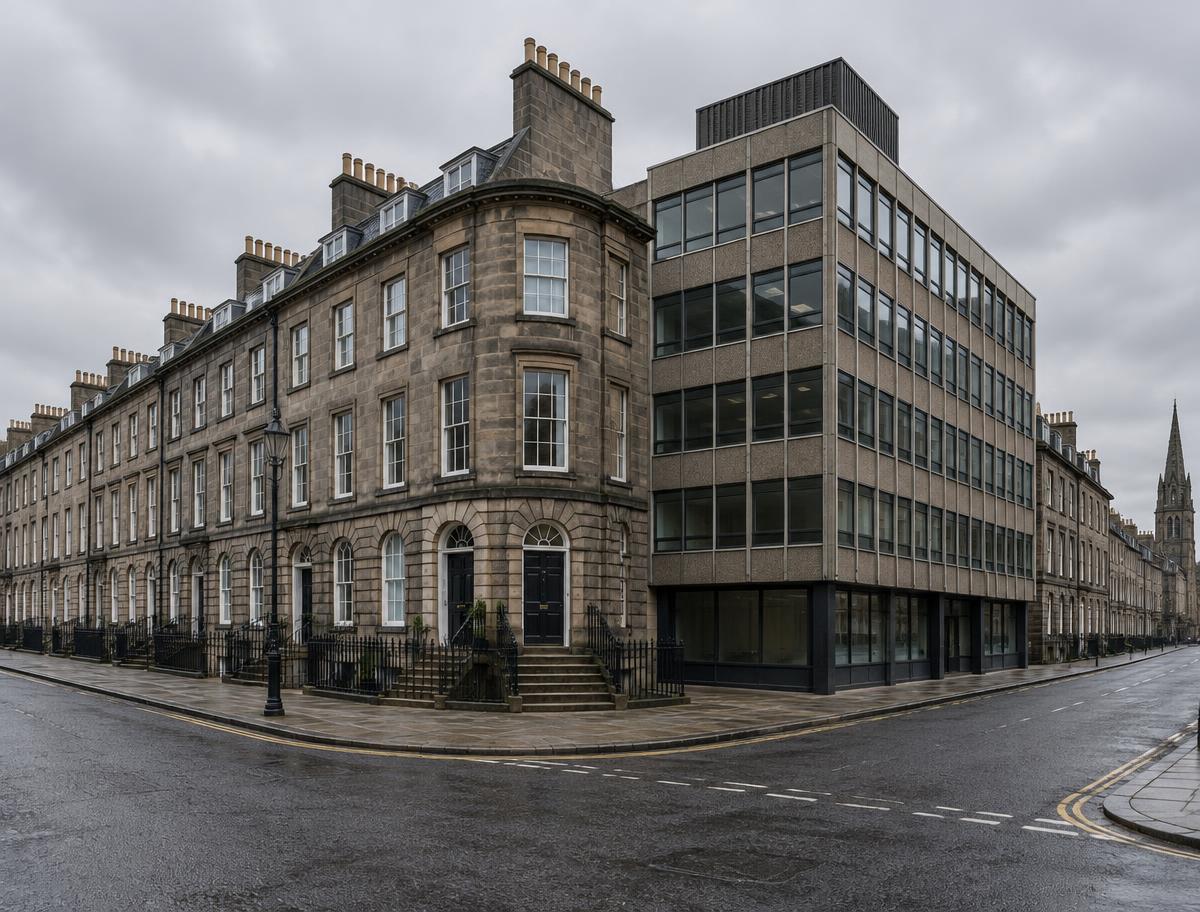
Plans for a 143-bedroom Dakota hotel on Dundas Street have been formally approved by Edinburgh City Council, paving the way for a seven-storey development in the heart of the city’s New Town.
The council’s Development Management Sub-Committee granted planning permission on 30 September for the scheme, which will see a 1980s office block demolished and replaced with a new hotel building on the corner of Dundas Street and Fettes Row.
What is being built
The development will be built on the site of Centrum House, a seven-storey office block dating from the 1980s that currently occupies the 0.19-hectare corner site. The new building will include a restaurant and bar on the ground floor, alongside the hotel reception, accessible to both guests and the wider public.
Bedrooms will be spread across the basement and upper floors, with suites featuring private roof terraces planned for the top floor. A gym, lounge and meeting rooms are also included in the basement level, giving the hotel a range of facilities beyond standard guest rooms.
The scheme will be operated by Dakota Hotels, a boutique hotel brand with existing properties in Edinburgh and Glasgow, and was brought forward by Scott Hobbs Planning on behalf of applicant Evans Dakota Hotels Ltd.
Dakota Hotels has built a reputation in Scotland for a distinctive, dark-fronted design aesthetic at its existing sites, and the new Dundas Street building is expected to follow a broadly similar architectural approach, adapted to meet the particular sensitivities of operating within a UNESCO World Heritage Site.
Concerns raised during consultation
The application drew objections from residents and heritage organisations concerned about the growing number of hotels in Edinburgh’s city centre and New Town, an area that holds UNESCO World Heritage status.
Edinburgh World Heritage told the consultation it had concerns about the increasing number of hotel developments across the World Heritage Site, noting that an earlier masterplan for the wider New Town North development had originally included a hotel on a different site but dropped it as not commercially viable. The organisation called for a wider review of how much additional hotel accommodation the area could absorb.
Local residents’ groups have also previously raised concerns about the cumulative impact of hotel development in the New Town, including increased traffic, noise and the loss of properties that might otherwise be used for housing or other commercial purposes serving residents rather than visitors.
Why the council approved it
Council officers recommended approval, concluding that the proposal would not harm the setting of nearby listed buildings and would preserve the character of the conservation area. Several category B listed buildings sit close to the site, including properties on Fettes Row and Dundas Street itself.
Officers said the development was in accordance with the development plan and national planning policy, and that the design would enliven and activate the corner site while incorporating features intended to support climate mitigation, adaptation and biodiversity.
A planning statement submitted with the application said the hotel would create around 100 local job opportunities and was expected to boost visitor spending and contribute positively to the local economy, factors that weighed in favour of approval alongside the design and heritage assessments.
What happens next
With planning permission granted, the developer can now proceed with demolishing the existing office block and beginning construction of the new hotel, though a detailed construction timetable has not been set out publicly.
The approval adds to a steady stream of new hotel developments across central Edinburgh in recent years, a trend that has fuelled debate about the balance between tourism growth and the availability of housing and other uses in the city centre, a tension likely to continue as further hotel applications come forward.
Edinburgh’s status as one of the UK’s most visited cities outside London has continued to drive demand for new hotel capacity, even as housing campaigners argue that the city’s World Heritage status and historic building stock should be used to support more residential development rather than further visitor accommodation.


