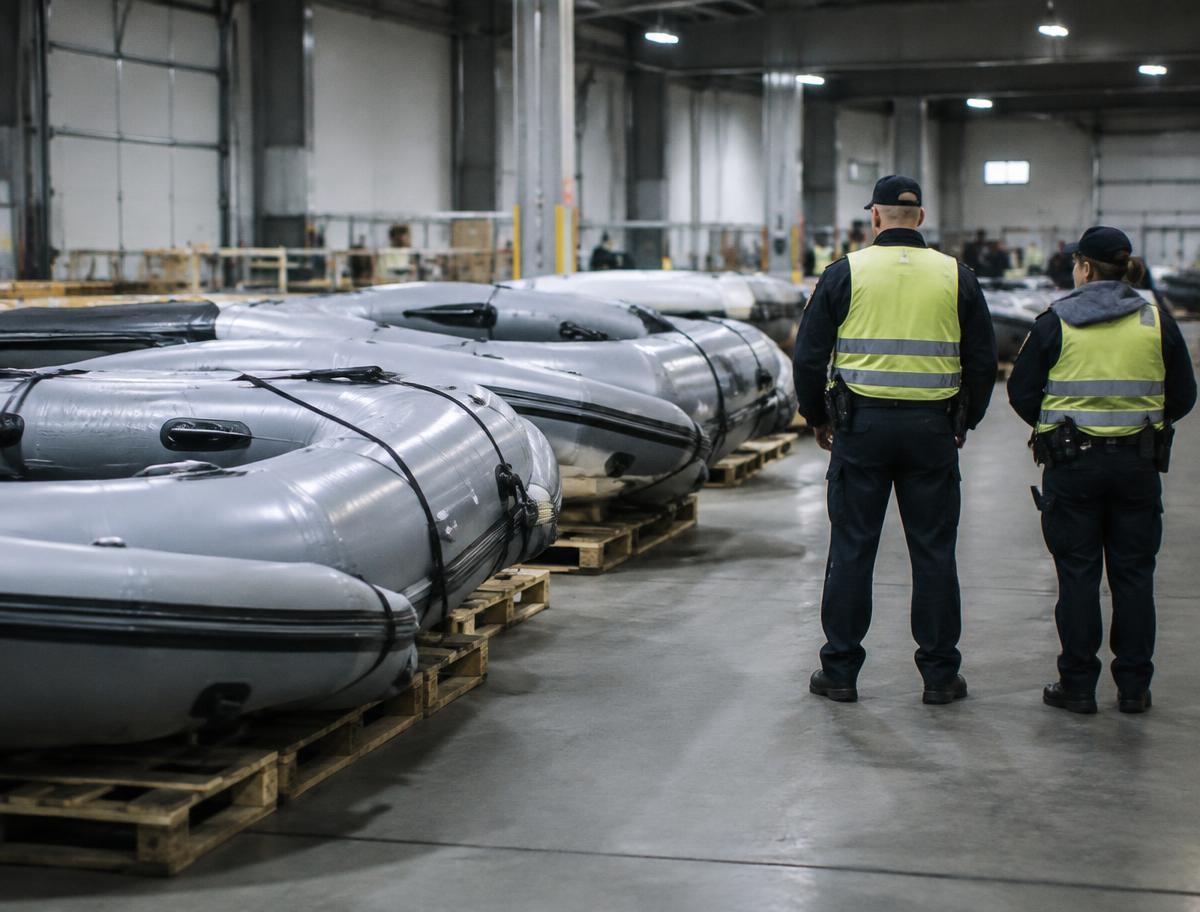
Twenty-five inflatable boats believed to have been destined for people smugglers operating in the English Channel have been seized at East Midlands Airport.
The National Crime Agency (NCA) said the boats, each about nine metres long, were found packed on pallets in an air freight shipment travelling from Turkey to the Netherlands. The cargo passed through the freight hub at East Midlands Airport, allowing NCA officers and Border Force to intercept it on Friday.
It is the first time such a consignment has been detected in air freight, the agency said.
Enough boats for 1,700 people
According to the NCA, each boat could have been used to carry around 70 people across the Channel if it had reached the smuggling gangs. In total, the agency estimates the shipment could have moved up to 1,700 migrants.
The figure reflects a grim reality of recent crossings. Smugglers have increasingly packed far more people into flimsy inflatables than they were designed to carry, contributing to deadly crushes and capsizes. Only days earlier, two men died and two women suffered serious burns trying to leave the French coast near Berck, French authorities said.
Second large seizure this year
This is the second time in 2026 that a large consignment of small boat equipment has been seized in the UK. In July, 25 boats and 25 engines were found in a maritime shipment at Felixstowe in Suffolk, where the vessel carrying them had stopped on its way to Germany.
Both cases involved cargo transiting the UK rather than destined for it, a sign of the complex international supply chains that smuggling networks rely on. Boats and engines are commonly manufactured in one country, moved through several others and stored near the northern French coast before being used.
Targeting the supply chain
NCA deputy director of investigations Craig Turner said the agency continued to target groups and individuals directly involved in supplying boats and engines used for people smuggling in the Channel.
"This work is happening both overseas, with international partners, and here in the UK," he said. "So far it has led to the seizure of in excess of 1,600 boats and engines, denying their use to criminal networks."
He added that the agency's assessment was that this activity was having an impact, driving up the cost of boats and engines for the gangs.
The strategy is based on a simple premise: without boats, the crossings cannot happen. Disrupting supply at source, or in transit, is seen by law enforcement as one of the few levers available that does not depend on intercepting dangerous vessels at sea.
The political backdrop
The seizure comes at a tense moment in the debate over Channel crossings. On Sunday, 149 migrants rescued mid-Channel by the RNLI and a French vessel were brought ashore at Gosport in Hampshire, where a protest by about 150 anti-migrant demonstrators led to scuffles with police and 12 arrests. One man has since been charged with failing to comply with a prohibited assembly direction.
Successive governments have promised to stop the boats. Critics argue that enforcement alone cannot end crossings while demand remains and safe legal routes are limited. Supporters of tougher action say breaking up the smugglers' business model is essential to saving lives.
What is clear is that the gangs keep adapting, from new departure points to new routes and, as this case shows, new ways of moving equipment across borders. The East Midlands seizure suggests that investigators are adapting too, now watching air cargo as closely as ports.
Investigators will now try to trace who ordered the boats, who paid for them and where in the Netherlands they were due to be collected. Those answers could lead officers further up the chain, to the organisers who profit most from the trade and rarely set foot on a beach themselves.
For the 1,700 people who might have boarded those boats, the seizure may mean one fewer dangerous journey, at least for now.