
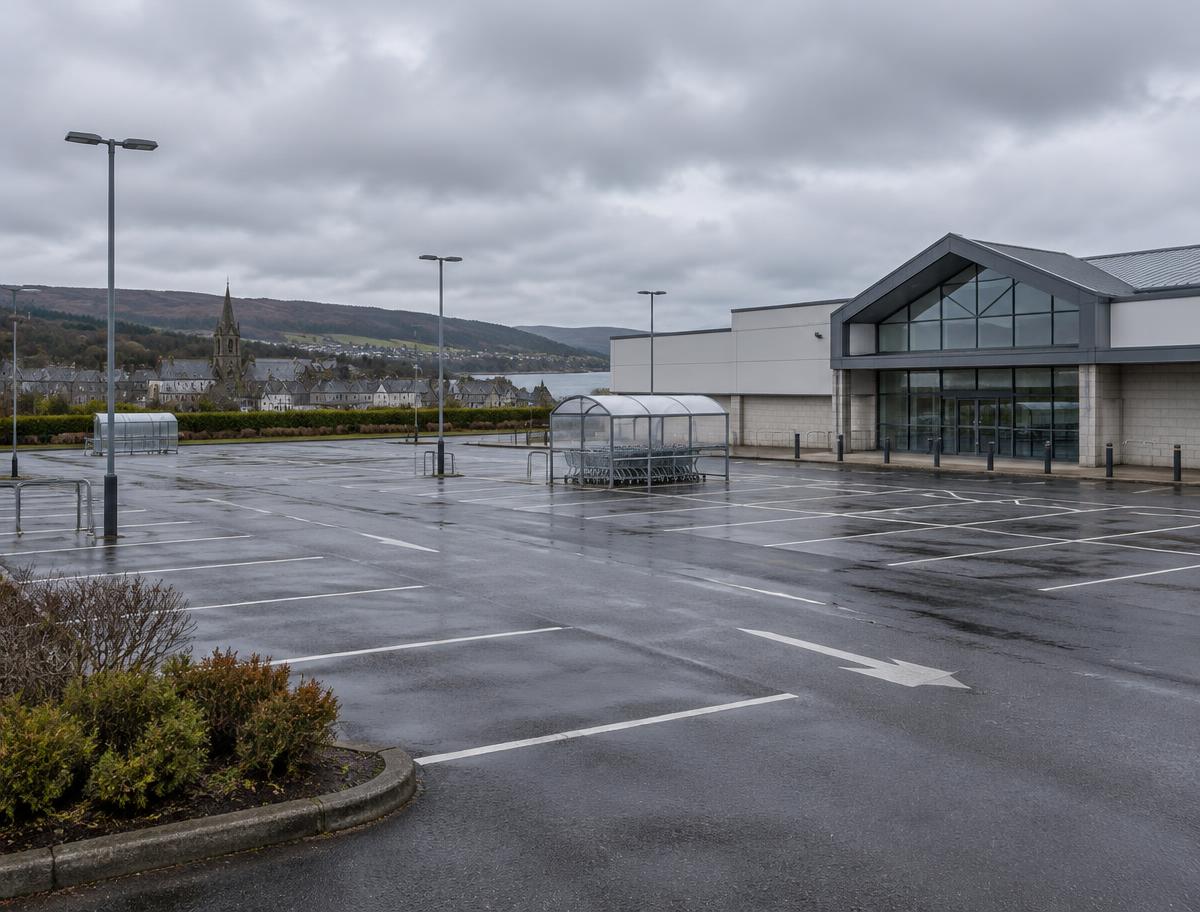
Tesco has lost a legal challenge against Dumfries and Galloway Council’s decision to allow a rival Sainsbury’s supermarket to open on a nearby retail park, after a judge ruled that councillors had been entitled to approve the change.
Lord Sandison, sitting in the Court of Session, dismissed Tesco’s petition for judicial review, finding that the council’s approach had been “well within the bounds of rationality which it required to respect”.
How the dispute began
The case centred on a former Homebase store at Cuckoo Bridge Retail Park in Dumfries. When the retail park was approved more than 25 years ago, the council attached a planning condition restricting sales there to non-food bulky goods, a measure intended to protect the vitality of Dumfries town centre.
Over the years, that condition has been successfully challenged by other retailers wanting to move into the retail park, including B&M, The Food Warehouse and Next, gradually eroding the restriction.
Sainsbury’s followed the same path, applying to have the condition on the former Homebase unit lifted so it could open its first store in Dumfries, selling primarily convenience goods. Dumfries and Galloway Council agreed earlier this year to grant the change, allowing the whole unit to be used as a supermarket.
The objections and the legal challenge
Both Tesco, which already has a supermarket a few hundred yards away, and Morrisons objected to Sainsbury’s plans when they were put before the council. Morrisons argued there was no identified need for a new supermarket at the site.
Despite the objections, council planning officers concluded that, taking all relevant planning considerations into account, the proposal could go ahead. They found there were no alternative units available in the town centre that could have accommodated the store, and that the change would not have any significant adverse impact on the town centre’s vitality.
Tesco then sought a judicial review of the council’s decision, arguing there was no “lawful or rational basis” for concluding that the Sainsbury’s application accorded with the development plan, and that the council’s reasons for approving it were “inadequate”. Permission for the judicial review was granted in June, with a substantive hearing held in September.
The court’s ruling
Lord Sandison rejected Tesco’s challenge, finding that the council’s decision-making process had been rational and lawful, even if reasonable people might have reached a different conclusion on the planning merits. Judicial review does not ask whether a court agrees with a decision, but whether the decision-maker acted lawfully, rationally and with adequate reasoning, a threshold the judge found had been met.
A long-running retail battle
The store, representing a £17m investment by Sainsbury’s, had already opened over the summer while the legal process continued, giving Dumfries its first Sainsbury’s and ending a situation in which the chain’s nearest store to the town was across the border in Carlisle. With Tesco’s challenge now dismissed, the store’s long-term future at Cuckoo Bridge appears secure, closing out a dispute that had run since the council’s original approval in February.
What judicial review covers
Judicial review is a specific type of legal challenge used to scrutinise the lawfulness of decisions made by public bodies, including local councils, rather than to re-run the underlying planning debate. Courts considering a judicial review do not ask whether they would have made the same decision; instead, they examine whether the decision-maker followed the correct legal process, took account of all relevant considerations, ignored irrelevant ones, and reached a conclusion that a reasonable authority could have reached on the evidence before it.
This relatively high threshold means that planning judicial reviews succeed relatively rarely, even when a losing objector strongly disagrees with the outcome on the merits. Lord Sandison’s ruling in the Tesco case followed that familiar pattern, finding that while reasonable people might disagree about whether Sainsbury’s should have been allowed to open at Cuckoo Bridge, the council had not acted outside the bounds of what the law permits.
The broader pattern of retail planning conditions
Conditions restricting retail units to selling only bulky, non-food goods were a common feature of out-of-town retail park approvals in the 1990s and early 2000s, designed to prevent large supermarkets and general stores from drawing trade away from traditional high streets. Over time, as shopping habits have shifted and planning authorities have had to weigh the benefits of extra consumer choice and competition against town centre protection, many of these conditions have come under sustained pressure from retailers seeking to vary them.
The gradual erosion of the Cuckoo Bridge condition, first through changes allowing B&M, The Food Warehouse and Next to trade there, and now through the Sainsbury’s approval, illustrates a trend seen in retail parks across the UK, where the practical effect of decades-old planning restrictions diminishes piecemeal, case by case, rather than through any single policy reversal.
Competition in the Dumfries grocery market
Dumfries already had supermarkets including Tesco, Morrisons, Aldi and Lidl before Sainsbury’s arrival, meaning the new store intensifies competition in a market that was already relatively well served. Supporters of the new store have argued that additional competition benefits shoppers through lower prices and greater choice, while Tesco and Morrisons’ objections reflected the commercial reality that a new large supermarket nearby is likely to draw some trade away from existing stores.
Economic and employment impact
Sainsbury’s £17m investment in the Cuckoo Bridge site also brought new jobs to Dumfries, with the store employing staff across food retail, logistics and in-store services. Local business groups have generally welcomed the investment as a sign of continued confidence in the town’s retail economy, even as rival chains contested the decision through the courts.
Costs and next steps
Having lost the judicial review, Tesco is likely to face a substantial legal costs bill, on top of its own expenses in bringing the case, though the precise sum will depend on separate arguments about costs that often follow the substantive judgment in such cases. There is no indication that Tesco intends to appeal the decision further, and with the Sainsbury’s store already trading, the practical effect of the ruling is to confirm the status quo on the ground rather than require any change to the shop that has operated throughout the legal dispute.


