
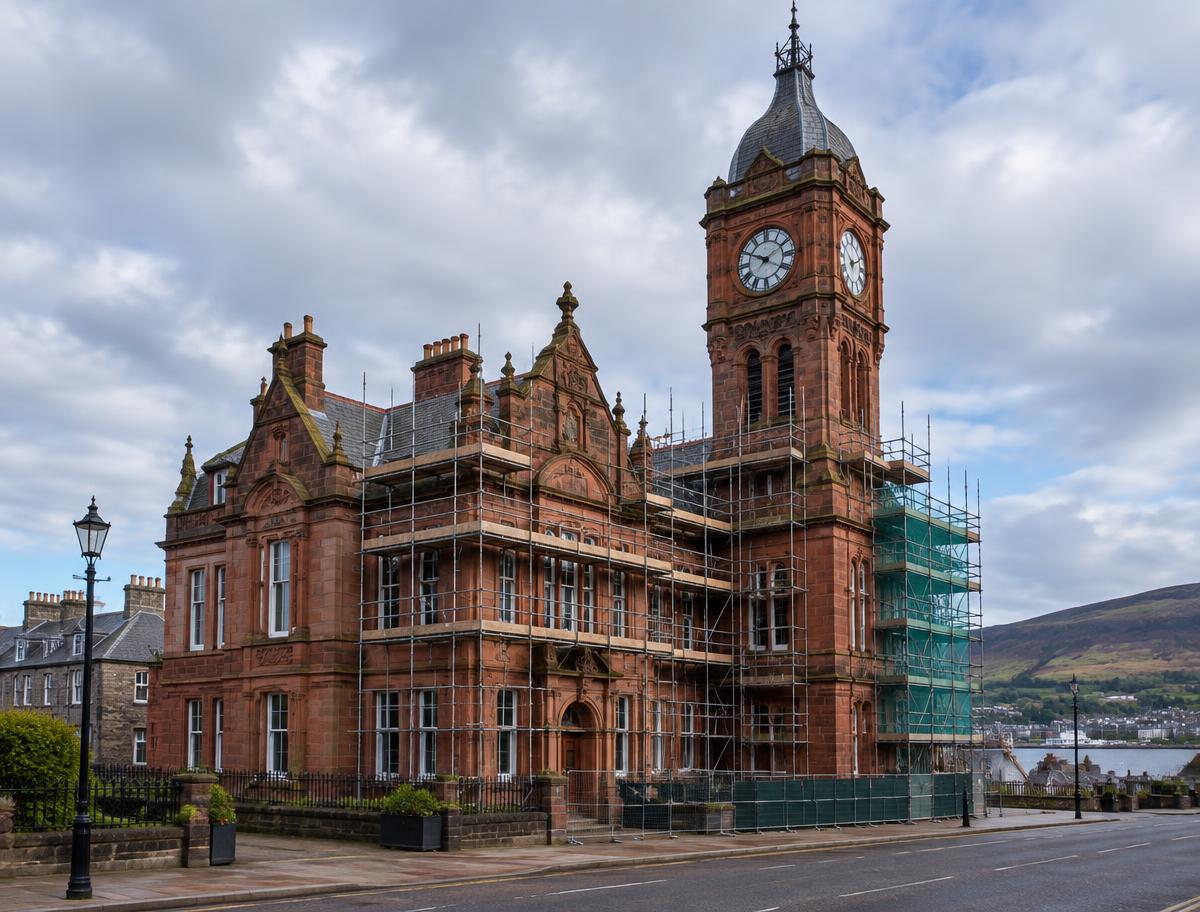
The former Municipal Buildings in Coatbridge are to be converted into 43 affordable council homes, bringing a new residential use to one of the town’s most significant historic civic properties.
The Kildonan Street building, which dates from 1894, served as the headquarters of the former burgh of Coatbridge and later as council offices until 2022, when it was vacated. Its conversion forms part of a wider push to regenerate Coatbridge town centre.
A listed building constraint
Because the Municipal Buildings carry Grade B listed status, the conversion project is more complex than a straightforward change of use from offices to flats. Listed building consent requirements mean any alterations must be sympathetic to the structure’s historic character, and plans for the site have been designed to retain key architectural features of the original building.
Notably, the building’s original council chambers, the grand civic space historically used for council meetings and official functions, are being earmarked for office and commercial use rather than being converted into residential units, preserving one of the building’s most distinctive internal spaces in a non-residential role.
What the new homes will include
The housing proposal includes secure cycle storage and electric-vehicle charging points, features intended to meet modern sustainability and transport standards even within a 19th-century structure. Fitting such facilities, along with contemporary heating, insulation and accessibility standards, into a historic listed building presents a particular technical and design challenge compared with new-build housing.
The 43 figure refers to the number of affordable homes planned for the completed development rather than homes that are already built or occupied, meaning the project remains at a stage prior to construction completion.
Part of a wider regeneration push
Coatbridge, along with neighbouring towns in North Lanarkshire, has seen a series of town-centre regeneration initiatives in recent years aimed at bringing vacant and underused buildings back into productive use, reducing the number of empty properties on the high street and surrounding streets, and increasing the supply of affordable housing in the area.
Converting a former civic building into homes rather than demolishing it allows the council to retain a recognisable local landmark while addressing demand for affordable housing, a combination that has been used in similar heritage-led housing schemes elsewhere in Scotland, including former school buildings, churches and other public properties no longer needed for their original purpose.
What remains to be done
No completion or move-in date for the Coatbridge development has been confirmed. The project will still need to proceed through detailed design, any further consents required because of the building’s listed status, and construction work before any of the 43 homes become available for occupation. For Coatbridge, officials say the significance lies in bringing a prominent former municipal site back into active use rather than allowing it to remain empty following the departure of council staff in 2022.
Why the town centre matters
Coatbridge has, like many former industrial towns in North Lanarkshire, faced challenges from declining footfall and vacant commercial premises in its town centre in recent decades. Local and national regeneration funding has increasingly focused on finding new uses for underused buildings rather than demolition, reflecting both heritage considerations and the practical difficulty of finding alternative uses or buyers for large, architecturally distinctive structures such as the former Municipal Buildings.
A landmark with civic history
Since its construction in the late 19th century, the Municipal Buildings have served as a civic focal point for Coatbridge, reflecting the town’s industrial-era prosperity at a time when burgh councils across Scotland invested in grand civic architecture to project local status and ambition. Converting the building into affordable homes while preserving its council chambers is intended to retain that civic legacy even as its primary function shifts from local government administration to housing for Coatbridge residents.


